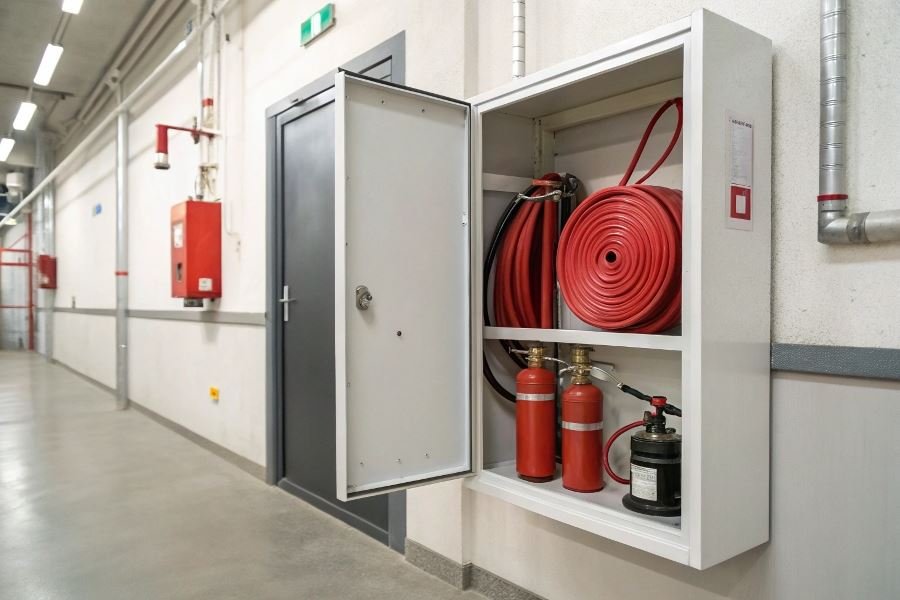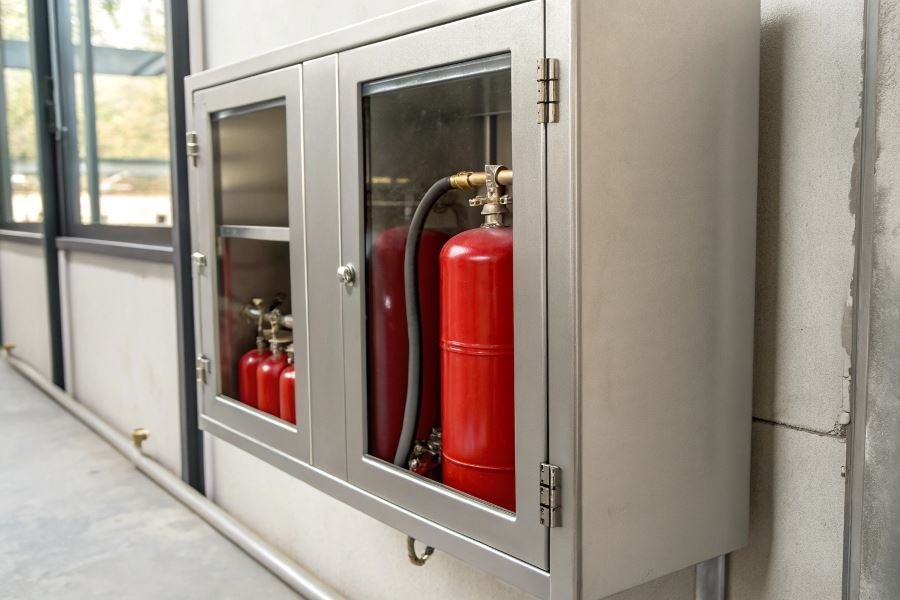
When lives and property hang in the balance, what stands between safety and disaster might just be the material of your fire cabinet.
Fire safety infrastructure rarely makes headlines until something goes terribly wrong. Yet the materials used in manufacturing fire cabinets represent one of the most consequential decisions in building safety design. These unassuming fixtures—housing extinguishers, hoses, and other firefighting equipment—must perform flawlessly during the exact moments when everything else is failing.
The foundation of fire safety infrastructure
Fire cabinets serve as the first line of defense during emergencies, protecting vital equipment while ensuring immediate accessibility. The materials selected for these cabinets don’t just influence aesthetics—they determine whether the cabinet will maintain structural integrity when exposed to extreme heat, corrosive environments, or physical impact.
“The right material choice in fire cabinet manufacturing isn’t just about meeting code—it’s about creating infrastructure that performs when conventional building systems are compromised.”
Performance requirements that save lives
When evaluating materials for fire cabinets, several critical performance factors must be considered:
- Fire resistance – The ability to withstand direct flame exposure without structural failure
- Temperature tolerance – Maintaining integrity during extreme temperature fluctuations
- Impact resistance – Withstanding physical damage during evacuation or firefighting
- Corrosion resistance – Ensuring longevity in diverse environmental conditions
- Weight-to-strength ratio – Balancing structural integrity with installation requirements
Navigating the regulatory landscape
Fire cabinet materials must satisfy a complex web of regulatory standards, including NFPA (National Fire Protection Association) requirements, OSHA regulations, and local building codes. These standards establish minimum performance thresholds for fire resistance ratings, visibility requirements, and durability benchmarks.
The UL (Underwriters Laboratories) certification process subjects materials to rigorous testing protocols that simulate real-world fire conditions—ensuring that when theory meets reality, safety prevails.
Material Showdown: What Your Fire Cabinet Is Really Made Of
When safety equipment meets architectural design, material selection becomes the critical foundation for success. Fire cabinets—those essential safety fixtures we often overlook until emergency strikes—deserve more attention than they typically receive, particularly regarding their construction materials.
The materials used in manufacturing fire cabinets directly impact their performance, longevity, and ability to protect life-saving equipment. A comprehensive comparison of materials for the manufacture of fire cabinets reveals that each option brings distinct advantages and limitations that safety professionals must carefully weigh. From traditional metals to cutting-edge composites, the selection process requires balancing durability, aesthetics, and regulatory compliance.
Steel: The Trusted Guardian
Carbon steel remains the industry workhorse, offering exceptional strength-to-weight ratio at a reasonable price point. With typical thicknesses of 1.0-1.5mm, carbon steel cabinets withstand temperatures up to 1000°F before structural integrity becomes compromised.
The drawback? Susceptibility to corrosion, particularly in humid environments.
Stainless steel elevates the game with superior corrosion resistance and a sleek, professional appearance. Grade 304 stainless—containing approximately 18% chromium and 8% nickel—has become the gold standard for high-end installations where appearance matters as much as function.
Galvanized steel strikes a middle ground, offering:
- Corrosion resistance through zinc coating (typically 20-25 microns)
- Cost efficiency compared to stainless options
- Service life of 15-20 years in normal conditions
Composite Revolution: Lightweight Contenders
Glass-reinforced plastics (GRP) and advanced composites have disrupted the traditional metal dominance with compelling advantages:
| Material | Weight Reduction | Fire Rating | Impact Resistance |
|---|---|---|---|
| GRP | 40-60% lighter than steel | Class 2 fire rating | Moderate |
| Carbon Fiber Composites | Up to 70% lighter | Class 1 fire rating | Excellent |
| Fiberglass | 50% lighter | Class 2 fire rating | Good |
These materials offer exceptional resistance to chemicals and environmental factors that would quickly degrade metal alternatives. Modern Fiberglass Reinforced Plastic cabinets incorporate fire-retardant resins that self-extinguish within seconds of flame removal.
The Bottom Line: Cost-Benefit Analysis
Initial investment tells only part of the story. The true cost equation must factor in:
Installation costs: Lightweight composites can reduce installation labor by up to 40%, particularly in retrofit applications where structural reinforcement might otherwise be necessary.
Maintenance requirements:
- Carbon steel: Requires repainting every 3-5 years ($75-150 per cabinet)
- Stainless steel: Minimal maintenance beyond cleaning
- GRP: Virtually maintenance-free with occasional cleaning
Lifespan considerations: While premium stainless cabinets command a 40-60% price premium over basic carbon steel, their extended service life (25+ years versus 10-15 for painted steel) often justifies the investment.
Hidden costs: Replacement due to corrosion failure can exceed initial purchase price by 300% when accounting for emergency procurement, installation disruption, and potential compliance penalties.
The material selection for fire cabinets ultimately requires balancing immediate budget constraints against long-term performance requirements. While traditional steel options continue to dominate price-sensitive markets, composite alternatives increasingly capture applications where weight, corrosion resistance, or aesthetic integration drives decision-making.
Expert Material Selection for Fire Cabinet Excellence
Indoor vs Outdoor Material Strategies
Selecting the right materials for fire cabinets requires balancing durability, compliance, and environmental resilience. For indoor applications, cold-rolled steel with a thickness of 1.0-1.5mm remains the industry standard due to its excellent structural integrity and cost-effectiveness. When protected with powder coating (typically 60-80 microns thick), these cabinets maintain their appearance for 7-10 years in controlled environments.
Outdoor installations face a different challenge matrix. Marine-grade aluminum (5052 or 5083 alloys) offers superior corrosion resistance with only one-third the weight of steel. For coastal or high-humidity regions, 316 stainless steel provides unmatched durability with its 2-3% molybdenum content that prevents chloride attack.
The material selection process should begin with a thorough environmental assessment, not with budget constraints.
Climate considerations dramatically impact material performance. In freeze-thaw cycle regions, fiberglass-reinforced plastic (FRP) cabinets prevent the micro-cracking that plagues metal alternatives. Meanwhile, desert installations benefit from thermally-reflective coatings that maintain internal temperatures 15-20°F lower than standard finishes.
Winning Material Combinations
The most successful fire cabinets leverage strategic material pairings:
Combination 1: Galvanized Steel + Intumescent Coating
This pairing delivers exceptional fire resistance (up to 120 minutes) while maintaining cost efficiency. The zinc coating (typically G90 or Z275) provides corrosion protection, while intumescent coatings expand to 50 times their original thickness during fire exposure.
Combination 2: Aluminum Frame + Tempered Glass
For high-visibility applications, this combination offers the perfect balance of durability and functionality. The anodized aluminum (minimum 20 microns thick) resists corrosion while tempered glass provides impact resistance four times stronger than standard glass.
Combination 3: Composite Core + Stainless Steel Facing
This premium solution combines a lightweight, fire-resistant composite core with a stainless steel exterior. The result is a cabinet that weighs 40% less than traditional all-steel models while maintaining superior fire ratings.
| Material Combination | Fire Rating | Weight | Corrosion Resistance | Relative Cost |
|---|---|---|---|---|
| Galvanized + Intumescent | 120 min | High | Moderate | $ |
| Aluminum + Tempered Glass | 60 min | Low | High | $$ |
| Composite + Stainless | 90 min | Medium | Excellent | $$$ |
Material Innovation Horizon
The fire cabinet industry is experiencing a material revolution. Nano-ceramic coatings are emerging as game-changers, offering hydrophobic properties that actively repel water and contaminants. These coatings maintain their protective qualities for up to 15 years—nearly double the lifespan of traditional finishes.
Graphene-enhanced composites represent the next frontier in fire cabinet materials. With thermal conductivity 10 times higher than copper and tensile strength 200 times greater than steel, these materials promise to revolutionize cabinet design while reducing weight by up to 60%.
Manufacturing technologies are evolving in parallel. Robotic laser welding has reduced production times by 40% while improving joint strength by 25%. Meanwhile, digital twin technology allows manufacturers to simulate decades of environmental exposure in virtual environments, optimizing material selection before production begins.
The most forward-thinking manufacturers are exploring bio-based composites derived from agricultural waste. These materials offer comparable fire resistance to traditional options while reducing carbon footprint by up to 70%—a compelling advantage as sustainability becomes increasingly important in procurement decisions.
Discover the optimal materials for fire cabinet manufacturing with our expert comparison guide. Learn about steel varieties, composite options, and application-specific recommendations to ensure safety compliance and long-term durability.
Discover the optimal materials for fire cabinet manufacturing with our expert comparison guide. Learn about steel varieties, composite options, and application-specific recommendations to ensure safety compliance and long-term durability.