
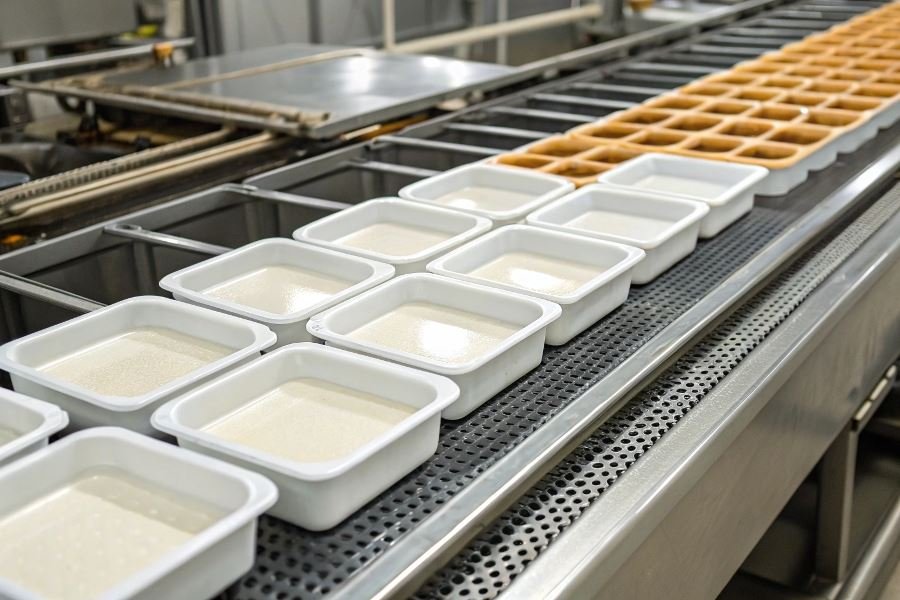
Ever watched $10,000 worth of product tumble onto a factory floor because a tray was 2mm too narrow? I have. The silence that follows such catastrophes in food processing plants is deafening—and expensive.
Selecting the right tray for your food conveyor system isn’t just a technical detail; it’s the foundation of operational efficiency. When products move seamlessly from preparation to packaging, it’s because someone took the time to match tray dimensions precisely to both the product and the conveyor specifications.
The ripple effect of poor tray selection extends far beyond occasional spills. A food processing line running at 120 units per minute loses approximately $2,000 for every hour of downtime. Improper tray configurations contribute to nearly 18% of all processing line stoppages in mid-sized operations, according to recent industry analyses.
Efficiency killers in disguise
Three critical factors determine optimal tray selection:
- Product characteristics – Weight distribution, moisture content, and fragility dictate tray depth and material
- Conveyor specifications – Belt width, speed variations, and transition points influence ideal tray dimensions
- Operational environment – Temperature fluctuations, cleaning protocols, and production volume determine durability requirements
“The most expensive tray you’ll ever buy is the one that almost works,” notes veteran food processing consultant James Harmon. This wisdom underscores why precision in tray selection isn’t merely about preventing catastrophic failures—it’s about optimizing every aspect of your production line.
Essential Considerations for Food Conveyor Tray Selection
Selecting the perfect tray for your food conveyor system isn’t just a minor operational detail—it’s the foundation of your entire production efficiency. The right tray transforms your conveyor from a simple transport mechanism into a precision instrument that maximizes throughput while maintaining product integrity.
When tackling how to correctly choose the size and shape of a tray for a food conveyor, three critical factors demand your attention: your specific food product requirements, your conveyor system’s technical specifications, and your operational flow patterns. Getting these elements right can mean the difference between smooth operations and costly bottlenecks.
Product-Centric Dimensioning
The journey begins with your product. Every food item has its own “footprint” that dictates tray requirements:
Weight capacity is non-negotiable. A tray handling delicate pastries requires different structural support than one carrying 10-pound meat packages. Industry standards typically recommend:
| Product Type | Recommended Tray Thickness | Max Load Capacity |
|---|---|---|
| Light Bakery | 2-3mm | 5-8 lbs |
| Packaged Meals | 3-5mm | 10-15 lbs |
| Meat Products | 5-8mm | 15-25 lbs |
Dimensional clearance matters just as much as weight. Allow a minimum 0.5-inch buffer zone around products to prevent edge contact during transport. For items with irregular shapes, measure at the widest points and add this buffer.
Products that might shift during transport need containment features—raised edges or compartmentalization. The Dorner 2200 Series offers customizable sidewall options specifically designed for this purpose.
System Compatibility Engineering
Your conveyor system imposes its own constraints that directly impact tray selection:
Belt width establishes your maximum tray width. Standard food industry conveyors typically offer widths of 12″, 18″, 24″, and 36″, but your tray should be 1-2″ narrower than the belt to prevent edge catching.
Drive mechanism compatibility cannot be overlooked. Chain-driven systems require trays with specific bottom patterns to engage properly, while belt-driven systems need flat-bottomed trays with appropriate friction characteristics.
Temperature extremes in freezing or cooking sections demand materials that won’t warp or degrade. Intralox offers thermoplastic trays specifically engineered for temperature fluctuations between -40°F and 212°F.
Operational Flow Optimization
The final consideration is how your trays affect overall material flow:
Throughput requirements dictate spacing and quantity. Calculate your pieces-per-minute target and work backward to determine optimal tray dimensions and spacing. For high-volume operations, smaller trays at closer intervals often outperform larger trays with greater spacing.
Transition points between conveyor sections create vulnerability. Trays must be sized to bridge these gaps without tipping or product displacement. The ideal tray length should span at least two conveyor rollers at all times.
Accumulation zones require special attention. If your process includes staging areas where products temporarily accumulate, trays need sufficient stability to prevent cascading failures when contact occurs.
By methodically addressing these product, system, and operational considerations, you’ll identify the optimal tray specifications that balance capacity, compatibility, and flow—transforming your conveyor system into a precision instrument that enhances your entire production process.
Turning Strategy into Action: Implementing Your Tray Selection
The decision-making roadmap
Selecting the perfect tray for your food conveyor isn’t just a procurement decision—it’s a strategic investment in operational efficiency. Let’s break down the implementation process into actionable steps that transform your careful planning into tangible results.
First, consolidate your requirements documentation. This means gathering your throughput calculations, food product specifications, and environmental constraints into a single decision matrix. Cross-reference these requirements against manufacturer specifications rather than relying on generic industry standards.
Next, prioritize your non-negotiable factors. Is heat retention critical? Does your operation demand rapid sanitation between service periods? Your hierarchy of needs will guide material selection and dimensional specifications.
The third step involves prototype testing. Many manufacturers offer sample trays for evaluation before bulk ordering. This isn’t merely a courtesy—it’s an essential validation step that can prevent costly system-wide incompatibilities.
The difference between a good tray selection and a great one often comes down to how thoroughly you test under actual operating conditions.
Validation beyond the spec sheet
Testing shouldn’t be an afterthought—it’s the bridge between theory and practice. Implement these validation methods to ensure your tray selection performs as expected:
-
Load testing: Fill trays with actual product weights plus 15% to account for unexpected loading variations.
-
Thermal cycling: Subject samples to your operation’s temperature extremes for at least 20 complete cycles to identify potential warping or material degradation.
-
Conveyor compatibility testing: Run empty and loaded trays through your entire system at varying speeds to identify potential catch points or stability issues.
-
Cleaning protocol validation: Process trays through your sanitation procedures to confirm they maintain structural integrity and appearance.
Document these tests methodically, creating a performance baseline against which you can measure future degradation or system changes.
Maintenance and reassessment framework
Even perfect tray selections require ongoing attention. Implement a structured maintenance program that includes:
| Timeframe | Maintenance Action | Decision Trigger |
|---|---|---|
| Daily | Visual inspection for cracks or deformation | Replace if structural integrity is compromised |
| Weekly | Sanitization effectiveness check | Modify cleaning protocols if residue persists |
| Monthly | Weight capacity verification | Reassess if load capacity diminishes by >5% |
| Quarterly | Full system compatibility check | Evaluate if conveyor speed or configuration changes |
| Annually | Complete tray fleet assessment | Consider replacement if >15% of inventory shows wear |
The lifespan of your tray fleet depends largely on material selection. Polycarbonate trays typically maintain structural integrity for 3-5 years in high-volume operations, while stainless steel options can last significantly longer but require different maintenance approaches.
Reassessment isn’t just about replacement schedules. Your operation evolves—menu items change, volume fluctuates, and equipment gets upgraded. Schedule formal tray specification reviews whenever:
- Menu offerings change substantially
- Throughput increases by more than 20%
- Conveyor equipment is modified or replaced
- Customer feedback indicates service issues
By implementing this comprehensive approach to tray selection, testing, and maintenance, you’re not just solving today’s operational challenges—you’re building a flexible framework that adapts to your evolving business needs.
Learn how to correctly choose the size and shape of a tray for a food conveyor to maximize efficiency and throughput. Our comprehensive guide covers product requirements, system compatibility, and optimization strategies for food processing operations.
Learn how to correctly choose the size and shape of a tray for a food conveyor to maximize efficiency and throughput. Our comprehensive guide covers product requirements, system compatibility, and optimization strategies for food processing operations.


