Ever wondered what keeps your packaged food safe from contamination? It’s not just about the ingredients or the processing – it’s often the unsung heroes of the production line: industrial sleeves. These critical components can make or break food safety protocols, yet they rarely get the spotlight they deserve.
Food processing sleeves serve as the crucial interface between machinery and food products. When properly selected, they ensure contamination-free operations while maintaining production efficiency. The FDA reported that improper equipment components contributed to over 23% of food recalls between 2015 and 2020 – a statistic that underscores why sleeve selection matters.
Navigating regulatory requirements
Food-grade sleeves must comply with FDA regulations and international standards like ISO 22000. These aren’t just bureaucratic hurdles – they’re essential safeguards. Materials must be non-toxic, non-absorbent, and resistant to cleaning chemicals. The European Food Safety Authority (EFSA) maintains even stricter guidelines for materials in direct food contact.
Critical selection factors at a glance
Selecting the right sleeve involves balancing multiple considerations:
| Factor | Impact | Key Consideration |
|---|---|---|
| Material compatibility | Product integrity | Will it react with acidic/alkaline foods? |
| Temperature resistance | Operational safety | Can it withstand processing temperatures? |
| Cleanability | Contamination prevention | Is it designed for thorough sanitization? |
| Durability | Cost-effectiveness | What’s the expected service life? |
The right sleeve selection isn’t just about compliance – it’s about optimizing your entire production process while ensuring consumer safety remains paramount.
The Critical Elements of Food-Grade Sleeves
When selecting sleeves for food processing equipment, manufacturers face a complex decision matrix that directly impacts product safety, operational efficiency, and regulatory compliance. The criteria for selecting sleeves for the food industry must balance technical performance with stringent hygiene requirements that protect consumers and preserve product integrity.
Material Compatibility: The Foundation of Food Safety
Food-grade sleeves must be manufactured from materials that won’t compromise product quality through chemical leaching or particulate contamination. FDA-approved materials like platinum-cured silicone, PTFE, and certain grades of polyurethane lead the market for their exceptional inertness.
Silicone sleeves offer outstanding flexibility and temperature resistance while maintaining a non-reactive surface. Their non-porous structure prevents bacterial harboring, making them ideal for dairy and beverage applications.
PTFE (polytetrafluoroethylene) provides unmatched chemical resistance against acidic foods and cleaning agents, with virtually zero absorption or migration properties.
For applications involving oils and fats, specialized polyurethane compounds deliver superior resistance to degradation while maintaining mechanical properties over extended production runs.
| Material | Food Compatibility | Chemical Resistance | Temperature Range |
|---|---|---|---|
| Platinum-cured Silicone | Excellent | Good | -60°F to 450°F |
| PTFE | Excellent | Excellent | -100°F to 500°F |
| Food-grade Polyurethane | Very Good | Good | -40°F to 225°F |
| EPDM | Good | Moderate | -40°F to 300°F |
Temperature and Pressure Performance: Engineering for Extremes
Food processing environments demand sleeves that maintain integrity across dramatic temperature fluctuations and varying pressure conditions. The thermal stability of sleeve materials directly impacts both safety and operational lifespan.
High-temperature applications like baking, sterilization, and hot-fill processes require sleeves with thermal stability above 300°F without degradation or off-gassing. Conversely, freezing applications demand materials that remain flexible at sub-zero temperatures without becoming brittle.
Pressure resistance specifications must account for:
- Burst pressure ratings – typically 3-4× the maximum operating pressure
- Vacuum resistance – critical for suction and transfer operations
- Pulsation tolerance – essential for pumping systems with variable loads
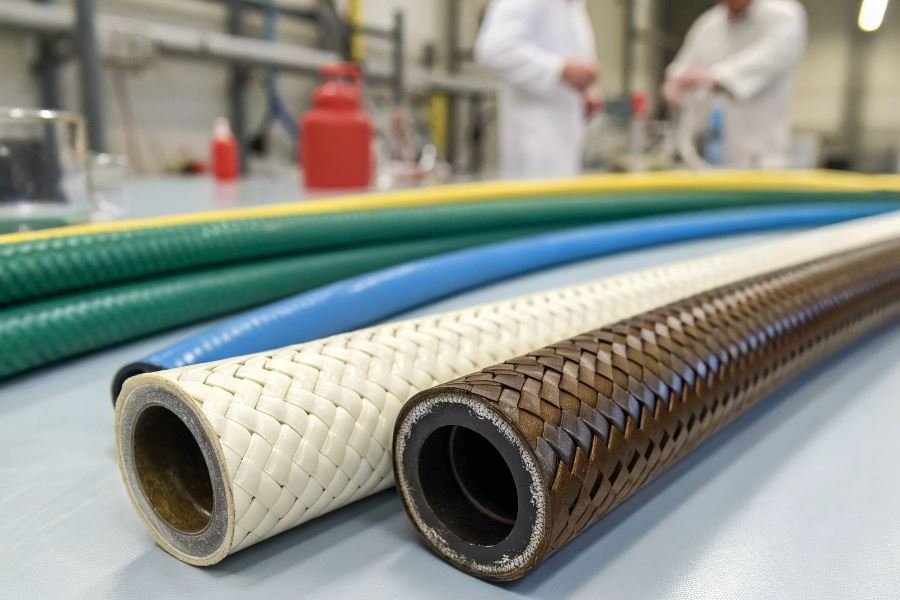
Modern food-grade sleeves incorporate reinforcement layers that dramatically improve pressure handling while maintaining flexibility. Braided textile inserts or wire reinforcement can increase pressure ratings by 300% compared to non-reinforced alternatives.
Hygienic Design: Eliminating Contamination Risks
The cleanability of food-grade sleeves represents perhaps their most critical attribute. Surfaces must resist biofilm formation and allow complete sanitization between production runs.
Smooth-bore designs with minimal crevices prevent product buildup and simplify cleaning validation protocols.
Advanced hygienic features include:
- Seamless construction eliminating potential bacteria traps
- Self-draining geometries that prevent liquid pooling
- CIP/SIP compatibility for automated cleaning systems
- Abrasion-resistant surfaces that don’t develop microscopic harborage points
The best food-grade sleeves incorporate antimicrobial compounds that provide an additional defense layer against bacterial colonization between cleaning cycles. These additives must be non-migratory to prevent product contact while still inhibiting microbial growth on the sleeve surface.
When evaluating cleanability, manufacturers should consider not just the initial state but how the sleeve will perform after hundreds of cleaning cycles and thousands of operational hours. Premium materials maintain their surface characteristics even after extended exposure to aggressive cleaning chemicals and mechanical stress.
Maximizing Your Sleeve Selection Strategy
Evaluation protocols that actually work
When selecting sleeves for food production, rigorous testing is non-negotiable. The most successful manufacturers implement a three-phase evaluation protocol: laboratory assessment, limited production trials, and extended wear testing. During lab assessment, sleeves should undergo accelerated wear simulation, chemical resistance testing, and temperature cycling between -40°F and 400°F to verify durability claims.
Industry wisdom: The sleeve that performs flawlessly in the lab often tells a different story on the production floor. Always insist on real-world testing.
DuPont and other leading materials scientists recommend conducting production trials with at least three different sleeve options simultaneously on identical equipment. This approach provides direct comparative data on performance variables including release properties, cleaning efficiency, and wear patterns. Document everything meticulously—seemingly minor variations often reveal significant long-term implications.
The true cost equation
Initial purchase price represents just 15-30% of a sleeve’s total ownership cost. Forward-thinking operations calculate Total Cost of Ownership (TCO) using this formula:
TCO = Purchase Price + Installation Costs + (Downtime Costs × Frequency) + Cleaning Costs + Energy Consumption + Disposal Costs – Residual Value
| Cost Factor | Standard Sleeve | Premium Sleeve |
|---|---|---|
| Purchase price | $1,200 | $2,100 |
| Annual cleaning costs | $3,600 | $1,800 |
| Downtime costs | $8,400 | $2,800 |
| Energy efficiency | -$0 | -$1,200 |
| Lifespan | 8 months | 24 months |
| 3-year TCO | $19,800 | $9,450 |
Premium sleeves from manufacturers like Trelleborg often deliver 50-70% lower TCO despite higher upfront costs. The most significant savings typically come from reduced downtime and extended replacement intervals.
Tomorrow’s sleeve technology
The food-grade sleeve landscape is evolving rapidly with several transformative technologies emerging:
Biomimetic surfaces are revolutionizing release properties by replicating natural non-stick structures like lotus leaves and shark skin. These surfaces achieve superior performance without PFAS compounds, addressing growing regulatory concerns about “forever chemicals” in food contact materials.
Smart monitoring capabilities are being embedded directly into sleeve materials. Marel and other equipment innovators are developing sleeves with integrated sensors that continuously monitor temperature, pressure, and wear conditions, transmitting real-time data to production management systems.
Antimicrobial nanotechnology is creating self-sanitizing surfaces that actively reduce bacterial loads between cleaning cycles. Early adopters report up to 60% reduction in contamination risks and significant extensions to production runs between sanitization procedures.
Biodegradable composites are addressing end-of-life concerns. New materials combining plant-based polymers with traditional reinforcing fibers offer comparable performance while reducing environmental impact. Though currently commanding a 15-20% price premium, these materials are projected to reach price parity by 2027 as production scales.
The most successful food manufacturers are establishing systematic sleeve evaluation programs that combine rigorous testing protocols with comprehensive TCO analysis. By balancing immediate operational needs with emerging technologies, they’re achieving the optimal blend of performance, compliance, and cost-effectiveness.
Discover essential criteria for selecting food industry sleeves that meet regulatory standards. Learn about material compatibility, temperature resistance, and hygienic design features to optimize your food processing operations and ensure compliance.
Discover essential criteria for selecting food industry sleeves that meet regulatory standards. Learn about material compatibility, temperature resistance, and hygienic design features to optimize your food processing operations and ensure compliance.