Ever walked into a commercial kitchen and wondered what keeps those gleaming stainless steel shelves from becoming breeding grounds for bacteria? The answer lies not just in regular cleaning but in the fundamental design and materials of the shelving itself. The difference between proper and improper storage systems can literally make people sick—or keep them safe.
Food-grade shelving isn’t just about holding products; it’s about creating an environment where contamination has nowhere to hide. The FDA reports that improper storage contributes to approximately 48 million cases of foodborne illness annually in the United States, making your shelving choice a critical business decision.
When comparing types of shelving for the food industry, three factors consistently rise to the top: material composition, structural design, and compliance with regulations. The ideal shelving solution balances durability with sanitation capabilities while meeting strict industry standards.
The compliance factor
The NSF (National Sanitation Foundation) and FDA guidelines aren’t suggestions—they’re essential benchmarks. Food-grade shelving must be non-porous, corrosion-resistant, and designed without crevices where bacteria can accumulate. The 2023 FDA Food Code specifically addresses storage requirements, mandating that food contact surfaces be “smooth, easily cleanable, and non-absorbent.”
Selection criteria that matter
When evaluating shelving options, consider:
- Temperature resistance: Will your shelving maintain integrity in freezers or near hot cooking areas?
- Weight capacity: Can it support heavy loads without bending or breaking?
- Cleanability: How easily can staff sanitize every surface?
- Adjustability: Can the system adapt as your storage needs evolve?
The right shelving doesn’t just store your products—it actively protects your business reputation and your customers’ health.
The Ultimate Shelving Showdown for Food Operations
When it comes to food storage infrastructure, the right shelving can make or break your operation. The food industry demands storage solutions that not only organize inventory efficiently but also maintain strict compliance with health regulations. Let’s dive into the three titans of food-grade shelving and see how they stack up against each other.
Stainless Steel: The Indestructible Champion
Stainless steel shelving stands as the gold standard in food storage environments where durability meets sanitation requirements. The comprehensive types of shelving for the food industry: comparison of characteristics reveals that 304-grade stainless steel offers exceptional resistance to corrosion, even in high-humidity environments like walk-in refrigerators.
What makes stainless truly shine:
- Unmatched longevity – With proper maintenance, quality stainless shelving can last 15-20 years in commercial settings
- Temperature resilience – Performs flawlessly from freezer (-20°F) to hot kitchen environments (up to 180°F)
- NSF certification – Meets stringent National Sanitation Foundation standards
Stainless excels in prep areas, dishwashing stations, and anywhere moisture is prevalent. The non-porous surface prevents bacterial growth, making it the preferred choice for high-risk food handling zones.
“Stainless steel isn’t just shelving—it’s an investment in food safety infrastructure that pays dividends through reduced contamination risk.”
Wire Shelving: The Ventilation Virtuoso
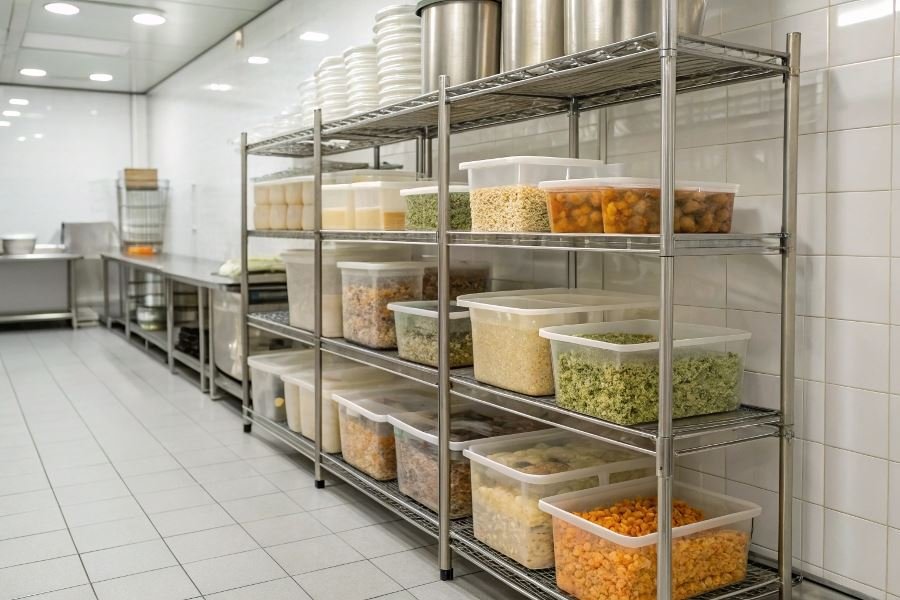
Wire shelving systems offer a compelling alternative with their open-grid design that revolutionizes air circulation. These systems typically support 600-800 pounds per shelf while allowing complete 360° airflow around stored items.
Key advantages include:
- Superior ventilation – Prevents moisture buildup and extends produce freshness
- Visibility – Enables quick inventory assessment without moving items
- Modular flexibility – Easily reconfigured as storage needs evolve
| Feature | Wire Shelving | Solid Shelving |
|---|---|---|
| Airflow | Excellent | Poor |
| Weight capacity | 600-800 lbs | 500-1000 lbs |
| Dust accumulation | Minimal | Significant |
| Price point | $$ | $$$ |
Wire shelving from Metro has become particularly popular in dry storage areas and walk-in coolers where maintaining consistent temperature throughout the storage space is critical.
Polymer Composites: The Corrosion Conqueror
Polymer and plastic composite shelving represents the newest evolution in food storage technology. These lightweight yet robust systems offer remarkable chemical resistance that outperforms even stainless steel in certain environments.
Standout features of modern polymer shelving:
- Complete corrosion immunity – Ideal for seafood storage or acidic food environments
- Temperature range – Premium models from Cambro withstand -40°F to 190°F
- Weight reduction – Typically 30-40% lighter than equivalent metal shelving
- Cleaning simplicity – Many units are dishwasher-safe for thorough sanitization
Polymer shelving particularly shines in freezer applications where metal shelving can become brittle or in environments with aggressive cleaning chemicals that might damage stainless steel over time.
The color-coding options available with polymer systems also support HACCP compliance by allowing visual separation of different food categories, reducing cross-contamination risks.
Each shelving type offers distinct advantages depending on your specific operation. The ideal food storage system often incorporates all three varieties strategically deployed throughout different zones of your facility.
Making the Right Shelving Investment for Food Operations
The true cost of food-grade shelving
When evaluating shelving options for food operations, the initial price tag tells only part of the story. Wire shelving typically offers the lowest upfront investment at $150-300 per unit, while solid stainless steel commands premium pricing at $500-1,200 per section. However, the total cost of ownership reveals a different picture.
Polymer-based systems present an intriguing middle ground at $250-450 per unit with minimal maintenance requirements. Their non-corrosive properties eliminate the need for frequent replacement parts or specialized cleaning agents, saving approximately 30% in maintenance costs over a five-year period compared to wire options.
The cheapest shelf is rarely the most economical when factoring in replacement frequency, cleaning labor, and compliance risks.
Consider this comparison of lifetime costs:
| Shelving Type | Initial Cost | Annual Maintenance | 10-Year Total Cost | Replacement Frequency |
|---|---|---|---|---|
| Wire | $200 | $75 | $950 | 5-7 years |
| Polymer | $350 | $25 | $600 | 10-15 years |
| Stainless Steel | $800 | $50 | $1,300 | 15-20+ years |
The calculation shifts dramatically for high-moisture environments like seafood processing, where wire shelving might require replacement every 3-4 years, making polymer or stainless steel substantially more economical despite higher upfront costs.
Beyond installation day
The implementation journey begins with installation but extends far beyond. Installation complexity varies significantly across shelving types. Wire systems typically assemble in 15-30 minutes per unit with basic tools, while custom stainless configurations may require professional installation and specialized equipment.
Maintenance requirements create even greater divergence in long-term value. Wire shelving demands regular inspection for rust formation, coating damage, and loose connections. The cleaning process requires removing all products, disassembling components, and thorough sanitization—a labor-intensive process consuming 2-3 staff hours weekly in busy operations.
Polymer alternatives offer remarkable simplicity: they can be cleaned in place with standard sanitizers without disassembly. This translates to approximately 100 labor hours saved annually for a medium-sized operation.
The adaptability factor also impacts long-term value. Modular systems from manufacturers like Metro and Cambro allow reconfiguration as operational needs evolve, extending useful life and preventing premature replacement.
Tomorrow’s shelving innovations
The food industry shelving landscape is evolving rapidly with several emerging trends:
-
Antimicrobial integration – Advanced polymer formulations now incorporate silver ion technology that actively inhibits bacterial growth between cleanings.
-
Smart inventory systems – RFID-enabled shelving from companies like Nexclinic automatically tracks inventory levels and expiration dates, reducing waste by up to 25%.
-
Sustainable materials – Bio-based polymers derived from renewable resources are gaining traction, offering comparable performance with reduced environmental impact.
-
Modular hybrid systems – Manufacturers are developing interchangeable components that combine the strength of metal frames with polymer shelving surfaces, optimizing both durability and sanitation.
The most forward-thinking operations are already implementing IoT-connected shelving that monitors temperature and humidity at the shelf level, providing unprecedented quality control and compliance documentation.
When selecting shelving today, consider not just current needs but compatibility with these emerging technologies to maximize long-term value and operational efficiency.
Discover the essential differences between stainless steel, wire, and polymer shelving systems for food safety compliance. Compare durability, sanitation features, and cost-effectiveness for your specific food industry application.
Discover the essential differences between stainless steel, wire, and polymer shelving systems for food safety compliance. Compare durability, sanitation features, and cost-effectiveness for your specific food industry application.