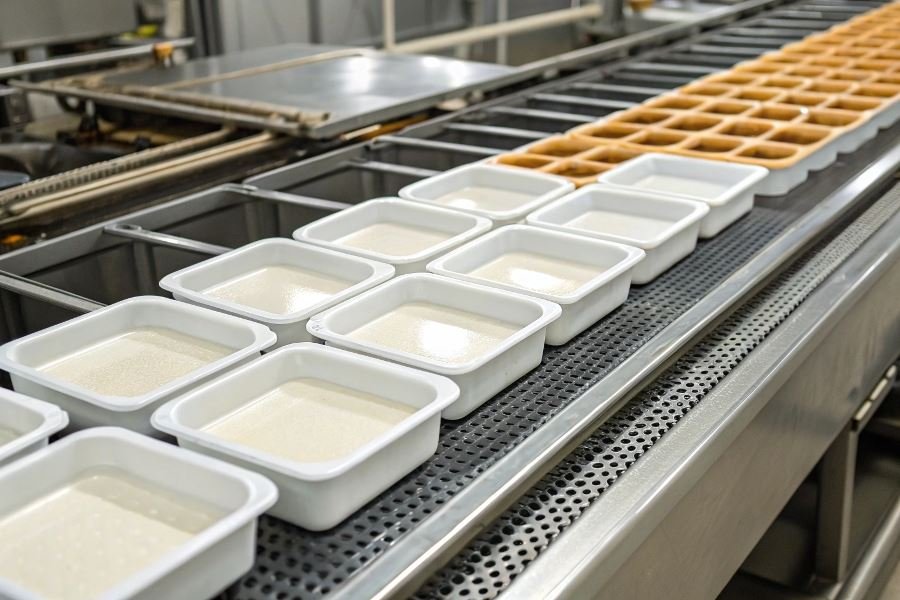
What if the humble food tray could help solve our global waste crisis while keeping your meals fresher? The food packaging industry stands at a critical crossroads, facing unprecedented challenges that demand ingenious solutions.
Food manufacturers are navigating a complex landscape where consumer expectations for sustainability clash with practical needs for food safety and shelf life. Traditional plastic trays, once the industry standard, now face scrutiny as 8 million metric tons of plastic enter our oceans annually. This environmental impact has catalyzed a wave of innovation in tray production technologies.
The evolution of food-grade trays tells a fascinating story of adaptation. What began with simple wooden crates in the early 20th century transformed into styrofoam containers in the 1960s, then rigid plastics in the 1980s. Today’s innovations include biodegradable materials derived from agricultural waste and smart packaging that monitors food freshness in real-time.
Three key drivers are propelling this revolution:
- Environmental imperatives – Regulations limiting single-use plastics have forced manufacturers to reimagine materials and production processes
- Consumer demand – 73% of consumers are willing to pay more for sustainable packaging
- Technological breakthroughs – Advances in material science have created options that were impossible just five years ago
The most promising innovations combine reduced environmental footprints with enhanced functionality. Mushroom-based packaging that biodegrades in weeks, plant-based trays that extend shelf life, and recycled plastic alternatives that maintain food safety standards are transforming how we package, transport, and consume food.
Revolutionizing Food Packaging: Top 3 Tray Innovations
Biodegradable Materials Transforming the Industry
The food packaging landscape is undergoing a remarkable transformation as manufacturers pivot away from traditional plastics. Innovative solutions in the production of trays for the food industry have emerged in response to growing environmental concerns and consumer demand for sustainable alternatives. Leading this revolution are biodegradable and compostable materials that decompose naturally without leaving harmful microplastics behind.
Novamont’s Mater-Bi bioplastic trays exemplify this shift, offering decomposition rates 60-90% faster than conventional plastics. These plant-based alternatives, derived from corn starch, sugarcane, and agricultural waste, maintain structural integrity while in use but break down completely in industrial composting facilities within 12 weeks.
Mushroom-based packaging represents another groundbreaking development. Ecovative Design has pioneered mycelium-based trays that are grown rather than manufactured. The process consumes 12% of the energy required for plastic production and creates zero toxic byproducts. These innovations aren’t just environmentally sound—they’re economically viable, with production costs decreasing by approximately 18% since their commercial introduction.
“The true innovation isn’t just in creating biodegradable materials, but in developing ones that perform as well as or better than their plastic predecessors while remaining cost-competitive.”
Smart Packaging Extending Food Freshness
The second major innovation wave centers on intelligent packaging technologies that actively monitor and extend food shelf life. These smart trays incorporate nanotechnology and IoT capabilities to transform passive containers into active food preservation systems.
Time-temperature indicators embedded directly into packaging materials change color when products approach expiration or experience temperature abuse during transport. Timestrip’s indicators can detect temperature variations as small as 2°C, providing consumers with visual confirmation of food safety.
Advanced smart trays now feature:
| Technology | Function | Benefit |
|---|---|---|
| Oxygen scavengers | Absorb oxygen within packaging | Extends shelf life by up to 40% |
| Ethylene absorbers | Remove ripening hormones | Prevents premature spoilage |
| Antimicrobial films | Release preservatives gradually | Reduces bacterial growth by 99.9% |
| RFID/NFC sensors | Track location and conditions | Enables real-time supply chain monitoring |
These technologies not only reduce food waste but also enhance safety by providing unprecedented traceability. Insignia Technologies has developed smart labels that gradually change color as packaged food ages, giving consumers a visual indicator of freshness beyond traditional date labels.
Manufacturing Processes Redefining Production
The third innovation frontier lies in revolutionary manufacturing processes that dramatically improve efficiency while reducing environmental impact. Thermoforming 4.0 systems have transformed production lines through automation and real-time analytics.
GEA’s integrated production systems have achieved energy reductions of 25-30% compared to conventional methods through:
- Precision-controlled heating elements that adjust temperature zones based on material thickness
- Closed-loop water cooling systems that recapture 85% of thermal energy
- AI-powered quality control systems that reduce material waste by identifying defects before final production
3D printing technology has also entered the tray manufacturing space, enabling rapid prototyping and small-batch production without expensive mold creation. This allows manufacturers to test new designs with minimal investment and respond quickly to market demands.
Perhaps most impressive are the advances in compression molding techniques that allow for ultra-thin yet strong tray walls, reducing material usage by up to 22% while maintaining structural integrity. These processes work particularly well with fiber-based materials like bagasse and wheat straw, creating truly sustainable packaging solutions that require 40% less energy to produce than traditional plastic alternatives.
The Future of Food Packaging is Here
Emerging technologies reshaping food trays
The food packaging landscape is undergoing a remarkable transformation. Biodegradable polymers derived from agricultural waste are now being engineered to match the durability of traditional plastics while decomposing in under 90 days. Companies like NatureWorks have developed PLA (polylactic acid) formulations that withstand temperatures from -40°F to 220°F—perfect for everything from frozen meals to hot-fill applications.
Smart packaging isn’t just a buzzword anymore—it’s becoming standard practice. Embedded sensors that monitor food freshness are being integrated directly into tray materials. These microsensors detect ethylene gas, temperature fluctuations, and bacterial growth, communicating data through NFC technology to smartphones or inventory systems.
3D printing has revolutionized prototype development, slashing design-to-production timelines from months to days. Food manufacturers can now test multiple tray designs simultaneously, with machines capable of printing food-safe prototypes using FDA-approved materials.
“The convergence of materials science and digital technology is creating packaging that actively preserves food quality rather than merely containing it.”
Regulatory landscape and compliance challenges
Navigating the regulatory environment for innovative food packaging requires strategic foresight. The FDA’s Food Contact Notification program has streamlined approval processes, but manufacturers must still demonstrate both safety and functionality through rigorous testing protocols.
The European Union’s Single-Use Plastics Directive has accelerated the transition toward sustainable alternatives, with compliance deadlines creating market opportunities for early adopters. Companies that proactively address these requirements gain competitive advantages in global markets.
| Regulatory Body | Key Requirements | Compliance Timeline |
|---|---|---|
| FDA | Food contact safety, migration testing | 120-day review period |
| EU Commission | Recyclability, reduced plastic content | Phased implementation through 2030 |
| ISO | Standards 22000 for food safety management | Annual certification |
Manufacturers partnering with certification bodies like NSF International can navigate these complex requirements more efficiently, reducing time-to-market for innovative solutions.
Investment landscape and growth potential
The advanced food tray market is projected to reach $9.8 billion by 2030, representing a CAGR of 6.7%. Private equity firms are taking notice, with significant investments flowing into companies developing proprietary sustainable materials and smart packaging technologies.
Strategic acquisition activity has intensified as established packaging giants seek to incorporate innovative startups. Sealed Air Corporation and similar industry leaders have established venture arms specifically targeting breakthrough technologies in food packaging.
The most promising investment opportunities include:
- Antimicrobial packaging technologies that extend shelf life without preservatives
- Compostable barrier materials that provide oxygen and moisture protection
- AI-enabled production systems that optimize material usage and reduce waste
- Closed-loop recycling infrastructure for post-consumer packaging
Manufacturing facilities incorporating these technologies are seeing efficiency gains of 15-30% while reducing material costs by up to 25%. The dual benefits of sustainability and profitability are driving unprecedented capital allocation to this sector.
The companies that will dominate tomorrow’s food packaging landscape are those investing in both material innovation and digital integration today.
Discover cutting-edge biodegradable materials and smart packaging technologies transforming food tray production. Explore how innovative manufacturing processes are enhancing sustainability, food safety, and efficiency in the packaging industry.
Discover cutting-edge biodegradable materials and smart packaging technologies transforming food tray production. Explore how innovative manufacturing processes are enhancing sustainability, food safety, and efficiency in the packaging industry.