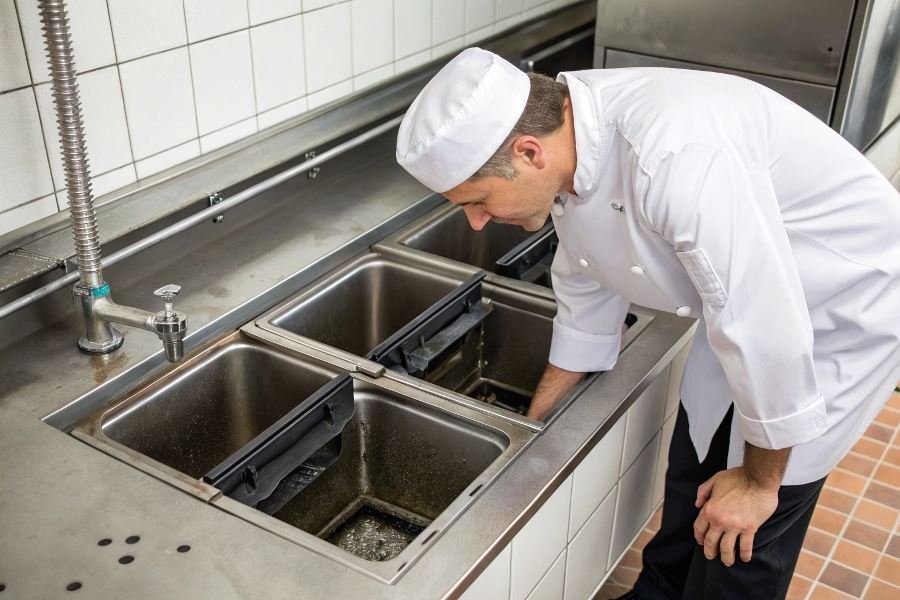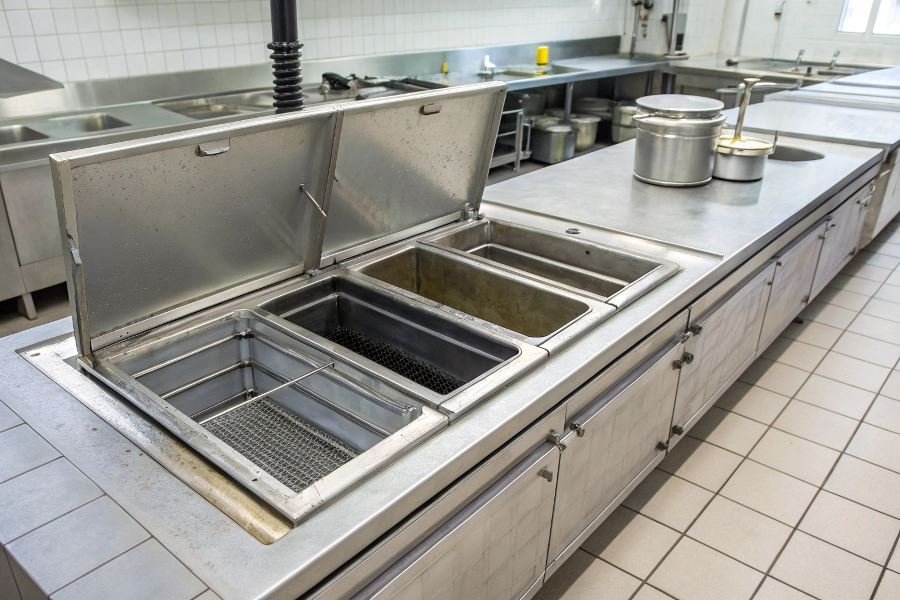
Ever walked past a restaurant and caught that unmistakable whiff of rancid grease? That’s what happens when a business neglects proper grease management. Behind every successful commercial kitchen operates an unsung hero—the grease trap—quietly preventing environmental disasters and costly plumbing emergencies.
Grease traps are specialized plumbing devices designed to intercept fats, oils, and grease (FOG) before they enter the wastewater system. Think of them as your kitchen’s first line of defense against the sticky, congealing mess that forms when hot grease cools and solidifies in pipes. Without these crucial systems, FOG would accumulate in sewer lines, creating massive “fatbergs” that can block entire municipal systems.
The regulatory landscape: More than just a suggestion
The EPA and local health departments don’t view grease traps as optional. Most municipalities now mandate specific grease trap requirements based on your establishment’s size and output. Failing inspections can result in hefty fines—sometimes exceeding $10,000—or even business closure until compliance is achieved.
When grease goes rogue: The costly consequences
Ignoring proper grease management isn’t just about avoiding fines. Consider these real-world impacts:
- Plumbing emergencies: Emergency plumbing repairs during peak business hours can cost 3-4 times more than preventative maintenance
- Environmental damage: FOG discharge is responsible for approximately 47% of sewer overflows in urban areas
- Business disruption: The average restaurant loses $3,000 in revenue for each day closed due to plumbing issues
Selecting the right grease trap isn’t merely about checking a regulatory box—it’s a critical business decision that affects your operation’s efficiency, compliance status, and bottom line. The right system protects both your business and the community infrastructure we all depend on.
Grease Trap Systems: Finding Your Perfect Match
When it comes to commercial kitchen waste management, choosing the right grease trap isn’t just about compliance—it’s about operational efficiency, maintenance costs, and environmental responsibility. Let’s dive into the three primary categories of grease interceptors that dominate the market today.
The selection process for types of grease traps suitable for your business depends largely on your kitchen’s size, output volume, and specific operational needs. Each system offers distinct advantages that might make it the ideal solution for your particular situation.
Passive Grease Interceptors: The Reliable Workhorses
Passive grease interceptors represent the most traditional approach to grease management, relying on fundamental physics rather than mechanical components. These gravity-based systems operate on a beautifully simple principle: FOG (fats, oils, and grease) is lighter than water and will naturally separate and float to the top when wastewater flow is slowed down.
Key characteristics:
- Capacity ranges from 20 to 2,000+ gallons
- No moving parts or electrical components
- Typically installed underground outside the facility
- Requires manual cleaning every 1-3 months
These interceptors excel in high-volume operations like cafeterias, large restaurants, and institutional kitchens. Their simplicity translates to remarkable durability—many units from reputable manufacturers like Zurn and Josam can function effectively for 15+ years with proper maintenance.
Industry insight: While passive systems have higher upfront installation costs, their operational expenses over time are typically 40-60% lower than automatic alternatives.
Automatic Grease Removal Devices: Smart Kitchen Solutions
For operations where space is at a premium or daily grease output is consistent, automatic grease removal devices (GRDs) offer a technology-driven alternative that minimizes maintenance headaches.
These systems use timers, sensors, and heating elements to automatically separate and remove accumulated grease, transferring it to a separate container for disposal. The automation dramatically reduces the need for manual cleaning.
Standout features:
- Compact design for under-sink or in-kitchen installation
- Daily self-cleaning cycles
- Digital monitoring capabilities
- 20-75 gallons per minute flow rates
Manufacturers like Thermaco have developed sophisticated units with programmable skimming cycles and even remote monitoring capabilities, allowing maintenance staff to track performance via smartphone apps.
Hydromechanical Grease Interceptors: The Versatile Middle Ground
Hydromechanical grease interceptors represent a hybrid approach, combining elements of both passive and automatic systems. These units use internal baffles and flow control devices to enhance separation efficiency while maintaining a relatively compact footprint.
Defining attributes:
- Point-of-use installation (typically under sinks)
- Flow rates from 10-100 gallons per minute
- Semi-regular maintenance (typically monthly)
- Smaller footprint than passive systems
These systems shine in operations with space constraints but moderate grease output, such as small restaurants, coffee shops, and food trucks. Models from Schier Products offer innovative features like visible flow control and quick-access covers that make maintenance significantly less time-consuming.
| Interceptor Type | Installation Cost | Maintenance Frequency | Space Required | Best For |
|---|---|---|---|---|
| Passive | 5, 000−25,000 | Every 1-3 months | Large (external) | High-volume kitchens |
| Automatic | 2, 000−10,000 | Minimal (weekly check) | Small (internal) | Space-constrained facilities |
| Hydromechanical | 1, 000−5,000 | Monthly | Medium (under-sink) | Moderate-volume operations |
The right grease trap system ultimately depends on your specific operational parameters, budget constraints, and facility limitations. By understanding these three fundamental approaches, you’re well-equipped to make an informed decision that balances compliance requirements with practical business considerations.
Making the Right Grease Trap Decision for Your Business
Choosing the perfect grease trap isn’t just about compliance—it’s about making a strategic business decision that affects your kitchen’s efficiency, maintenance schedule, and bottom line. Let’s dive into the factors that should guide your selection process.
Sizing Your Trap for Success
The cardinal rule of grease trap selection is proper sizing. An undersized unit creates a maintenance nightmare, while oversizing wastes valuable capital and space.
Flow rate matching is essential—your grease trap must handle your kitchen’s busiest hours without backing up. For most restaurants, this means calculating:
- Number of meals served during peak hours
- Types of cooking equipment in operation
- Number of pre-rinse stations and dishwashers
A small café might function perfectly with a 20-25 GPM (gallons per minute) trap, while a busy steakhouse could require 75+ GPM capacity. The Uniform Plumbing Code provides this handy formula: Multiply the total drainage fixture units by 3 GPM, then factor in a retention time of at least 30 minutes.
Remember that undersizing is the most common and costly mistake businesses make when selecting grease traps.
Installation and Maintenance Realities
Installation requirements vary dramatically between trap types, directly impacting both upfront costs and ongoing maintenance.
Installation Comparison
| Trap Type | Installation Complexity | Space Required | Professional Help Needed |
|---|---|---|---|
| Under-sink | Low | Minimal | Optional |
| In-floor | High | Moderate | Required |
| Automatic | Moderate | Moderate | Required |
| Gravity GRD | Very High | Substantial | Required |
Maintenance commitments should factor heavily into your decision. Passive systems require more frequent manual cleaning—typically every 1-4 weeks depending on usage. Automatic systems, while more expensive initially, can extend cleaning intervals to 2-3 months with proper operation.
Accessibility is crucial. An under-sink unit that requires moving equipment for servicing will quickly become neglected. Similarly, outdoor in-ground units need vehicle access for pumping services.
The True Cost Equation
The sticker price is just the beginning of your grease trap investment story.
Initial Investment Considerations:
- Purchase price (300−15,000 depending on type and size)
- Installation costs (often 1-3× the unit price)
- Permitting fees
- Potential kitchen downtime during installation
Long-term operational expenses often dwarf the initial investment:
- Cleaning frequency and associated labor costs
- Professional pumping services (150−500 per service)
- Replacement parts and repairs
- Potential fines for non-compliance (1, 000−10,000)
- Water bill impacts from inefficient systems
Automatic grease recovery devices from manufacturers like Thermaco might cost 3-4 times more upfront than passive traps, but their self-cleaning capabilities can reduce maintenance costs by up to 70% over a five-year period.
The most cost-effective solution isn’t always the cheapest to purchase—calculate your total cost of ownership over at least five years.
When making your final decision, consider your business’s growth trajectory. A properly sized system should accommodate at least 25% additional capacity beyond your current needs to prevent premature replacement as your business expands.
Discover the essential types of grease traps for commercial kitchens and learn how to select the perfect system for your business needs. Compare passive, automatic, and hydromechanical options while ensuring regulatory compliance.
Discover the essential types of grease traps for commercial kitchens and learn how to select the perfect system for your business needs. Compare passive, automatic, and hydromechanical options while ensuring regulatory compliance.