Did you know that a single commercial fryer can produce up to 35 pounds of grease per week? That’s over 1,800 pounds annually—enough to cause catastrophic plumbing failures if not properly managed. The unsung heroes preventing this disaster? Grease traps.
Commercial kitchens rely on these essential systems to capture fats, oils, and grease (FOG) before they enter and devastate municipal sewer systems. But when it comes to choosing between floor grease traps and connected systems, restaurant owners and facility managers face a critical decision that impacts both operations and compliance.
The foundation: What exactly are grease traps?
Grease traps function on a simple principle: they slow wastewater flow, allowing time for fats, oils, and grease to cool, separate, and float to the surface while heavier solids sink. This separation prevents FOG from entering and clogging plumbing and municipal systems.
Floor grease traps: The traditional workhorses
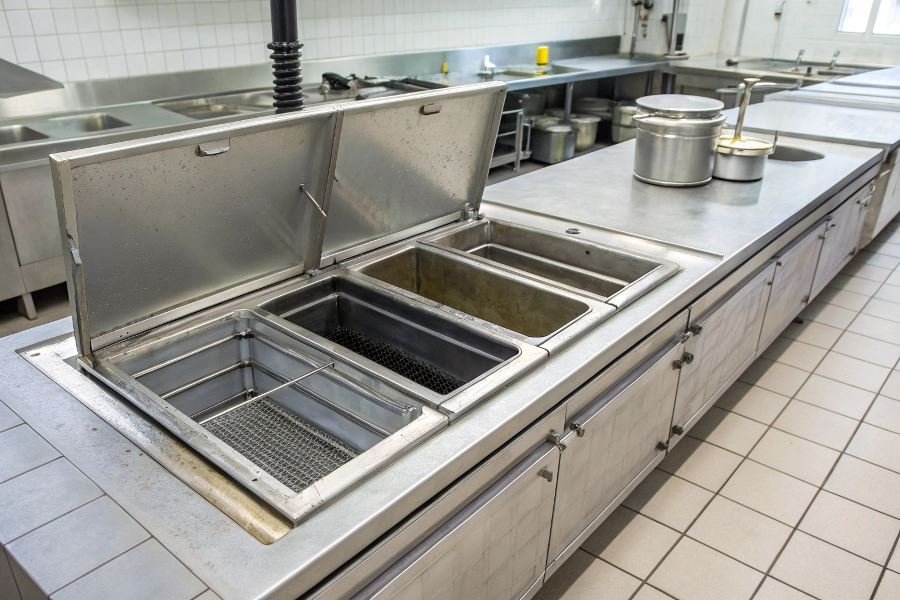
Floor grease traps—also called in-floor or below-ground interceptors—are installed directly into the floor of a kitchen or immediately outside the facility. These robust systems typically offer:
- High capacity: Often handling 500-2,000+ gallons
- Substantial separation time: Allowing for excellent grease retention
- Accessibility challenges: Requiring staff to physically open floor access points for cleaning
- Maintenance intensity: Typically needing professional pumping every 1-3 months
Connected grease traps: The modern alternative
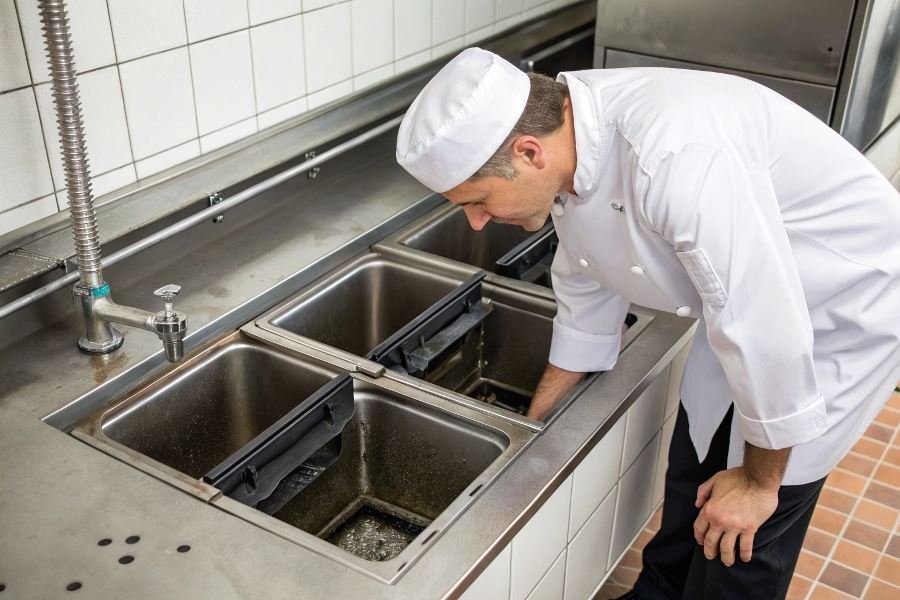
Connected or point-of-use grease traps mount directly to specific fixtures or under sinks. Their profile includes:
- Targeted installation: Positioned at specific grease-producing stations
- Moderate capacity: Usually 20-100 gallons
- Easier maintenance access: Positioned for simpler inspection and cleaning
- More frequent servicing: Often requiring weekly or bi-weekly attention
Effectiveness factors: What truly matters
The battle between these systems ultimately comes down to four critical factors: kitchen volume, space constraints, maintenance capabilities, and local code requirements. High-volume operations typically benefit from floor systems’ capacity, while smaller kitchens may find connected traps more practical and cost-effective.
The Ultimate Grease Trap Showdown
Capturing FOG Where It Matters
When evaluating grease management systems, efficiency is measured by one critical metric: how effectively the system captures fats, oils, and greases (FOG) before they enter your plumbing. Floor grease traps typically capture 85-95% of FOG materials due to their larger capacity and longer retention time. The physics is simple—FOG rises to the top while wastewater continues through the system. Connected grease traps, installed directly to fixtures, offer a more targeted approach with 75-90% efficiency rates. The question of floor vs connected grease traps: which is more effective ultimately depends on your specific operation volume and space constraints.
Real-world testing reveals floor units excel in high-volume environments like full-service restaurants, while connected systems shine in smaller operations with limited grease output. The Thermaco Big Dipper series demonstrates this principle perfectly, with retention capacities ranging from 20-100 pounds depending on the model.
Space and Installation Realities
| Trap Type | Space Required | Installation Complexity | Structural Modifications |
|---|---|---|---|
| Floor | 9-16 sq ft | High | Often extensive |
| Connected | 2-4 sq ft | Moderate | Minimal |
Floor traps demand significant real estate—typically installed in-ground requiring concrete cutting and potentially complex plumbing modifications. The average installation costs between 3, 000−7,000 depending on existing infrastructure.
Connected systems mount directly to dishwashers, sinks, or other fixtures, requiring minimal structural changes. Their compact profile makes them ideal for kitchens where every square inch matters. Installation typically runs 1, 000−2,500, making them an attractive option for smaller establishments or retrofits.
The Maintenance Equation
The most efficient trap becomes worthless without proper maintenance.
Floor traps require less frequent cleaning (typically quarterly) but demand more intensive service—often requiring professional pumping services costing 200−600 per service. Access can be challenging, especially in busy kitchens where equipment may need to be moved.
Connected traps need more frequent attention (weekly or monthly cleaning) but can typically be maintained by staff. The Goslyn GOS-40 exemplifies this with its easy-access design allowing for 15-minute cleaning procedures without specialized equipment.
Navigating Regulatory Waters
Compliance isn’t optional. Most municipalities follow standards based on the Uniform Plumbing Code or International Plumbing Code, which specify minimum retention times and capacities.
Floor traps generally satisfy even the strictest requirements due to their larger capacity. Connected systems may require multiple units or supplemental interceptors to meet code in higher-volume operations.
The critical factor: documentation. Regardless of system type, maintaining cleaning logs and service records is essential for passing inspections. Many jurisdictions require minimum quarterly maintenance, with some requiring monthly service depending on volume.
The Financial Long Game
Initial investment for floor traps (5, 000−15,000 installed) dwarfs connected systems (1, 500−4,000 installed). However, the calculation changes when considering operational expenses:
- Floor traps: Higher service costs but less frequent maintenance
- Connected traps: Lower per-service costs but more frequent attention
The break-even point typically occurs between years 3-5, depending on operation size. For establishments planning to operate beyond five years, floor systems often deliver better lifetime value despite higher upfront costs.
The Schier Great Basin series illustrates this principle with its 20-year warranty and engineered durability that offsets the higher initial investment through reduced replacement costs.
Making the Right Grease Trap Choice for Your Operation
When it comes to grease management, the decision between floor and connected grease traps isn’t just about preference—it’s about operational efficiency, compliance, and your bottom line. Let’s cut through the grease and determine which system truly delivers the best results for your specific situation.
Floor Grease Traps Shine in These Environments
Floor grease traps excel in particular operational contexts where their design advantages can be fully leveraged:
High-volume food service operations benefit tremendously from floor grease traps. Restaurants serving 300+ meals daily generate significant FOG (fats, oils, and grease) that requires the larger capacity these systems provide.
Commercial kitchens with limited plumbing access find floor units practical since they’re self-contained and don’t require extensive connection to existing plumbing infrastructure.
Facilities with fluctuating grease output appreciate the buffer capacity of floor units, which can handle sudden surges without backing up or requiring immediate maintenance.
Floor grease traps typically offer 500-1500 gallon capacity compared to the 20-50 gallon range of most connected units—a critical difference for high-volume operations.
These systems particularly suit:
- Full-service restaurants
- Hotel kitchens
- University dining halls
- Hospital food service operations
- Large cafeterias
Connected Grease Traps Work Best When
Connected grease traps deliver optimal performance in specific scenarios:
Space-constrained facilities benefit from the compact profile of connected units. Coffee shops, small cafés, and food trucks with minimal kitchen space can install these units directly under sinks without sacrificing valuable floor space.
Operations with moderate grease output find connected traps sufficient and more cost-effective. Establishments primarily serving pre-prepared foods or those with limited frying operations typically generate less FOG.
Businesses with frequent menu changes appreciate the accessibility of connected units, which allow for easier cleaning when grease composition changes due to menu adjustments.
Decision Framework for Maximum Effectiveness
When evaluating which system will deliver superior results for your operation, consider these critical factors:
| Factor | Floor Grease Traps | Connected Grease Traps |
|---|---|---|
| Daily meals | 200+ | Under 200 |
| Kitchen space | Basement/dedicated area available | Limited space |
| Maintenance resources | Staff available for regular cleaning | Limited maintenance capability |
| Initial budget | 3, 000−10,000 | 500−2,000 |
| Menu type | Heavy frying/grease production | Limited grease production |
Regulatory compliance requirements should guide your decision. Many municipalities have specific requirements based on your operation size. Check with local water authorities before making your final selection.
Long-term operational costs often favor floor systems for larger operations despite higher upfront investment. Connected systems may require more frequent servicing, offsetting their lower initial cost.
The effectiveness priority matrix should align with your specific challenges:
- Prioritize capacity? Choose floor systems
- Prioritize accessibility? Connected systems offer advantages
- Prioritize maintenance simplicity? Connected units are easier to service in-house
- Prioritize longevity? Floor systems typically last 15-20 years versus 5-8 for connected units
The most effective grease trap isn’t simply the most powerful—it’s the one that aligns with your operational realities, spatial constraints, and maintenance capabilities. By carefully evaluating these factors, you’ll select a system that delivers optimal performance for your specific needs.
Discover which grease trap system delivers superior performance for your commercial kitchen. Compare floor vs connected grease traps based on efficiency, maintenance requirements, compliance standards, and long-term cost effectiveness.
Discover which grease trap system delivers superior performance for your commercial kitchen. Compare floor vs connected grease traps based on efficiency, maintenance requirements, compliance standards, and long-term cost effectiveness.