
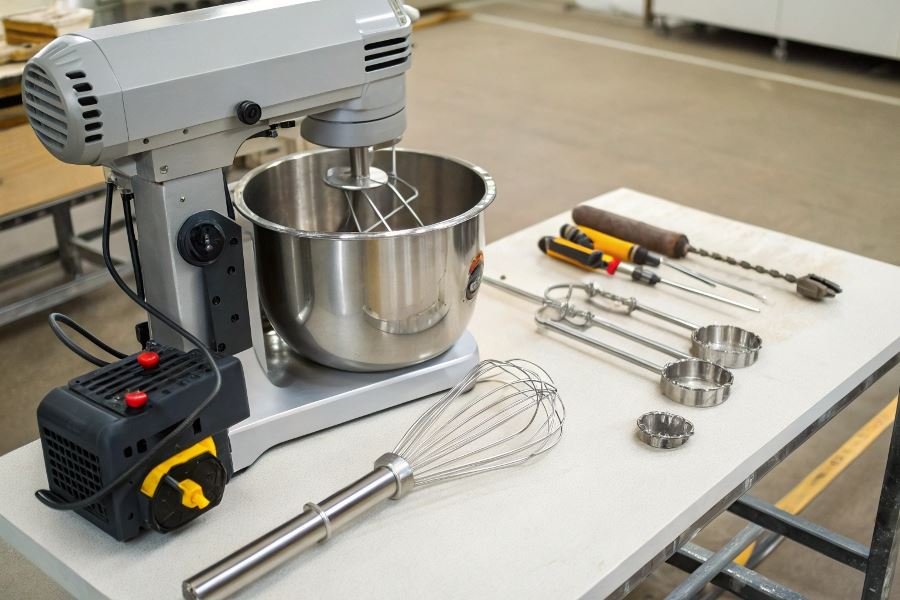
Ever watched a master chef select the perfect tool for a culinary creation? In manufacturing, the stakes are exponentially higher. A single attachment choice can mean the difference between product excellence and costly failure.
Industrial mixing isn’t just about blending ingredients—it’s about precision engineering at scale. When a pharmaceutical company needs to create a life-saving suspension or a food manufacturer must achieve the perfect consistency for their signature sauce, the attachment selection becomes critical. These specialized tools transform raw materials into valuable products through carefully controlled mechanical actions.
The challenges facing industrial mixing operations are as diverse as the industries they serve. Viscosity variations, temperature sensitivity, and particle distribution uniformity represent just a few hurdles manufacturers face daily. Consider this: a paint manufacturer using an improper impeller might create a product with color inconsistencies visible only after application, potentially costing millions in recalls.
Attachment selection directly impacts your bottom line. The right industrial mixer attachment doesn’t just improve product quality—it can dramatically reduce processing time, minimize energy consumption, and extend equipment lifespan. One food processing facility reported a 37% reduction in mixing time after switching to application-specific attachments, translating to significant energy savings and increased production capacity.
The science of industrial mixing has evolved dramatically, with specialized attachments now designed to address specific material behaviors. From high-shear dispersers that break down agglomerates to gentle anchor impellers that maintain delicate structures, each attachment serves a distinct purpose in the production ecosystem.
Essential Attachments for Industrial Mixers: Your Complete Guide
The difference between mediocre and exceptional mixing results often comes down to one critical factor: choosing the right attachment. Industrial mixers are versatile powerhouses, but they’re only as effective as the attachments you pair them with. Understanding which attachments for industrial mixers are needed for different tasks can dramatically improve efficiency, product quality, and equipment longevity while reducing processing time and energy consumption.
Let’s dive into the world of industrial mixer attachments, breaking them down by application type and viscosity requirements to help you make informed decisions for your specific mixing challenges.
High-Viscosity Applications: Power Through Thickness
When dealing with high-viscosity materials like doughs, pastes, and heavy creams, you need attachments designed to handle serious resistance:
Anchor Impellers: These workhorses feature a design that scrapes the vessel walls while pushing material downward and inward.
- Ideal for: Putties, adhesives, and materials exceeding 50,000 cP
- Working principle: Creates vertical flow patterns that prevent material from climbing the shaft
- Typical speed range: 20-60 RPM
Spiral Attachments: With their helical design, spiral attachments excel at moving thick materials with minimal shear.
The double-ribbon spiral variant provides exceptional results for materials that tend to separate during mixing, maintaining homogeneity throughout the process.
Planetary Mixers: Not just an attachment but a mixing system where tools rotate on their axis while orbiting the vessel.
| Attachment Type | Viscosity Range (cP) | Shear Rate | Best Applications |
|---|---|---|---|
| Anchor | 20,000-1,000,000+ | Low | Putties, doughs, silicones |
| Spiral | 10,000-500,000 | Low-Medium | Thick creams, pastes, gels |
| Planetary | 5,000-1,000,000+ | Variable | Bakery products, pharmaceuticals |
Low-Viscosity Applications: Efficiency in Fluidity
For thinner materials like beverages, sauces, and liquid chemicals, different attachment designs optimize flow and mixing:
Propeller Attachments: These create strong axial flow patterns ideal for blending and solid suspension.
- Perfect for: Liquids below 5,000 cP requiring rapid homogenization
- Energy efficiency: High throughput with relatively low power consumption
- Configuration options: 3-blade and 4-blade designs for varying turbulence needs
Turbine Impellers: Featuring multiple straight or curved blades, these create radial flow patterns.
Paddle Mixers: With their large surface area, paddles provide gentle but thorough mixing for shear-sensitive materials.
Specialized Mixing Challenges: Precision Tools
Some mixing operations require highly specialized attachments:
High-Shear Dispersers: These disc-style impellers rotate at high speeds (up to 5,000 RPM) to create intense shear forces.
- Applications: Breaking down agglomerates, creating emulsions, dispersing powders
- Design features: Saw-tooth edges increase shear effectiveness
- Consideration: Generate heat, may require cooling systems for temperature-sensitive products
Homogenizers: When microscopic particle size and perfect uniformity are non-negotiable, rotor-stator homogenizers deliver unmatched results.
Emulsification Attachments: Specialized designs with precise tolerances create stable emulsions by forcing immiscible liquids together under controlled conditions.
The right attachment transforms your industrial mixer from a general-purpose machine into a precision instrument tailored to your specific processing requirements. By matching attachment characteristics to your material properties and desired outcomes, you’ll achieve consistent quality while maximizing equipment efficiency and lifespan.
Optimizing Your Industrial Mixing Operations
Key selection factors that drive performance
Selecting the right attachment for your industrial mixer isn’t just about compatibility—it’s about transforming your production efficiency. The difference between an adequate attachment and the optimal one can mean thousands of dollars in saved production time and material costs.
When evaluating mixer attachments, focus first on viscosity requirements. High-viscosity materials like industrial adhesives demand robust helical ribbon blenders that generate significant torque, while low-viscosity liquids work efficiently with turbine or propeller attachments that create appropriate flow patterns.
The shear rate your process requires will dramatically narrow your options. High-shear applications—like emulsification in cosmetics manufacturing—demand specialized rotor-stator attachments that can generate the necessary mechanical force to break down particles to the required size.
The right attachment doesn’t just mix—it transforms your material precisely as specified while minimizing energy consumption and process time.
Processing temperature represents another critical variable. Attachments for high-temperature applications require specialized materials like 316L stainless steel or exotic alloys that maintain structural integrity under extreme conditions. For cryogenic applications, materials must resist becoming brittle at ultra-low temperatures.
Maintenance strategies that extend attachment lifespan
The longevity of your mixer attachments depends largely on preventative maintenance protocols. Implementing a rigorous inspection schedule can extend attachment life by 30-40% compared to reactive maintenance approaches.
Material selection plays a decisive role in maintenance requirements. While 304 stainless steel offers excellent corrosion resistance for many applications, processes involving chlorides or sulfuric compounds may require the enhanced protection of Hastelloy or titanium components.
Proper cleaning procedures dramatically impact attachment lifespan. Consider this maintenance comparison:
| Maintenance Approach | Average Lifespan | Downtime Per Year | ROI Impact |
|---|---|---|---|
| Reactive Only | 2-3 years | 72-96 hours | Baseline |
| Scheduled Preventative | 4-5 years | 24-36 hours | +40-60% |
| Predictive with Monitoring | 6-8 years | 8-16 hours | +80-120% |
Vibration analysis has emerged as the gold standard for predictive maintenance, allowing operators to detect impending failures before catastrophic damage occurs. Implementing vibration monitoring can reduce unplanned downtime by up to 70%.
Premium vs standard attachments: The real cost equation
The initial price difference between premium and standard attachments often appears substantial—premium options typically command a 40-70% price premium. However, this surface-level comparison misses the deeper economic reality.
Production efficiency gains from premium attachments frequently offset their higher acquisition costs. A high-efficiency hydrofoil impeller might cost $4,500 compared to $2,800 for a standard model, but can reduce mixing time by 25-30% while consuming 15-20% less energy.
When calculating total cost of ownership, factor in these critical variables:
- Process time reduction (labor and facility utilization)
- Energy consumption differences
- Maintenance frequency and associated costs
- Production quality improvements
- Expected service life differential
Premium attachments typically deliver superior material distribution uniformity, which directly impacts product quality consistency. For pharmaceutical or food production, this quality advantage alone can justify the premium investment through reduced rejection rates.
The most sophisticated operations implement a hybrid approach—deploying premium attachments for critical processes where performance advantages deliver clear ROI, while utilizing standard options for less demanding applications where the performance differential doesn’t justify the premium.
Discover the essential industrial mixer attachments for every manufacturing challenge. From anchor impellers for high-viscosity materials to specialized emulsification tools, learn how to optimize production efficiency with the right equipment.
Discover the essential industrial mixer attachments for every manufacturing challenge. From anchor impellers for high-viscosity materials to specialized emulsification tools, learn how to optimize production efficiency with the right equipment.


