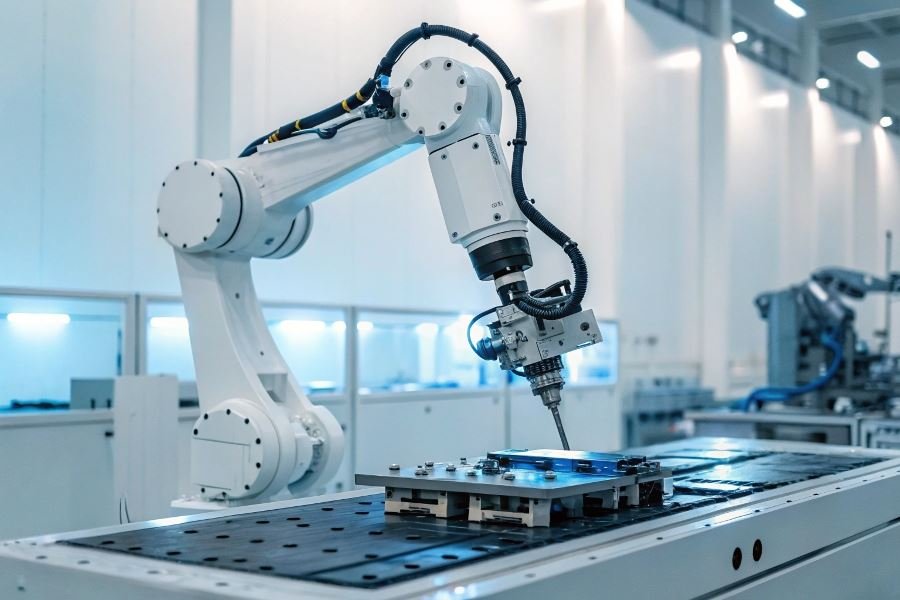
What if the machine that built your smartphone was smarter than the device itself? This isn’t science fiction—it’s the reality of modern industrial robotics, where precision, speed, and adaptability converge to transform production floors worldwide.
Industrial robots—automated, programmable machines designed to perform specific tasks with minimal human intervention—have evolved dramatically since Unimate, the first industrial robot, was installed at General Motors in 1961. What began as simple mechanical arms performing repetitive tasks has blossomed into sophisticated systems capable of complex operations, decision-making, and even learning.
The global industrial robotics market isn’t just growing—it’s exploding. With a market value exceeding $43 billion and projected annual growth rates of 10-12%, manufacturers across sectors are embracing automation at unprecedented rates. The automotive industry remains the largest adopter, but electronics, food processing, pharmaceuticals, and logistics are rapidly catching up.
The evolving ecosystem of industrial automation
Today’s industrial robot landscape features diverse players, from established giants to innovative startups. Companies like ABB, FANUC, and KUKA dominate with comprehensive portfolios, while newcomers like Rethink Robotics and Universal Robots disrupt the market with collaborative solutions designed to work alongside humans rather than replace them.
The most fascinating development isn’t just what these robots can do, but how they’re changing the manufacturing paradigm itself. Factories implementing robotics report productivity increases of 30-50%, while simultaneously improving product quality and workplace safety. The question for manufacturers is no longer if they should adopt robotics, but which solutions best match their specific operational needs.
The Robot Revolution: Mastering Industrial Automation
The manufacturing floor has transformed dramatically since the first Unimate robot arm appeared at General Motors in 1961. Today’s industrial landscape features a diverse ecosystem of specialized robots, each designed to excel at specific tasks. Understanding the various types of industrial robots, their applications, and selection criteria for different tasks has become essential knowledge for manufacturing leaders looking to optimize production lines and maintain competitive advantage.
Articulated Robots: The Manufacturing Workhorses
Articulated robots represent the most versatile and widely deployed category in industrial settings. With 4-7 rotary joints resembling a human arm, these mechanical marvels offer unparalleled flexibility.
Key capabilities:
- Rotational movement in multiple axes (typically 6)
- Payload capacity ranging from 3kg to over 2,000kg
- Reach envelope of 0.5m to 4.5m
Their jointed design allows articulated robots to navigate complex paths and access difficult areas, making them ideal for welding, painting, assembly, and material handling. However, their complexity comes with tradeoffs in precision (±0.1mm) compared to more specialized robots.
Selection factors: When evaluating articulated robots, focus on payload requirements, reach needs, and cycle time expectations. The ABB IRB series and KUKA KR series offer excellent options across various size categories.
SCARA Robots: Precision Assembly Champions
SCARA (Selective Compliance Assembly Robot Arm) robots excel where speed and precision matter most. Their distinctive design features rigid vertical movement with compliant horizontal motion.
Ideal applications:
- Electronic component placement
- Small parts assembly
- Pick-and-place operations
- Laboratory automation
With repeatability as precise as ±0.01mm, SCARA robots outperform articulated models in consistent, high-speed operations within a defined plane. Their cylindrical work envelope makes them perfect for assembly lines where vertical insertion tasks dominate.
| SCARA Characteristic | Typical Range |
|---|---|
| Payload capacity | 0.5kg – 20kg |
| Cycle times | 0.3s – 0.7s |
| Work envelope | Cylindrical |
| Axes | 3-4 |
Delta Robots: Speed Demons of Automation
When production demands lightning-fast movement, delta robots deliver unmatched performance. These spider-like machines use parallelogram linkages connected to a common base.
Performance highlights:
- Cycle times as low as 0.3 seconds
- Acceleration up to 15G
- Precision within ±0.1mm
Food packaging, pharmaceutical sorting, and high-speed pick-and-place operations benefit tremendously from delta robots’ velocity. The Fanuc M-3iA can execute over 200 picks per minute, though payload capacity rarely exceeds 8kg.
Cartesian/Gantry Robots: Linear Precision Masters
Cartesian robots (also called gantry robots) operate on three perpendicular axes using linear actuators. Their straightforward design creates a rectangular work envelope perfect for applications requiring simple, precise linear movement.
Application strengths:
- CNC operations
- 3D printing
- Large-scale material handling
- Pick-and-place over extended areas
These robots excel in applications where workspace coverage matters more than complex movement patterns. Their modular design allows for customization to specific workspace dimensions, though they typically require more floor space than other robot types.
Collaborative Robots: The Human-Machine Partnership
Collaborative robots (cobots) represent the newest frontier in industrial automation. Unlike traditional robots that operate in safety cages, cobots work alongside humans, combining mechanical precision with human problem-solving.
Safety features:
- Force/torque sensing to detect contact
- Rounded edges and padding
- Speed and separation monitoring
- Power and force limiting
The Universal Robots UR series pioneered this category, offering easy programming through intuitive interfaces. While cobots typically handle lower payloads (under 35kg) and operate at reduced speeds compared to traditional robots, they excel in flexible manufacturing environments where production requirements change frequently.
The Strategic Robot Selection Framework: Matching Capabilities to Business Needs
Decoding technical assessment criteria
Selecting the right industrial robot begins with a clear-eyed assessment of technical requirements. Payload capacity stands as the fundamental starting point—can the robot handle your materials? While a FANUC M-2000iA can hoist up to 2.3 tons, a collaborative Universal Robots UR3 manages just 3kg. This 760-fold difference illustrates why precision in requirement specification matters.
Reach considerations extend beyond simply “how far” to encompass the robot’s working envelope—the three-dimensional space where it operates effectively. For assembly operations in confined spaces, a SCARA robot with 500-800mm reach might be ideal, while automotive welding demands articulated robots with reaches exceeding 2 meters.
Speed and precision create an engineering balancing act. Delta robots excel at lightning-fast pick-and-place operations (up to 300 picks per minute) but sacrifice some positional accuracy. Meanwhile, articulated robots from ABB Robotics can achieve repeatability within ±0.02mm—critical for microelectronics but potentially overkill for palletizing applications.
Navigating implementation realities
Integration complexity varies dramatically based on your existing infrastructure. Brownfield implementations (adding robots to existing production lines) typically demand 30-40% more integration time than greenfield projects. The difference? Compatibility challenges with legacy systems and physical space constraints.
Programming requirements have evolved significantly. Traditional robots required specialized knowledge of proprietary languages like KUKA KRL or ABB RAPID. Modern systems increasingly offer intuitive interfaces:
| Programming Approach | Learning Curve | Flexibility | Best For |
|---|---|---|---|
| Teach pendants | Moderate | Limited | Repetitive tasks |
| Offline programming | Steep | High | Complex operations |
| Lead-through programming | Minimal | Moderate | Small businesses |
| No-code platforms | Very low | Limited | Standard applications |
Maintenance needs directly impact total cost of ownership. Articulated robots typically require preventive maintenance every 3,000-4,000 operating hours, while delta robots may need more frequent attention due to their high-speed operation. Factor in both scheduled maintenance and potential downtime costs when calculating true operational expenses.
Calculating the true return on investment
Cost factors extend well beyond the robot’s purchase price. A comprehensive ROI analysis includes:
- Initial hardware costs (typically 50, 000−150,000 for industrial robots)
- Integration expenses (often 1-3× the robot cost)
- Training requirements (40-80 hours per operator)
- Ongoing maintenance (3-7% of purchase price annually)
- Energy consumption (particularly relevant for high-payload applications)
Productivity gains materialize through multiple channels. Manufacturing operations implementing robotics typically report 20-30% throughput improvements, 15-25% reductions in material waste, and quality improvements that reduce rework by 25-35%. These figures vary significantly by application—pharmaceutical applications often see higher quality improvements, while automotive implementations may realize greater throughput gains.
Long-term value assessment requires looking beyond immediate metrics. The most successful implementations align robot capabilities with strategic business objectives rather than focusing exclusively on labor replacement. Robots excel at dangerous, dirty, and repetitive tasks, freeing human workers for higher-value activities that leverage creativity and problem-solving skills.
The most expensive robot is the one that doesn’t meet your requirements—regardless of its price tag.
Discover the complete guide to industrial robots, from articulated and SCARA to delta and collaborative models. Learn key selection criteria including payload capacity, precision, and ROI to optimize your manufacturing operations.
Discover the complete guide to industrial robots, from articulated and SCARA to delta and collaborative models. Learn key selection criteria including payload capacity, precision, and ROI to optimize your manufacturing operations.