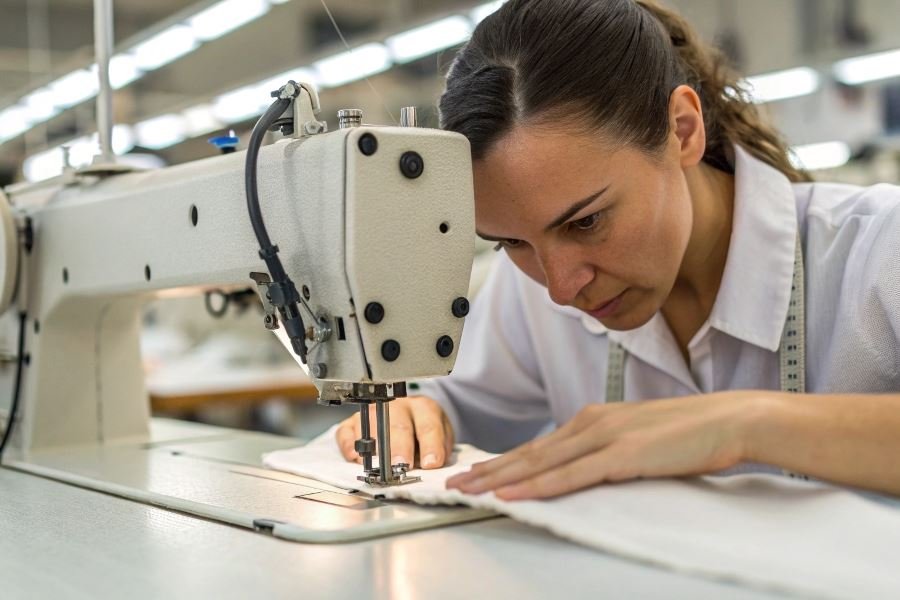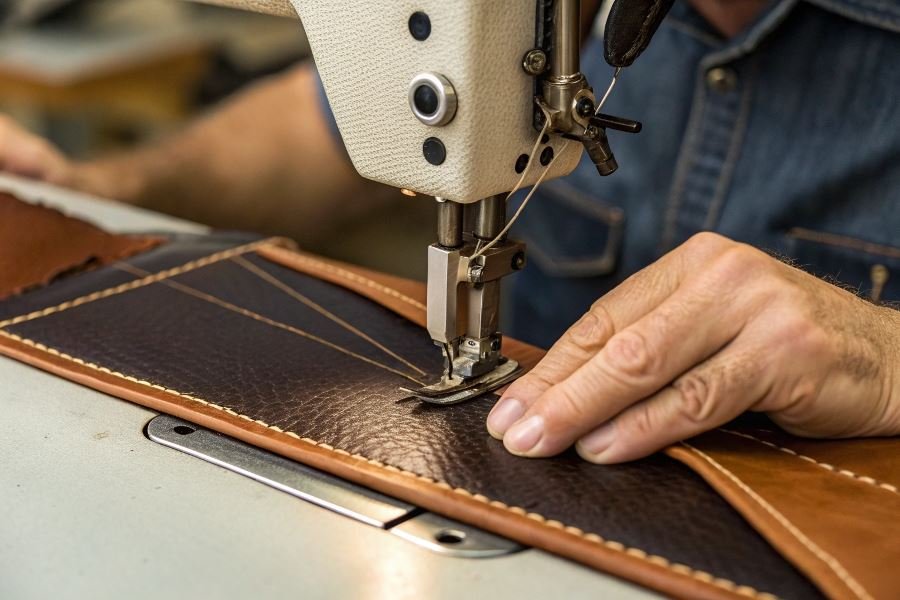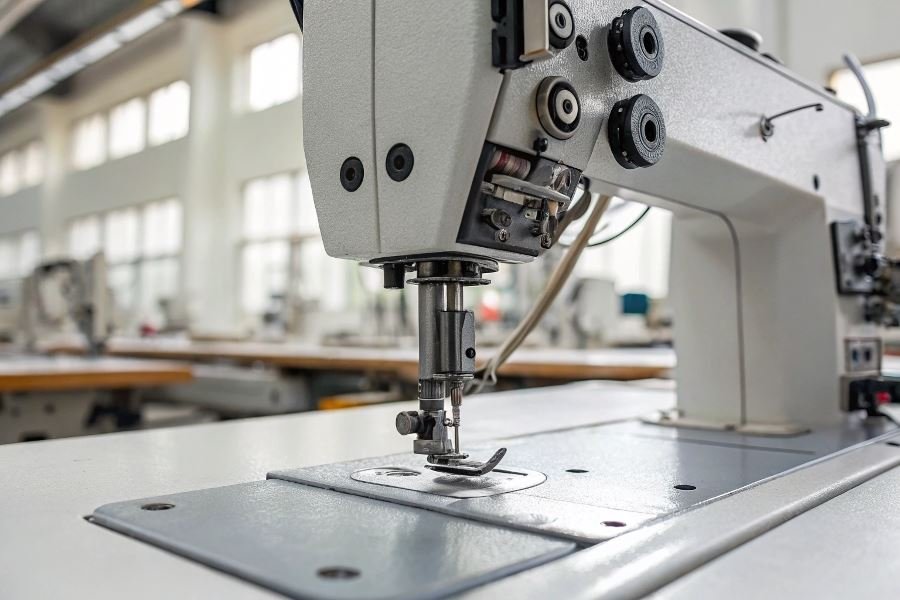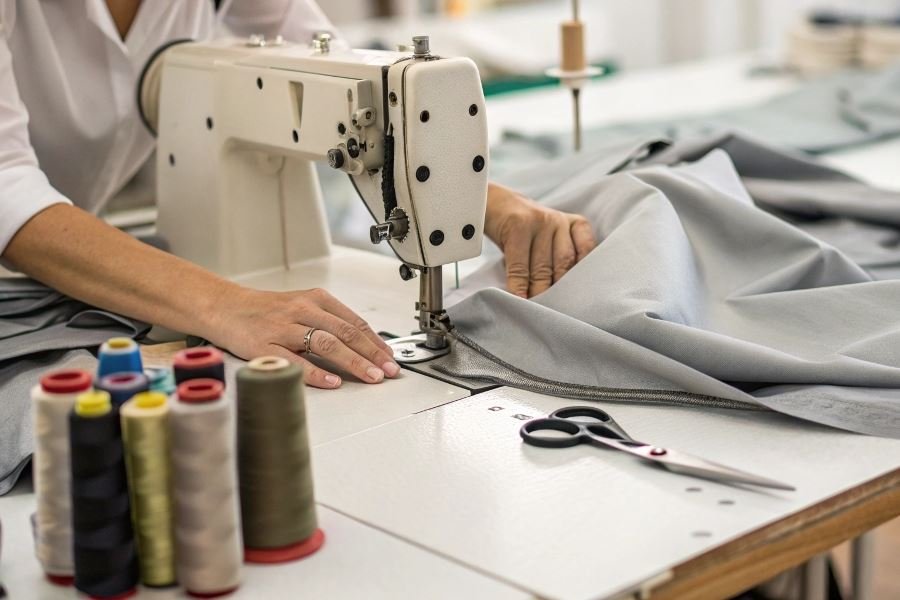
Ever watched a professional seamstress zip through thick denim like it’s silk? That’s not just skill—it’s industrial-grade machinery at work. While your trusty home machine might struggle through a few layers of canvas, industrial machines handle it without breaking a sweat.
Industrial sewing machines represent a significant leap forward for anyone serious about sewing professionally or pursuing ambitious projects. These powerhouses aren’t just faster versions of domestic machines—they’re purpose-built workhorses designed for specific tasks and continuous operation.
Domestic vs. industrial: More than just size
The differences between household and industrial machines go far beyond appearances:
| Feature | Domestic Machine | Industrial Machine |
|---|---|---|
| Motor power | 0.5-1 amp | 3-5 amp (up to 5× stronger) |
| Speed | 800-1,000 stitches/minute | 1,500-5,000 stitches/minute |
| Duty cycle | Intermittent use | Continuous operation |
| Construction | Plastic components | All-metal construction |
| Specialization | Multi-purpose | Task-specific |
Why invest in industrial equipment?
The benefits of upgrading to industrial equipment extend beyond raw power:
- Precision and consistency in stitching, even through challenging materials
- Dramatically increased productivity with speeds up to 5× faster
- Specialized functionality for specific operations (straight stitch, serging, buttonholes)
- Longevity measured in decades rather than years
- Repairability with readily available parts and simpler mechanical systems
Matching the machine to your mission
Before investing $800-2,500 in your first industrial machine, assess your specific needs:
- What materials will you primarily work with? Leather demands different capabilities than lightweight fabrics.
- Which operations do you perform most frequently? Straight stitching, overlocking, or specialized functions?
- What’s your workspace situation? Industrial machines require dedicated space and often cannot be easily moved.
- What’s your production volume? Higher output justifies greater investment.
The right industrial machine doesn’t just improve your output—it transforms your entire approach to creating.
Essential Features That Make Industrial Machines Beginner-Friendly
When transitioning from domestic to industrial sewing machines, the learning curve can feel like jumping from a bicycle to a motorcycle. The power, precision, and possibilities expand dramatically, but so does the complexity. Industrial sewing machines for beginners: where to start often becomes the burning question for those ready to elevate their craft or business. Let’s break down the essential features that make certain industrial machines more approachable for newcomers while still delivering professional results.
Motor Power and Speed: Finding Your Sweet Spot
Industrial machines pack serious muscle under the hood, but that doesn’t mean beginners should start with Formula 1 speeds.
Servo motors have revolutionized the beginner experience by offering:
- Precise speed control (from crawling to racing)
- Quieter operation than clutch motors
- Energy efficiency (uses power only when actively sewing)
- Needle positioning capabilities
A 550-750 watt servo motor provides the ideal balance for newcomers. This power range handles multiple fabric layers without struggling yet remains manageable when you’re developing control.
The ability to dial down to 10% speed while maintaining full torque is perhaps the most valuable feature for those just starting with industrial machines.
Traditional clutch motors (typically 1/2 HP) operate at full speed or nothing, making them challenging for precision work. If your machine comes with one, consider upgrading to a servo motor—it’s an investment in your learning curve and sanity.
Stitch Versatility: How Much Do You Really Need?
Industrial machines excel through specialization, unlike domestic all-in-ones. For beginners, the sweet spot lies in machines that offer:
- Straight stitch perfection – The foundation of industrial sewing
- Basic zigzag capability (if your projects require it)
- Simple stitch length adjustment
| Machine Type | Best For Beginners | Typical Applications |
|---|---|---|
| Lockstitch | ★★★★★ | Most general sewing, straight seams |
| Overlock | ★★★☆☆ | Seam finishing, knits, stretchy fabrics |
| Coverstitch | ★★☆☆☆ | Hems on t-shirts, athletic wear |
Single-needle lockstitch machines represent the ideal starting point—they’re the Toyota Corolla of industrial machines: reliable, straightforward, and capable of handling most tasks while you build confidence.
Top 3 Beginner-Friendly Industrial Machines
After testing dozens of models and consulting with sewing educators, these three consistently emerge as ideal entry points:
-
Juki DDL-8700 – The gold standard for beginners. This straight-stitch workhorse offers exceptional stitch quality with manageable learning requirements. Its widespread adoption means abundant tutorials and support exist online.
-
Brother S-7300A – Features a user-friendly direct-drive motor system that eliminates the intimidating belt setup. The automatic thread trimmer saves time while the digital control panel makes adjustments intuitive.
-
Consew 7360R – Offers remarkable value with a servo motor included standard. The walking foot design handles thicker materials like leather and canvas, making it versatile for crafters exploring different mediums.
Each of these machines balances industrial capability with features that flatten the learning curve. Remember that mastering one specialized machine thoroughly will advance your skills faster than struggling with complex multi-function equipment.
Setting Up Your Industrial Sewing Machine Like a Pro
You’ve taken the plunge and invested in an industrial sewing machine—congratulations! That powerful workhorse sitting in your workspace represents unlimited potential, but only if you set it up correctly. Let’s transform that intimidating piece of machinery into your most reliable business partner.
Creating the ideal workspace
Industrial sewing machines demand respect—and space. Unlike domestic machines, these powerhouses require:
- A dedicated area of at least 4×6 feet
- Reinforced flooring to handle 100+ pound machines
- Proper electrical capacity (typically 110V, but some require 220V)
- Noise reduction considerations for your sanity
Position matters tremendously. Place your machine perpendicular to a window for natural lighting without glare. The tabletop should sit at elbow height when seated to prevent back strain during those marathon sewing sessions.
The difference between amateur and professional results often begins with proper machine setup, not just sewing skill.
Industrial machines generate significant vibration. Consider investing in a Consew Industrial Table with built-in vibration dampening or add rubber isolation pads under standard tables. Your neighbors (and your precision work) will thank you.
Maintenance essentials every beginner must master
Industrial machines are remarkably reliable when maintained properly. Establish these habits from day one:
- Daily cleaning routine: Remove lint from bobbin area and feed dogs
- Weekly oil check: Most industrial machines require regular oiling
- Monthly belt inspection: Check tension and wear patterns
Never use compressed air to clean your machine—this forces debris deeper into mechanisms. Instead, use a soft brush and vacuum combination.
The maintenance learning curve pays dividends. A well-maintained Juki DDL-8700 can run for decades with minimal repairs, while neglected machines develop expensive problems within months.
Troubleshooting like a seasoned professional
When problems arise (and they will), approach them methodically:
| Problem | First Check | Second Check | Common Solution |
|---|---|---|---|
| Thread breaking | Tension settings | Thread path | Reduce upper tension |
| Skipped stitches | Needle type/size | Timing | Replace with correct needle |
| Uneven feeding | Feed dog height | Presser foot pressure | Adjust feed dog height |
| Machine noise | Oil levels | Belt tension | Apply oil to recommended points |
Document every adjustment you make. This creates a valuable troubleshooting history and prevents repeating unsuccessful fixes.
Learning resources worth your time
The industrial sewing community offers incredible support for beginners:
- Online tutorials: Sailrite’s YouTube channel offers exceptional industrial machine tutorials
- Manufacturer manuals: Download and print the complete manual for your specific model
- Local classes: Many fabric stores offer industrial machine workshops
- Industry forums: Connect with professionals facing similar challenges
Start with basic operations before attempting complex techniques. Master straight stitching, thread tension, and bobbin winding before moving to specialized operations.
Consider recording your practice sessions. Reviewing your technique often reveals inconsistencies invisible in real-time, accelerating your learning curve dramatically.
With proper setup, consistent maintenance, and quality learning resources, your industrial sewing machine will quickly transform from an intimidating investment into the foundation of your craftsmanship journey.
Discover the essential guide to industrial sewing machines for beginners. Learn key differences from domestic models, explore beginner-friendly features, and get expert setup advice to launch your professional sewing journey successfully.
Discover the essential guide to industrial sewing machines for beginners. Learn key differences from domestic models, explore beginner-friendly features, and get expert setup advice to launch your professional sewing journey successfully.