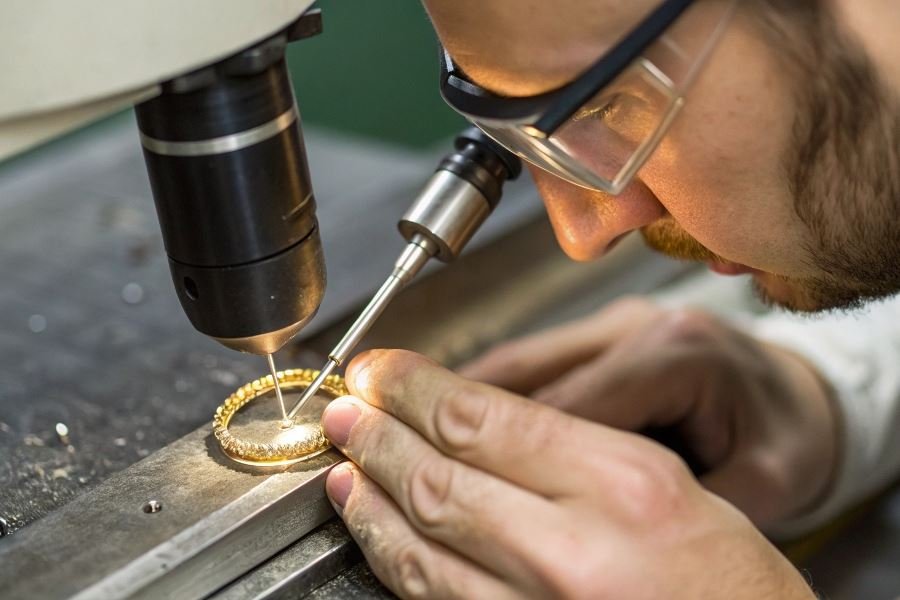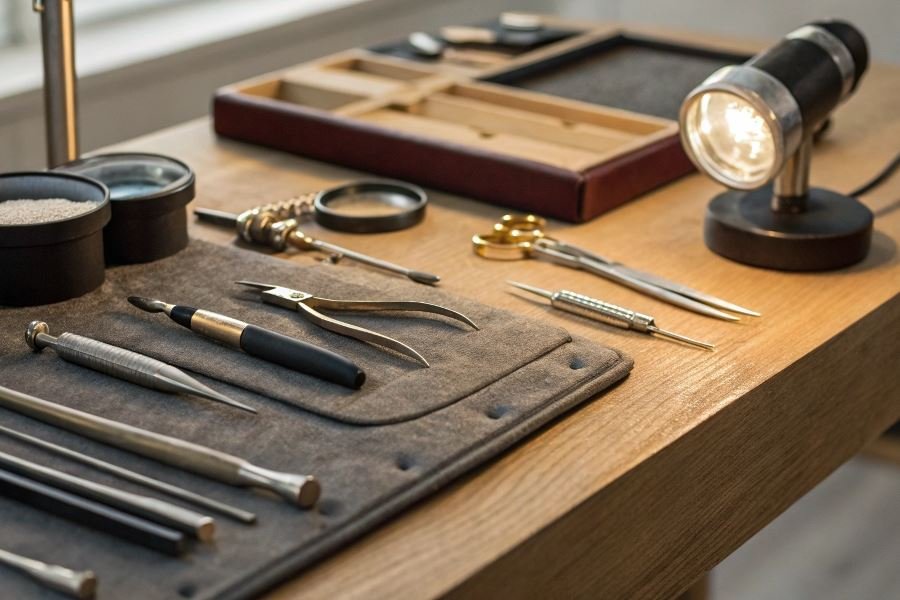
The difference between amateur trinkets and heirloom-quality jewelry often isn’t just skill—it’s the tools in your hands.
When master jeweler Thomas Gentille created his groundbreaking minimalist pieces in the 1970s, he didn’t begin with gemstones or precious metals—he started by assembling the perfect toolkit. This approach remains essential today. Building a jewelry workshop requires thoughtful investment in equipment that will serve as the backbone of your creative process for years to come.
Quality tools aren’t merely purchases; they’re partnerships. A precision-forged pair of pliers or a well-balanced hammer becomes an extension of your artistic vision, allowing you to translate imagination into tangible beauty. The finest jewelers can immediately feel the difference between standard and professional-grade equipment—in both the working experience and the finished product.
Before filling your shopping cart, assess which techniques will define your signature style. Metalsmithing requires different equipment than beadwork, while stone setting demands specialized tools unlike those needed for wire wrapping. Map your creative journey first, then acquire the tools that will take you there.
Smart budgeting doesn’t mean cutting corners—it means strategic allocation. Consider investing heavily in foundational items you’ll use daily (quality pliers, saw frames, and files), while being more conservative with specialized tools for techniques you’ll employ less frequently. Many jewelers find that a $200 investment in core tools yields better results than spreading the same amount across cheaper versions of everything.
Remember: exceptional jewelry begins with exceptional tools.
The Jewelry Maker’s Arsenal: Essential Tools for Success
Every jewelry workshop begins with a core set of hand tools that form the backbone of your creative process. Understanding which essential tools to prioritize can save you thousands of dollars and countless hours of frustration. Quality matters immensely in these everyday tools, as they’ll be in your hands for hours at a time.
Basic Hand Tools: The Foundation of Craftsmanship
Pliers: Your Extended Fingers
A comprehensive plier set should include at minimum:
- Chain-nose pliers for precise gripping and bending
- Round-nose pliers for creating loops and curves
- Flat-nose pliers for firm holding and straightening
- Nylon-jaw pliers for working with delicate materials without marking
Premium brands like Lindstrom and Swanstrom command higher prices ($75-150 per pair) but offer ergonomic handles and precision-machined jaws that maintain alignment even after years of use.
Files: Shaping Your Vision
Files come in various cuts (coarseness) and profiles:
- Needle files for detail work ($30-60 for quality set)
- Half-round files for curved surfaces ($15-25 each)
- Flat files for straight edges ($12-20 each)
- Escapement files for ultra-fine finishing ($40-80 for set)
Other Essential Hand Tools:
- Hammers for forming and texturing metal
- Mandrels for shaping rings and bracelets
Advanced Equipment for Metalworking
Torch Systems: Controlled Fire
The choice between torch systems significantly impacts your workflow:
- Butane torches: Portable and affordable ($30-75), ideal for small-scale work
- Propane/oxygen systems: Greater heat output for larger pieces ($200-500)
- Acetylene setups: Professional-grade heat control ($400-1000+)
Smith Little Torch remains the industry standard for precision work, offering exceptional flame control for delicate soldering tasks.
Kilns and Furnaces:
- Microkilns: Compact units for small components ($150-300)
- Programmable kilns: Digital temperature control for consistent results ($500-1500)
Safety note: Never compromise on ventilation systems and protective equipment. A proper extraction system prevents respiratory issues from flux fumes and metal particulates.
Measurement and Precision Tools
Accurate measurement tools ensure consistency and quality in every piece, marking the difference between amateur and professional jewelry.
Essential Measurement Tools:
- Digital calipers (Mitutoyo $120-180 or iGaging $40-60) for accuracy to 0.01mm
- Ring mandrels in stepped or tapered designs ($25-75)
- Metal thickness gauges for consistent material use ($15-30)
- Wire gauges with precision slots for measuring wire diameter ($20-40)
- Digital scales with 0.01g accuracy ($30-100) for pricing materials, consistent alloy mixing, and gemstone verification
The combination of these tool categories creates the foundation upon which all jewelry craftsmanship is built. Investing wisely in quality tools pays dividends in precision, efficiency, and the professional finish of your creations.
Smart Investments in Your Jewelry Workshop Toolkit
Quality vs price in the long game
Investing in jewelry tools is a balancing act between immediate costs and lasting value. Professional jewelers understand that the $200 premium pliers aren’t just a status symbol—they’re engineered to maintain precise alignment after thousands of uses, while the $30 alternatives might need replacement within months.
The true cost equation extends beyond the price tag. A quality Foredom flex shaft purchased for $350 might serve faithfully for 15+ years with minimal maintenance, averaging just $23 annually. Meanwhile, budget alternatives often require replacement every 2-3 years, ultimately costing more while delivering inferior performance.
The most expensive tool in your workshop is the one that fails when you need it most.
Consider German-made Gesswein files as an example. At $45-60 each, they significantly outprice imported alternatives, but their precision-cut teeth maintain sharpness through hundreds of hours of use, while cheaper files dull quickly and damage delicate workpieces.
Where the professionals shop
Finding reliable tools requires knowing where to look:
Specialty suppliers like Rio Grande and Otto Frei have built reputations on curating quality tools with knowledgeable customer service. Their catalogs offer everything from basic pliers to specialized stone-setting equipment.
Trade shows remain goldmines for discovering specialized tools and building relationships with suppliers. The annual JCK Las Vegas and MJSA Expo showcase innovations while offering show-special pricing.
Estate sales and retiring jewelers often yield vintage tools of exceptional quality. German and Swiss tools from the mid-20th century were frequently hand-finished to standards rarely matched today.
| Supplier Type | Advantages | Considerations |
|---|---|---|
| Specialty Retailers | Curated selection, expertise | Premium pricing |
| Trade Shows | Direct manufacturer access, demonstrations | Requires travel, annual events |
| Estate/Used | Exceptional quality, value pricing | Requires inspection, possible refurbishment |
| General Online | Convenience, competitive pricing | Variable quality, limited expertise |
Extending tool life through proper care
The finest tools become worthless without proper maintenance. Implementing these practices can triple the functional lifespan of your investment:
Daily cleaning routines prevent compound and metal dust accumulation. A simple wipe-down with mineral oil prevents rust on steel tools, while compressed air clears debris from mechanical components.
Dedicated storage solutions protect delicate edges and precision surfaces. Invest in tool rolls for files, lined drawers for pliers, and dust covers for machinery. The GRS BenchMate system exemplifies thoughtful organization that preserves tool integrity.
Regular maintenance schedules catch issues before they become failures. Lubricate moving parts quarterly, check electrical connections annually, and sharpen cutting edges at the first sign of resistance rather than waiting for obvious dullness.
Professional servicing for complex equipment pays dividends. Sending your Durston rolling mill for factory reconditioning every 5-7 years costs approximately $200-300 but ensures decades of precision performance.
By approaching tool acquisition strategically, sourcing from reputable suppliers, and implementing disciplined maintenance, your jewelry workshop becomes an appreciating asset rather than a recurring expense. The craftsperson who respects their tools produces work that commands respect in the marketplace.
Discover the essential jewelry-making tools every artisan needs before investing in workshop equipment. Learn about hand tools, soldering equipment, and precision instruments that deliver quality results and long-term value for your craft.
Discover the essential jewelry-making tools every artisan needs before investing in workshop equipment. Learn about hand tools, soldering equipment, and precision instruments that deliver quality results and long-term value for your craft.