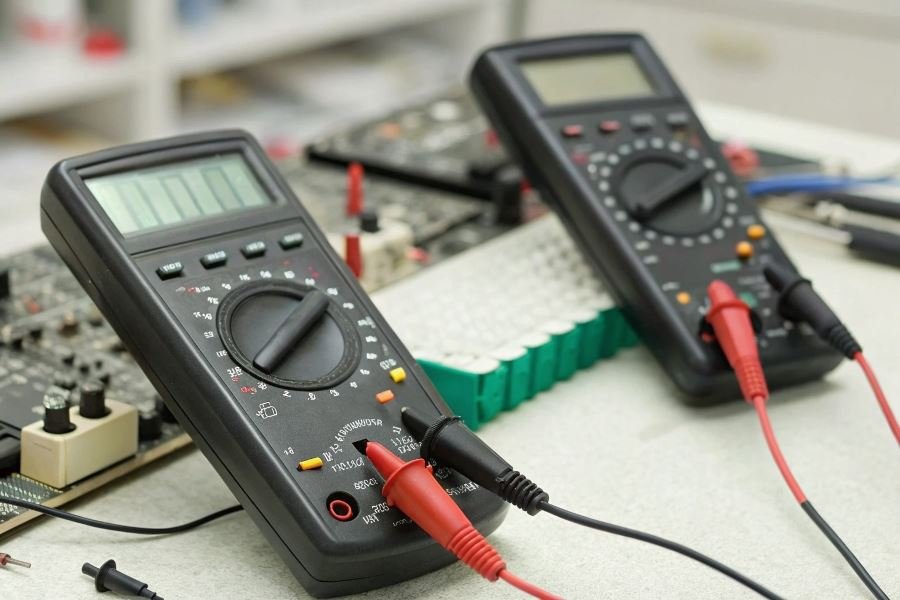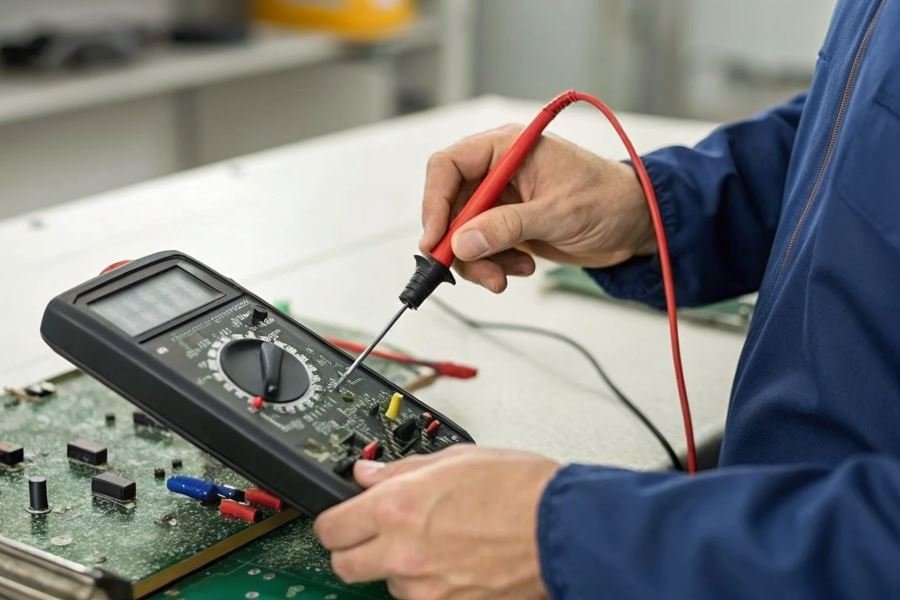
Ever wondered why some DIY electronics repairs succeed while others fail miserably? The difference often comes down to one critical tool: the humble voltmeter. This unassuming device holds the key to unlocking the mysteries behind malfunctioning circuits and components.
Properly using a voltmeter when diagnosing electronics isn’t just a skill—it’s an essential foundation for anyone serious about electronics repair or design. When voltage measurements are off by even a fraction, the consequences can range from misdiagnosis to component failure or even safety hazards.
Voltage measurement accuracy matters more than you think. Consider this: modern microprocessors operate with voltage tolerances of less than 5%—meaning a reading that’s off by just 0.2V could lead you down a completely wrong troubleshooting path. Your multimeter becomes your detective’s magnifying glass, revealing the invisible electrical currents that tell the true story of what’s happening inside your devices.
Today’s market offers three primary voltmeter types, each with distinct advantages:
- Digital multimeters (DMMs) provide precise numerical readings ideal for most electronics work
- Analog meters excel at observing gradual voltage changes and trends
- Oscilloscopes with voltage measurement capabilities offer visual representations of voltage over time—perfect for complex signal analysis
Safety first: Protecting yourself and your equipment
Before touching any circuit with your probes, remember that electricity demands respect. Always:
- Disconnect power sources when possible
- Use insulated probes rated for your application
- Keep one hand in your pocket when measuring high voltages to prevent current from crossing your heart
- Verify your meter’s functionality on a known voltage source before critical measurements
Master these fundamentals, and you’ll transform from frustrated tinkerer to confident electronics diagnostician faster than you might imagine.
Essential Voltmeter Techniques That Transform Your Electronics Diagnosis
When electrical problems arise in your devices, a voltmeter becomes your most trusted detective. Mastering this tool isn’t just about connecting probes—it’s about understanding the language of electricity. The difference between a novice and an expert technician often comes down to how they properly use a voltmeter when diagnosing electronics, transforming guesswork into precision.
Setting up your voltmeter for measurement success
Your diagnostic journey begins with proper setup. First, select a quality digital multimeter like the Fluke 117 or Klein Tools MM600 that offers both accuracy and safety features. Before any measurement:
- Inspect your meter and test leads for damage
- Select the appropriate function (voltage, resistance, continuity)
- Choose AC or DC measurement mode
- Set the range higher than your expected reading
Safety first: Always verify your meter’s CAT rating matches your application. For household electronics, CAT II 600V is typically sufficient, while industrial applications may require CAT III or IV ratings.
Never connect your meter to a circuit when set to measure current (amps) unless you’re measuring in series. This common mistake can damage both your meter and the circuit.
Measuring voltages with precision and purpose
DC voltage measurement technique
- Set your meter to DC voltage (⎓ or V with straight line)
- Connect the black probe to COM and red probe to V/Ω
- Touch the black probe to the negative/ground point
- Touch the red probe to the test point
- Read the display, noting both value and polarity
AC voltage measurement technique
- Set your meter to AC voltage (∿ or V with wavy line)
- Connect probes as with DC measurements
- Touch probes to the test points (polarity doesn’t matter for AC)
- Read the display, noting the RMS value
Pro tip: When measuring sensitive electronics, start with the highest range and work down to avoid overloading circuits with unexpected voltage levels.
Interpreting readings and avoiding measurement pitfalls
| Reading Type | What It Means | Possible Issues |
|---|---|---|
| Expected value | Circuit functioning normally | None |
| Zero volts | Open circuit or no power | Check power source, connections |
| Fluctuating reading | Intermittent connection | Look for loose connections |
| Lower than expected | Voltage drop or load issue | Check for resistance problems |
| Higher than expected | Regulation failure | Possible component failure |
The most common measurement errors stem from:
- Improper range selection: Too high means less precision; too low risks damage
- Poor probe contact: Always ensure solid connections to test points
- Loading the circuit: Digital meters have high impedance but can still affect sensitive circuits
- Ignoring reference points: Always measure relative to the correct ground or reference
- Misinterpreting AC vs DC: Using the wrong mode gives meaningless readings
Remember: Your voltmeter is only as accurate as your technique. When readings don’t make sense, question your method before questioning the circuit.
For intermittent issues, the Min/Max function on better meters captures fluctuations you might otherwise miss. For precision work, consider using the relative measurement mode (often labeled “REL”) to zero out test lead resistance or establish baseline readings.
By mastering these essential techniques, you’ll diagnose electronics problems with confidence and accuracy that separates professionals from amateurs.
Advanced Voltmeter Techniques That Transform Diagnostics
Diagnosing specific components with precision
When you move beyond basic voltage testing, your voltmeter becomes a surgical tool for component-level diagnosis. Capacitors, those workhorses of electronic circuits, reveal their health through voltage readings that tell a complete story. A healthy capacitor should show a quick charge followed by stable voltage retention. If your Fluke multimeter shows voltage dropping rapidly after charging, you’re looking at a leaky capacitor that needs replacement.
Transistors—the gatekeepers of electronic signals—require a methodical three-point check. Measure voltage between collector-emitter, base-emitter, and collector-base junctions. A properly functioning NPN transistor typically shows 0.6-0.7V between base-emitter when forward-biased. Deviations from expected values often indicate a failing transistor, saving you hours of troubleshooting downstream components.
Integrated circuits demand pattern recognition. By measuring voltage at each pin against the manufacturer’s specifications, you can identify exactly where signal processing breaks down. This pin-by-pin voltage mapping technique has rescued countless circuit boards from the scrap heap.
Combining diagnostic tools for complete analysis
The voltmeter shines brightest when paired with complementary tools. When your Keysight oscilloscope shows unusual waveforms, your voltmeter provides the exact DC offset causing the anomaly. This one-two diagnostic approach cuts troubleshooting time dramatically.
The voltmeter-logic analyzer partnership reveals timing-related voltage issues that neither tool could identify alone.
Consider this diagnostic workflow that professionals swear by:
| Diagnostic Step | Tool Combination | What It Reveals |
|---|---|---|
| Signal Integrity | Voltmeter + Oscilloscope | Voltage levels + waveform distortion |
| Logic Faults | Voltmeter + Logic Analyzer | Voltage thresholds + timing violations |
| Power Issues | Voltmeter + Thermal Camera | Voltage drops + heat signatures |
This multi-instrument approach transforms good diagnostics into great ones. When your Klein Tools voltmeter shows correct voltage but components still fail, thermal imaging often reveals the excessive heat signature of components operating at the edge of their specifications.
Professional techniques for voltmeter mastery
The floating measurement technique eliminates common-mode noise when measuring sensitive circuits. By isolating your voltmeter from ground, you measure only the differential voltage between test points. This approach is essential when diagnosing modern low-voltage digital circuits where noise can mask actual readings.
Voltage drop mapping systematically measures voltage across each component in a series circuit, creating a comprehensive picture of power distribution. When a circuit draws excessive current, this technique pinpoints exactly which component is causing the drain—often revealing issues that component-level testing misses.
The reference comparison method uses a known-good device as a benchmark. By simultaneously measuring identical points on both the suspect and reference devices, subtle voltage differences immediately highlight the problematic area. This technique cuts diagnostic time by 60% in complex circuits.
These advanced techniques transform your voltmeter from a simple voltage checker into a diagnostic powerhouse. The difference between basic testing and professional diagnosis isn’t the tool—it’s how you use it.
Learn essential voltmeter techniques for accurate electronics diagnosis. Master proper setup, measurement methods, and result interpretation to effectively troubleshoot circuits and components. Perfect for DIY repairs and professional diagnostics.
Learn essential voltmeter techniques for accurate electronics diagnosis. Master proper setup, measurement methods, and result interpretation to effectively troubleshoot circuits and components. Perfect for DIY repairs and professional diagnostics.