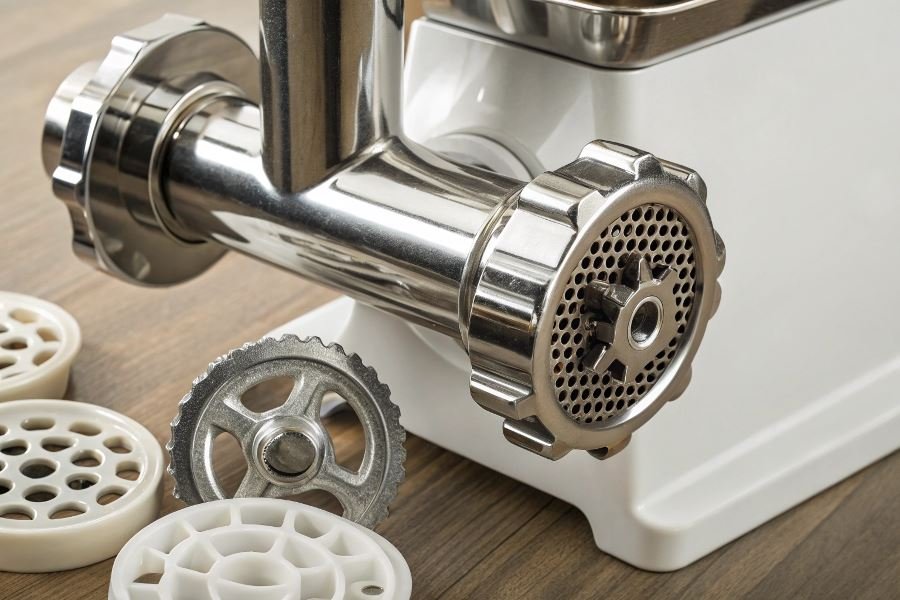
Ever wondered why some food processing operations consistently outperform their competitors? The secret often lies not in their marketing or even their recipes, but in something far more fundamental: their equipment efficiency calculations.
When it comes to meat processing, your grinder isn’t just a piece of equipment—it’s the heartbeat of your production line. A properly calibrated meat grinder operating at peak performance can be the difference between thriving and merely surviving in today’s competitive marketplace.
The foundation of operational excellence
Meat grinder performance directly impacts every aspect of your operation. From energy consumption to labor costs, from product consistency to maintenance schedules—all these factors ultimately affect your bottom line.
The most successful processors understand that a 5% improvement in grinder efficiency can translate to tens of thousands of dollars in annual savings.
Performance metrics that matter
To truly optimize your operation, focus on these critical indicators:
| Performance Indicator | Business Impact |
|---|---|
| Throughput rate (lbs/hour) | Production capacity and labor efficiency |
| Power consumption (kWh) | Operational costs and sustainability |
| Yield percentage | Raw material utilization and waste reduction |
| Downtime frequency | Maintenance costs and production reliability |
Calculation approaches for real-world applications
The most effective performance assessments combine quantitative measurements with qualitative evaluations. While throughput calculations provide hard numbers, factors like product texture consistency and equipment longevity require more nuanced assessment methods.
“The difference between good and great meat processing isn’t just in the equipment—it’s in knowing precisely how that equipment performs under your specific conditions.”
By establishing baseline measurements and implementing regular performance monitoring, you’ll gain the insights needed to make data-driven decisions that optimize your meat processing operation for maximum efficiency and profitability.
Essential Factors in Meat Grinder Performance
When calculating meat grinder performance for your enterprise, precision matters more than most business owners realize. The difference between optimal and suboptimal equipment can translate to thousands of dollars in operational costs annually.
Understanding meat grinder performance: how to calculate for your enterprise requires analyzing three critical factors that determine whether your processing line will hum with efficiency or become a bottleneck. Let’s dive into the metrics that separate industry leaders from those struggling to keep pace.
Matching Capacity to Enterprise Scale
Your processing capacity should align perfectly with your production needs—not too small to create bottlenecks, not too large to waste resources.
For small operations (processing under 500 pounds daily):
- 0.5-1 HP grinders with 200-400 lb/hr capacity typically suffice
- Batch processing approach works effectively
- Consider 20-25% capacity buffer for growth
Medium enterprises (500-2000 pounds daily) require more substantial equipment:
| Enterprise Size | Recommended Capacity | Ideal Motor Power | Buffer Capacity |
|---|---|---|---|
| Medium | 500-1000 lb/hr | 2-3 HP | 15-20% |
| Large | 1000-3000 lb/hr | 5-10 HP | 10-15% |
| Industrial | 3000+ lb/hr | 10+ HP | 5-10% |
Calculate your optimal capacity using this formula:
(Daily processing volume × 1.2) ÷ available processing hours = minimum hourly capacity needed
Power Consumption Calculations
Energy efficiency directly impacts your bottom line. Modern Hobart commercial grinders offer significantly better power-to-output ratios than older models.
The relationship between power consumption and output follows a predictable pattern:
- Base calculation: 0.75-1 kWh per 100 pounds of processed meat
- Efficiency factor: Newer models (post-2020) typically reduce consumption by 15-25%
- Material hardness multiplier:
- Soft meats (poultry): 0.8× base consumption
- Standard meats (beef/pork): 1× base consumption
- Frozen or tough cuts: 1.5-2× base consumption
Calculate your expected power costs by multiplying your hourly throughput by the appropriate consumption rate, then by your electricity cost per kWh.
Precision and Consistency Metrics
The uniformity of your ground product directly affects quality perception and cooking performance. Modern Biro grinders with precision-engineered plates deliver remarkable consistency.
Key precision measurements include:
- Particle size distribution (PSD)
- Premium products: 90%+ particles within ±10% of target size
- Standard products: 80%+ particles within ±15% of target size
- Temperature rise during processing
- Ideal: <5°F increase during grinding
- Acceptable: 5-10°F increase
- Problematic: >10°F increase (indicates friction issues)
- Protein extraction percentage
- Optimal: 12-15% for emulsified products
- Standard: 8-12% for most ground products
Measure consistency by taking samples at regular intervals throughout production runs. Calculate the standard deviation of particle sizes—lower numbers indicate better consistency. Industry leaders maintain deviation under 5% across production runs.
By properly calculating these three essential factors, you’ll ensure your meat grinding operation delivers the perfect balance of throughput, efficiency, and quality that today’s market demands.
Turning Numbers into Profit: Meat Grinder Performance Calculations
When production floor efficiency translates directly to your bottom line, meat grinder performance metrics become more than spreadsheet fodder—they become your competitive edge. Let’s dive into the practical implementation of performance calculations that transform theoretical knowledge into tangible business results.
Setting your performance baseline
Establishing baseline performance standards begins with comprehensive documentation of your current operations. The most successful meat processing enterprises track three critical metrics:
- Throughput rate – Measured in pounds per hour (lb/hr)
- Energy consumption – Kilowatt-hours per ton (kWh/ton)
- Yield percentage – Finished product weight divided by raw material input
A properly established baseline requires at least 30 days of consistent measurement. The Hobart 4146 commercial grinder, for instance, typically processes 25-35 lb/min under optimal conditions—but your specific performance may vary based on meat temperature, fat content, and blade sharpness.
The difference between mediocre and exceptional meat processing operations isn’t the equipment—it’s the rigor of their performance measurement systems.
Industry benchmarks provide crucial context for your numbers. The American Meat Institute suggests commercial grinders should maintain a minimum 92% yield with energy consumption below 75 kWh per ton of processed meat.
Monitoring protocols that drive continuous improvement
Developing robust monitoring protocols transforms one-time calculations into sustainable business advantages. Effective monitoring systems include:
Daily performance tracking
- Temperature readings at three processing stages
- Hourly throughput measurements
- Quality sampling at predetermined intervals
Weekly analysis sessions
- Cross-departmental review of performance data
- Identification of performance anomalies
- Adjustment of operational parameters
Monthly comprehensive assessment
- Trend analysis across all metrics
- Comparison against industry benchmarks
- Recalibration of performance targets
Modern monitoring has evolved beyond clipboards and spreadsheets. The ThermoWorks BlueTherm Duo enables continuous temperature monitoring with Bluetooth connectivity, while Marel production management software provides real-time performance dashboards.
The dollars and sense of performance improvements
Cost-benefit analysis transforms performance data into actionable business decisions. Consider this comparison of upgrade options for a medium-scale operation:
| Improvement Option | Implementation Cost | Annual Savings | ROI Timeframe |
|---|---|---|---|
| Blade replacement schedule | $1,200 | $4,800 | 3 months |
| Variable speed drive | $3,500 | $7,200 | 6 months |
| Full grinder upgrade | $22,000 | $15,000 | 18 months |
The most overlooked factor in equipment upgrade decisions is downtime cost. A Biro EMG-32 grinder installation typically requires 2-3 days of production interruption—representing 5, 000−8,000 in lost production for many operations.
Performance improvements deliver benefits beyond direct cost savings. Enhanced grinder efficiency typically results in:
- Reduced product variation leading to improved customer satisfaction
- Lower maintenance requirements freeing technical staff for other priorities
- Extended equipment lifespan delaying capital expenditure requirements
The most successful meat processing enterprises recognize that performance calculations aren’t merely technical exercises—they’re strategic business tools that drive profitability through operational excellence.
Discover how to accurately calculate meat grinder performance metrics for your enterprise. Learn essential throughput factors, efficiency benchmarks, and cost-effective monitoring protocols to optimize your food processing operations.
Discover how to accurately calculate meat grinder performance metrics for your enterprise. Learn essential throughput factors, efficiency benchmarks, and cost-effective monitoring protocols to optimize your food processing operations.