What if your storage system could boost productivity by 40%? The right rack solution isn’t just about storing inventory—it’s about transforming your entire operation.
Behind every successful business lies an often-overlooked hero: the storage system. Whether you’re managing a bustling warehouse, a retail stockroom, or a manufacturing facility, how you organize your space directly impacts your bottom line. The choice between mobile and stationary racks represents a critical decision point that can either streamline operations or create costly bottlenecks.
The foundation of business efficiency
Storage systems do far more than hold products—they orchestrate your entire workflow. A well-designed rack system reduces picking times, minimizes employee fatigue, and maximizes valuable floor space. According to industry research, optimized storage solutions can reduce order fulfillment times by up to 30% and improve inventory accuracy by 25%.
Mobile vs. stationary: The fundamental divide
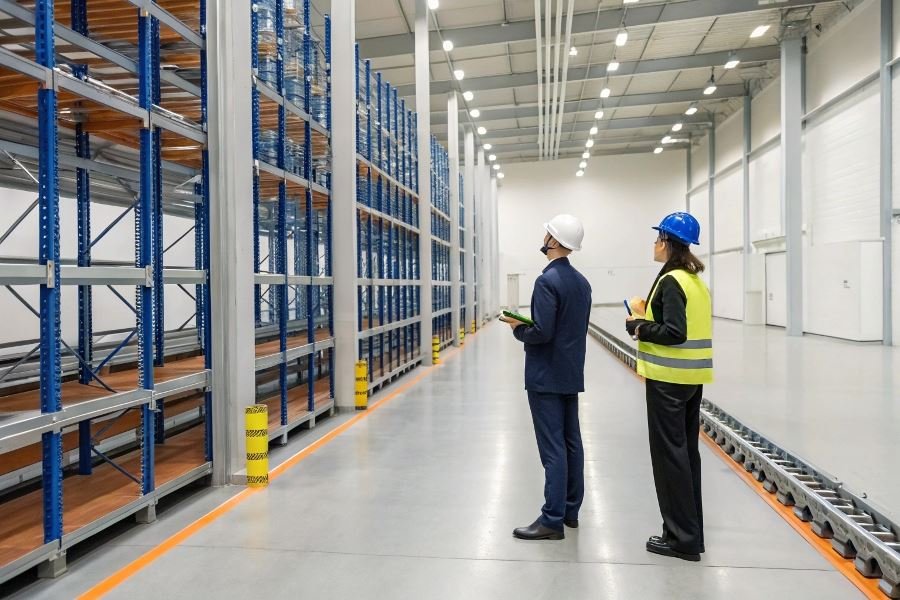
Mobile rack systems operate on tracks or wheels, allowing entire shelving units to move laterally, eliminating fixed aisles. This creates a compact footprint where only one operational aisle is needed at any time.
Stationary rack systems, by contrast, remain fixed in place, offering immediate access to all inventory but requiring permanent aisles between each rack.
The difference isn’t merely structural—it’s philosophical. Mobile systems prioritize space efficiency, while stationary systems emphasize accessibility and simplicity.
Matching solutions to business realities
Your ideal storage solution depends on several factors:
- Space constraints: Limited square footage favors mobile systems
- Access frequency: High-turnover inventory benefits from stationary accessibility
- Budget considerations: Initial investment vs. long-term space savings
- Growth projections: How your storage needs might evolve over time
The most successful businesses don’t just select storage systems—they strategically deploy them as competitive advantages.
Operational Factors That Define Your Storage Solution
When evaluating storage solutions for your warehouse or facility, the decision between mobile and stationary racks represents a critical operational choice that impacts everything from your bottom line to daily workflow efficiency. The right racking system can transform your operations, while the wrong choice might constrain your business for years.
Let’s dive into the operational factors that should guide your decision-making process when comparing mobile vs stationary racks: what to choose for your business depends largely on your specific operational requirements, space constraints, and long-term growth plans. Each system offers distinct advantages that must be carefully weighed against your unique business needs.
Space Utilization That Transforms Operations
Mobile racking systems deliver remarkable space efficiency, typically reducing your storage footprint by 40-50% compared to conventional stationary racks. This dramatic space recovery occurs because mobile systems eliminate multiple fixed aisles, requiring only a single movable aisle that provides access to inventory as needed.
For perspective:
- A 10,000 sq ft warehouse using stationary racks might accommodate 800 pallet positions
- The same space with mobile racking could house 1,200+ pallet positions
This efficiency translates directly to operational savings:
| Metric | Stationary Racks | Mobile Racks |
|---|---|---|
| Floor Space Required | 100% (baseline) | 50-60% |
| Storage Capacity | 100% (baseline) | 160-200% |
| Rent/Sq Ft Efficiency | Standard | Up to 2x better |
Accessibility and Retrieval Dynamics
While stationary racks excel in immediate access speed, mobile systems prioritize storage density with a modest trade-off in retrieval time.
Stationary racks provide constant, simultaneous access to all inventory positions—ideal for high-velocity operations where seconds count. Every pallet location remains accessible without mechanical movement, supporting rapid picking operations and high-throughput environments.
Mobile racks require opening the appropriate aisle before retrieval, adding 15-45 seconds to each access cycle. However, modern systems from providers like Spacesaver feature programmable controls that can pre-position aisles during downtime, minimizing wait periods during peak activity.
Structural Requirements and Facility Integration
Installation complexity varies significantly between these systems:
Stationary racks typically require:
- Standard concrete flooring (3,000-4,000 PSI)
- Minimal structural modifications
- Straightforward installation (often 2-5 days)
Mobile systems demand:
- Reinforced flooring (often 4,000+ PSI)
- Precisely leveled surfaces (±0.125″ tolerance)
- Rail installation and electrical work
- Extended installation timeframes (7-14 days)
Facilities with irregular floors, limited load-bearing capacity, or frequent layout changes may find stationary systems more accommodating. Conversely, purpose-built or newly renovated spaces can be optimized for mobile systems from the outset.
Investment Profile and Long-term Returns
The financial equation balances higher upfront costs against long-term spatial efficiency:
Mobile racking systems typically command a 40-60% premium in initial investment compared to stationary alternatives. However, this differential often reaches breakeven within 2-4 years through:
- Reduced real estate requirements
- Lower utility costs (heating/cooling smaller spaces)
- Increased storage capacity without facility expansion
- Enhanced inventory protection (fewer handling incidents)
Businesses in high-rent districts or those facing imminent expansion needs typically see the fastest ROI from mobile systems, while operations with abundant affordable space may benefit more from stationary solutions.
The ultimate choice hinges on aligning your storage infrastructure with both current operational demands and future growth trajectories.
Making the Final Decision: Mobile vs Stationary Racks
Industry Success Stories That Speak Volumes
The warehouse revolution isn’t theoretical—it’s happening right now across multiple sectors. In manufacturing, Toyota implemented mobile racking systems that reduced their warehouse footprint by 40% while increasing inventory capacity by 35%. The automotive giant’s transition took just 8 weeks from planning to full operation.
Meanwhile, pharmaceutical distributor McKesson opted for high-density stationary racks with advanced picking technology, achieving 99.9% inventory accuracy—critical in their regulated environment. Their decision hinged on the need for absolute stability and precise inventory control.
The warehouse decision isn’t just about storage—it’s about competitive advantage. Companies that optimize their racking systems report an average 27% increase in operational efficiency.
Food distributors face unique challenges with temperature control and expiration dates. Sysco deployed a hybrid solution: mobile racks in freezer zones (maximizing expensive cold storage space) and stationary systems in ambient areas. This strategic combination delivered $2.3 million in annual energy savings while extending product shelf life.
Future-Proofing Your Storage Investment
Scalability separates good storage decisions from great ones. Mobile racking systems offer superior adaptability—Spacesaver systems can increase capacity by up to 50% without expanding your building footprint. When e-commerce fulfillment company ShipBob experienced 300% growth in three years, their mobile racking investment scaled without requiring facility relocation.
Stationary systems excel when your product mix remains consistent. Unarco selective rack installations allow for modular expansion, with businesses typically adding 15-20% capacity annually without disrupting operations.
Consider these future-proofing factors:
| Consideration | Mobile Advantage | Stationary Advantage |
|---|---|---|
| Space Flexibility | Reconfigurable in hours | Fixed but highly stable |
| Growth Capacity | 40-50% more storage potential | Easier vertical expansion |
| Technology Integration | Supports automation retrofits | Better suited for immediate robotics |
| ROI Timeline | 2-3 year payback on space savings | 1-2 year payback on operational speed |
Transition Without Disruption
Implementation timelines vary dramatically based on system complexity. Stationary rack installations typically complete in 2-4 weeks, while mobile systems require 4-8 weeks due to rail installation and testing.
Smart businesses implement in phases. Office supply giant Staples maintained 99% fulfillment rates during their warehouse transformation by converting one zone at a time, using temporary overflow storage during transitions.
The operational learning curve also differs. Mobile rack systems require 1-2 weeks of staff training on safety protocols and mechanical operation. Stationary systems focus training on efficient picking paths, typically requiring just 2-3 days before reaching optimal productivity.
Finding Your Perfect Rack Partner
For enterprises with complex needs, SSI Schaefer offers comprehensive mobile and stationary solutions with advanced warehouse management integration. Their customization capabilities shine for businesses handling 10,000+ SKUs.
Mid-sized operations often find Interlake Mecalux provides the ideal balance of customization and cost-effectiveness. Their hybrid solutions allow businesses to start with stationary racks and convert high-density areas to mobile systems as needs evolve.
Smaller businesses with growth ambitions should consider Ridg-U-Rak, whose modular systems start at under $10,000 and can expand incrementally. Their consultation process includes free space planning and 3D visualization—invaluable for businesses making their first significant warehouse investment.
The perfect racking solution aligns with your operational reality today while accommodating your growth trajectory tomorrow. The most successful implementations aren’t just about hardware—they’re strategic decisions that transform storage from a necessity into a competitive advantage.
Discover the optimal storage solution for your business needs with our comprehensive comparison of mobile vs stationary racks. Learn about space efficiency, accessibility, ROI, and industry-specific applications to make an informed investment decision.
Discover the optimal storage solution for your business needs with our comprehensive comparison of mobile vs stationary racks. Learn about space efficiency, accessibility, ROI, and industry-specific applications to make an informed investment decision.