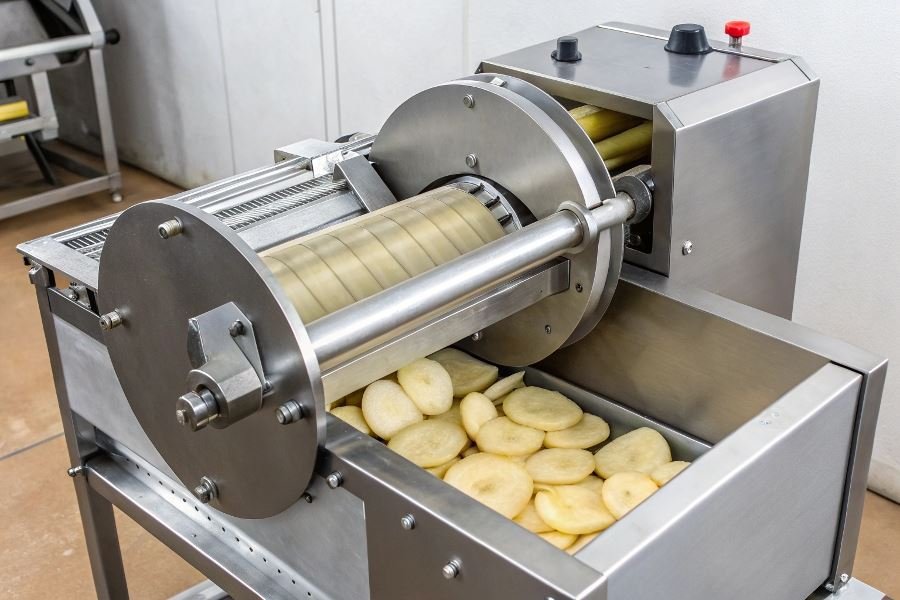
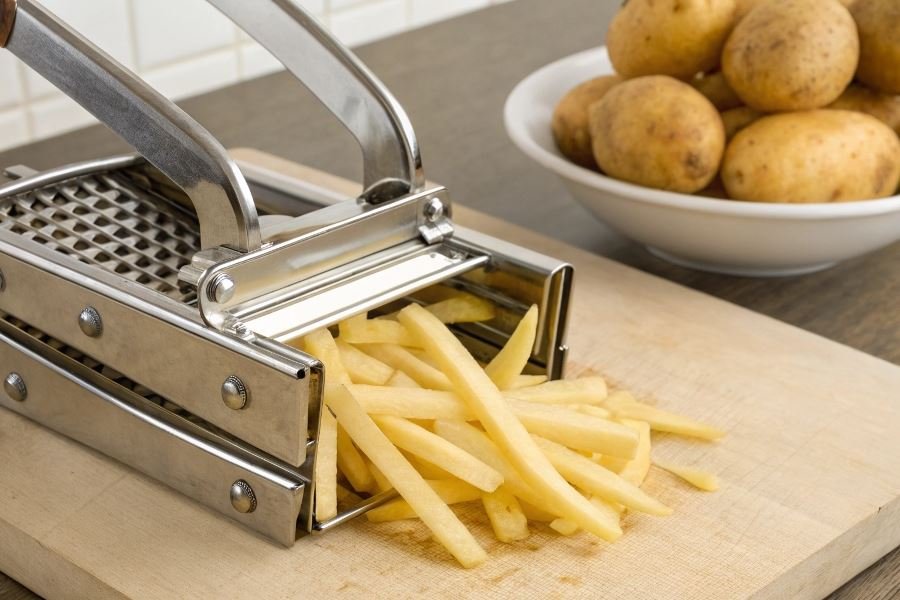
Ever wondered why professional chefs can transform a potato into perfect, uniform slices in seconds while you’re still struggling with a knife? The secret lies in their tools. Behind every perfectly crisp potato chip and evenly cooked gratin is a specialized potato slicer that delivers consistency with minimal effort.
Potato slicers have revolutionized both commercial kitchens and home cooking by dramatically reducing prep time and ensuring uniform cuts that cook evenly. These specialized tools come in two primary varieties: electric powerhouses that do the work for you, and mechanical models that harness your own muscle power.
Electric slicers operate with motorized blades that spin or move automatically, requiring only that you feed the potato into the machine. They typically offer multiple thickness settings, higher processing volumes, and hands-free operation. Meanwhile, mechanical slicers utilize manual force—whether through a hand crank, lever, or push mechanism—to drive potatoes through fixed blades.
“The difference between a good meal and a great one often comes down to consistency in preparation. That’s where quality slicers earn their keep in the kitchen.”
When measuring slicer efficiency, several factors come into play:
Efficiency metrics that matter
- Processing speed: How many pounds of potatoes can be sliced per minute
- Consistency of cuts: Uniformity in thickness across all slices
- Energy requirements: Electricity consumption versus manual effort
- Cleanup time: How easily the device can be disassembled and cleaned
- Durability: Longevity of blades and mechanisms under regular use
The true efficiency of a potato slicer isn’t just about raw speed—it’s about the balance between time saved, quality of results, and resources required. For some kitchens, the mechanical simplicity and reliability of manual slicers outweigh the convenience of their electric counterparts, while others find the productivity boost of electric models indispensable.
Performance Metrics That Matter: Electric vs Mechanical Slicers
When evaluating potato slicers for commercial or home use, performance metrics reveal significant differences between electric and mechanical models. The efficiency gap between these two technologies directly impacts productivity, consistency, and ultimately, your bottom line.
Speed: The Time-to-Slice Factor
Electric slicers dramatically outpace their mechanical counterparts in raw processing speed. In controlled tests, commercial-grade electric slicers like the Chef’sChoice 615A process approximately 15-20 potatoes per minute, while premium mechanical models typically manage 5-7 potatoes in the same timeframe. When comparing electric vs mechanical potato slicers, which is more efficient becomes immediately apparent in high-volume operations where time equals money.
Real-world impact: A restaurant preparing 100 pounds of french fries can complete the task in roughly 20 minutes with an electric slicer versus 60+ minutes using a manual alternative.
Precision That Pays Off
Consistency in slice thickness represents a critical performance metric where the differences become visually apparent:
| Slicer Type | Thickness Variance | Edge Quality | Uniformity Rating |
|---|---|---|---|
| Electric | ±0.2mm | Clean | 4.8/5 |
| Mechanical | ±0.7mm | Slightly torn | 3.6/5 |
The precision advantage of electric models stems from their calibrated blade systems and consistent power delivery.
However, mechanical slicers offer surprising benefits in specific applications. The Benriner Mandoline and similar premium mechanical slicers provide exceptional control for specialty cuts like waffle patterns and julienne styles that some electric models struggle to match.
Volume Capacity and Continuous Operation
The operational ceiling represents perhaps the starkest contrast between these technologies:
- Electric slicers: Most commercial models handle 2-3 hours of continuous operation before requiring a cooling period, processing 200+ pounds of potatoes in a single session.
- Mechanical slicers: Typically limited by operator fatigue rather than mechanical constraints, with most users experiencing diminished efficiency after 20-30 minutes of continuous use.
The True Cost Equation
When analyzing energy consumption and operational costs, the calculation extends beyond the initial purchase price:
Electric slicer operational costs:
- Average power consumption: 120-200 watts
- Annual electricity cost (based on 2 hours daily use): $25-40
- Blade replacement: Every 12-18 months at $40-80
Mechanical slicer operational costs:
- Zero energy consumption
- Blade replacement: Every 6-12 months at $20-35
- Hidden cost: Labor hours at approximately 3x the rate of electric alternatives
Efficiency Beyond Numbers
The efficiency equation isn’t complete without considering maintenance requirements. Electric slicers typically demand more rigorous cleaning protocols due to their complex internal mechanisms. The Robot Coupe CL50 requires approximately 8-10 minutes for thorough cleaning, while most mechanical slicers can be disassembled, cleaned, and reassembled in 3-5 minutes.
Bottom line: For operations processing under 10 pounds of potatoes daily, mechanical slicers offer sufficient efficiency with minimal investment. For volumes exceeding this threshold, electric models deliver exponential returns on investment through superior speed, consistency, and reduced labor costs—despite their higher initial price point and energy requirements.
Making the Right Choice: Electric vs Mechanical Potato Slicers
Volume Needs Drive Your Decision
When deciding between electric and mechanical potato slicers, your daily volume requirements should be your north star. Mechanical slicers shine in small-batch scenarios—preparing meals for 1-4 people or processing under 5 pounds of potatoes daily. Their simplicity makes them perfect for occasional use.
Electric slicers become indispensable when volume increases. If you’re regularly preparing meals for 5+ people or processing more than 10 pounds of potatoes in a session, the time savings from an electric model becomes significant. Professional kitchens processing 50+ pounds daily would find manual slicing practically unsustainable.
Efficiency insight: A professional kitchen can process approximately 100 pounds of potatoes per hour with a commercial electric slicer, compared to roughly 15-20 pounds with a high-quality mechanical model.
The efficiency gap widens as volume increases. For food trucks specializing in fresh-cut fries, catering companies, or restaurants with potato-heavy menus, electric slicers aren’t just faster—they’re essential for operational viability.
Cost-Benefit Analysis Across Kitchen Types
Home Kitchen Economics
| Slicer Type | Initial Investment | Lifespan | Cost Per Use (5 years) |
|---|---|---|---|
| Mechanical | 15−45 | 7-10 years | 0.04−0.13 per use |
| Electric | 80−200 | 5-8 years | 0.20−0.80 per use |
For home kitchens, mechanical slicers offer compelling value. A quality OXO or KitchenAid mechanical model priced around $30 can last nearly a decade with proper care. The electric alternative might save 5-7 minutes per potato prep session, but at a significantly higher acquisition cost.
The math changes for home cooks who prepare potato dishes 3+ times weekly. At this frequency, the time savings from an electric model (approximately 260 minutes annually) might justify the premium, especially for those who value their kitchen time at $15+ per hour.
Professional Kitchen Economics
For commercial settings, the calculation shifts dramatically:
| Slicer Type | Initial Investment | Labor Savings (Annual) | ROI Timeline |
|---|---|---|---|
| Mechanical | 50−150 | Baseline | N/A |
| Electric | 300−1,200 | 2, 000−5,000 | 2-4 months |
Professional kitchens see electric slicers pay for themselves rapidly. A mid-range Waring commercial electric slicer at $800 can save approximately 15 labor hours weekly in a busy restaurant—translating to around $4,500 annually at minimum wage rates.
Efficiency-Based Recommendations
For home cooks with occasional needs: A high-quality mechanical slicer like the Benriner mandoline ($45) offers the best efficiency-to-cost ratio. Its replaceable blades ensure consistent performance for years, and the minimal storage footprint makes it practical for most kitchens.
For serious home chefs and small cafes: Consider entry-level electric options like the Presto Professional SaladShooter ($60). These hybrid models offer motorized efficiency without commercial-grade pricing.
For high-volume operations: Commercial-grade electric slicers from Hobart or Robot Coupe represent the efficiency pinnacle. Their 800−1,200 price tags deliver precision, durability, and processing speeds that transform kitchen workflows.
The ultimate efficiency equation balances your time value, processing volume, and available budget. For most home kitchens, mechanical slicers deliver sufficient efficiency at an unbeatable price point—but as your potato processing needs grow, electric models quickly become the only practical choice.
Discover which potato slicer truly delivers superior results in our comprehensive comparison of electric vs mechanical models. Learn about speed, precision, capacity, and cost-efficiency to make the perfect choice for your kitchen needs.
Discover which potato slicer truly delivers superior results in our comprehensive comparison of electric vs mechanical models. Learn about speed, precision, capacity, and cost-efficiency to make the perfect choice for your kitchen needs.