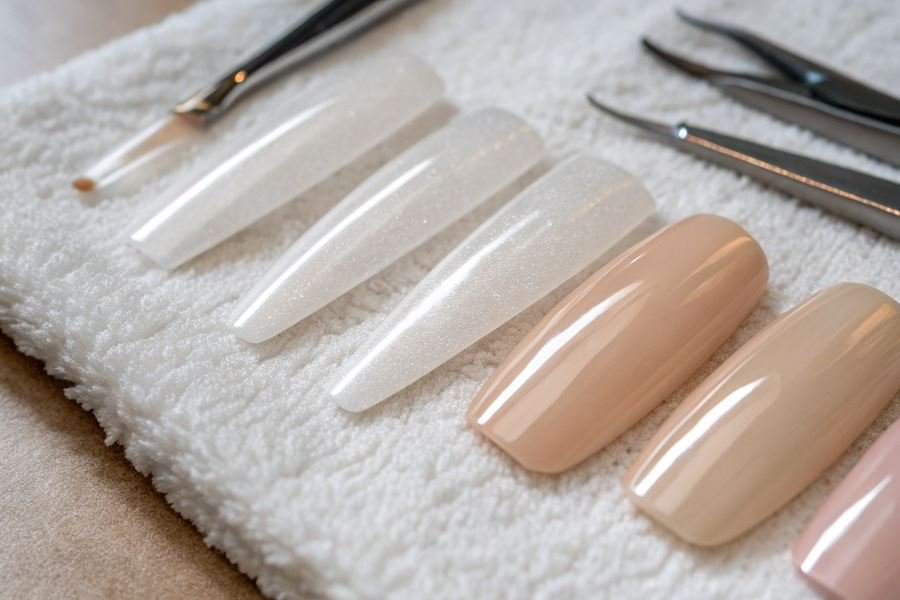
Ever wondered why some extensions look seamlessly natural while others scream “artificial”? The secret often lies not in the extension itself, but in that tiny component many overlook: the tip.
Extension tips have undergone remarkable transformation since their commercial introduction in the 1980s. What began as basic connectors has evolved into sophisticated application tools engineered for precision, comfort, and longevity. Today’s professional extension tips are marvels of design, with shapes and sizes specifically calibrated to achieve different aesthetic outcomes and address unique client requirements.
“The right extension tip can mean the difference between a satisfied client who returns for years and one who never comes back,” notes industry veteran Sarah Kline, who has witnessed the evolution firsthand.
The relationship between tip characteristics and application quality is both direct and profound. Tip shape—whether flat, round, oval, or pointed—determines how extensions bond with natural material and how weight distributes across the application area. Size affects precision and coverage, with smaller tips allowing for detailed work in tight spaces while larger ones enable faster application across broader surfaces.
When selecting extension tips for specific client needs, three factors reign supreme:
- Material compatibility – Different base materials require specific tip designs for optimal adhesion
- Desired outcome – Natural-looking results often demand different tips than dramatic styles
- Client lifestyle – Active clients need tips designed for durability under stress
Understanding these fundamentals transforms extension application from mere technical work into an art form that delivers consistently exceptional results tailored to each unique client.
The Ultimate Guide to Extension Tips: Shape, Size, and Material Mastery
When professionals discuss the tools of their trade, few elements generate as much passionate debate as extension tips. These seemingly simple components dramatically influence precision, efficiency, and final results across numerous applications. The right tip transforms a good technique into an exceptional one, while the wrong choice can undermine even the most skilled hands.
A comprehensive comparison of tips for extension: shapes, sizes, and application features reveals that these components aren’t merely accessories—they’re essential performance determinants. Whether you’re applying specialized coatings, adhesives, or decorative elements, understanding the nuanced differences between tip variations can elevate your work from acceptable to extraordinary.
Round vs. Flat vs. Angled: The Shape Showdown
Round tips excel in controlled, precise applications where consistent flow matters. Their uniform distribution pattern makes them ideal for:
- Spot treatments requiring pinpoint accuracy
- Circular pattern applications
- Even distribution across small areas
Flat tips dominate when coverage is paramount. Their broader surface area delivers:
- 40% faster coverage on large, flat surfaces
- Streak-free application on horizontal planes
- Superior performance on textured substrates
Angled tips bridge the gap between precision and coverage, offering versatility for complex projects. Their asymmetrical design provides access to difficult corners and edges while maintaining reasonable coverage rates.
Size Matters: Speed vs. Detail Tradeoffs
| Tip Size | Application Speed | Detail Capability | Ideal Use Case |
|---|---|---|---|
| Micro (0.5-1mm) | Very Slow | Exceptional | Fine detail work, repairs |
| Small (1-2mm) | Slow | Excellent | Precision applications |
| Medium (2-4mm) | Moderate | Good | General purpose work |
| Large (4-6mm) | Fast | Limited | Coverage of large areas |
| Extra Large (6mm+) | Very Fast | Minimal | Broad surface coating |
The relationship between tip size and application speed isn’t merely linear—it’s exponential. Doubling tip diameter can quadruple coverage rate, but at the cost of precision control. For detail work requiring sub-millimeter accuracy, micro tips remain unmatched despite their slower application rate.
Material Differences: The Unsung Heroes
The composition of extension tips dramatically affects their performance characteristics:
Silicone-based tips provide:
- Superior flexibility for contoured surfaces
- Excellent chemical resistance
- Reduced product waste through non-stick properties
Metal-alloy tips deliver:
- Unmatched durability (lasting up to 5x longer than alternatives)
- Consistent performance under high pressure
- Precision that doesn’t degrade over time
Composite tips blend attributes from multiple materials, offering balanced performance for specialized applications. Their hybrid construction addresses specific challenges like temperature sensitivity or unusual substrate interactions.
The material selection becomes particularly critical when working with aggressive compounds or when tip longevity directly impacts production efficiency. While premium materials command higher prices, their extended lifespan and superior performance characteristics typically deliver better long-term value.
Understanding these fundamental differences empowers professionals to select the optimal extension tip configuration for each specific application, ensuring consistent results and maximum efficiency.
Expert Recommendations for Extension Tip Mastery
Winning Combinations for Every Skill Level
The difference between amateur and professional results often comes down to having the right extension tip combinations. For beginners, the round tip in 1.5mm size paired with a medium-flow valve and standard grip creates a forgiving setup that allows for controlled application while learning. Professionals consistently reach for the precision 0.8mm fine tip combined with a quick-release adapter and ergonomic grip for detailed work that requires absolute accuracy.
The third essential combination crosses skill boundaries: a fan-shaped tip (2.5mm) with pressure-sensitive flow control and extended reach attachment. This versatile setup handles large surface coverage while maintaining edge definition—perfect for both novices tackling bigger projects and experts needing efficiency without sacrificing quality.
| Skill Level | Primary Tip | Secondary Tip | Accessory |
|-------------|-------------|---------------|-----------|
| Beginner  | Round 1.5mm | Flat 2.0mm  | Standard grip |
| Intermediate| Angled 1.2mm| Fan 2.5mm   | Quick-release adapter |
| Professional| Fine 0.8mm | Custom-ground | Pressure-sensitive control |
Extending Tip Lifespan Through Proper Care
Extension tips represent a significant investment in your toolkit, and proper maintenance dramatically affects both performance and longevity. The cardinal rule: clean immediately after use. Allowing materials to dry within the tip creates microscopic blockages that affect flow patterns and eventually require replacement.
Weekly deep cleaning using manufacturer-recommended solvents removes residue that daily maintenance might miss.
Storage position matters significantly—always store tips pointing downward in a dedicated holder to prevent material backflow into valve mechanisms. For professionals working with multiple materials, investing in a Tip Master Storage System with humidity control prevents premature deterioration of specialized tips.
Temperature fluctuations create expansion and contraction cycles that stress metal components. Store your extension tips in a climate-controlled environment between 65-75°F for maximum lifespan. This simple practice can double the functional life of precision tips.
The Future of Extension Technology
The extension tip landscape is evolving rapidly with several innovations poised to transform application methods by 2026. Nano-coated surfaces are already entering the market, creating virtually frictionless flow patterns that reduce clogging by up to 87% while extending cleaning intervals.
Material science breakthroughs have produced composite ceramic tips that maintain precision edges 4-5 times longer than traditional metal alternatives. Though currently premium-priced, these tips deliver exceptional value through dramatically extended service life and consistent performance characteristics.
Perhaps most exciting is the integration of digital flow monitoring into advanced extension systems. These smart tips provide real-time feedback on application consistency, material viscosity, and pressure variations—allowing professionals to maintain perfect results across entire projects.
“The extension tip remains the physical connection between vision and execution. As technology advances, this critical interface will continue to evolve, but will always require the human element of skill and judgment.”
For those serious about optimizing their extension tip selection, combining traditional knowledge with emerging technologies creates an unbeatable advantage in both efficiency and results quality.
Discover the ultimate guide to extension tips with our comprehensive comparison of shapes, sizes, and application techniques. Master precision application, learn expert combinations, and elevate your extension work with professional insights.
Discover the ultimate guide to extension tips with our comprehensive comparison of shapes, sizes, and application techniques. Master precision application, learn expert combinations, and elevate your extension work with professional insights.