Ever walked into a restaurant kitchen during the dinner rush and witnessed the ballet of chaos? Behind that choreographed madness lies an unsung hero: properly sized storage cabinets. The difference between smooth service and kitchen nightmares often comes down to inches—not feet—of cabinet space.
Restaurant owners who’ve upgraded their storage solutions report up to 30% faster table turnover rates. Why? Because when every dish has its perfect home, staff spend less time searching and more time serving. The math is simple: optimized storage equals optimized profits.
Cabinet dimensions aren’t just about fitting dishes—they’re about creating systems that breathe with your business. A fine dining establishment needs precision storage for delicate stemware and multiple plate sizes, while a bustling café requires quick-access solutions for high-turnover items. The right cabinet transforms from passive storage to active business partner.
Three factors determine your ideal cabinet dimensions: establishment type, service volume, and dish inventory diversity. A steakhouse serving 200 covers nightly on heavy plateware needs dramatically different storage than a patisserie showcasing delicate porcelain for 50 daily customers.
Smart storage isn’t about maximizing space—it’s about optimizing flow. When your cabinets match your operational rhythm, everything else falls into place. Your dishes aren’t just stored; they’re staged for success.
Cabinet Dimensions That Drive Operational Excellence
When designing a kitchen space, few elements impact workflow efficiency as dramatically as cabinet sizing. The optimal cabinet sizes for dishes depending on the type of establishment can make the difference between a smoothly running operation and a logistical nightmare. Let’s explore how these critical dimensions vary across different hospitality environments and what makes each unique.
Residential vs Commercial: The Fundamental Divide
Residential kitchens typically operate with cabinets 12-15 inches deep and 30-42 inches high—dimensions that simply won’t cut it in commercial settings. Commercial establishments require cabinets with 18-24 inch depths and heights reaching 84-96 inches to accommodate larger inventory and specialized equipment. The material requirements differ too: while residential cabinets might use decorative woods, commercial settings demand stainless steel or high-grade melamine that can withstand constant use and sanitization procedures.
| Feature | Residential Cabinets | Commercial Cabinets |
|---|---|---|
| Depth | 12-15 inches | 18-24 inches |
| Height | 30-42 inches | 84-96 inches |
| Materials | Decorative woods, MDF | Stainless steel, industrial-grade melamine |
| Load capacity | 50-75 lbs per shelf | 150-300 lbs per shelf |
Space-Efficient Solutions for Small Cafés
Small cafés and bistros face unique challenges with limited square footage. The winning approach? Vertical storage solutions with adjustable shelving systems. Cabinets measuring 18 inches deep by 72 inches high maximize wall space while remaining accessible to staff. Corner cabinets with rotating carousel systems can increase storage capacity by up to 40% without expanding footprint.
For these establishments, multi-functional cabinetry delivers exceptional value—think under-counter dish storage that doubles as a service station. Wall-mounted dish racks positioned 15 inches above prep surfaces create accessible storage while preserving precious counter space for food preparation.
Full-Service Restaurant Requirements
Full-service restaurants require comprehensive storage solutions that balance accessibility with volume. The ideal configuration includes:
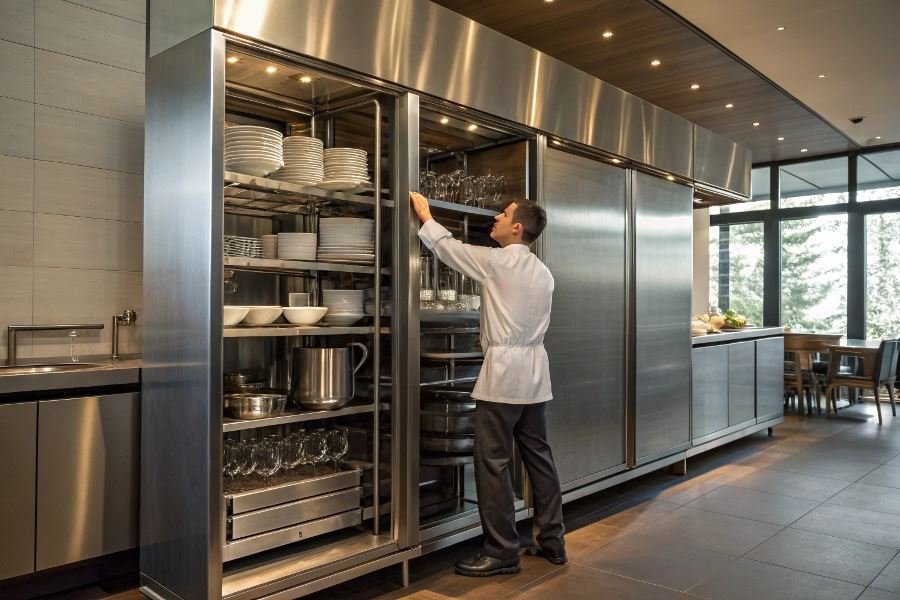
- Plate storage cabinets: 24 inches deep, 84 inches high with adjustable shelves spaced 10-12 inches apart
- Glassware cabinets: 18 inches deep with specialized racks and 8-inch shelf spacing
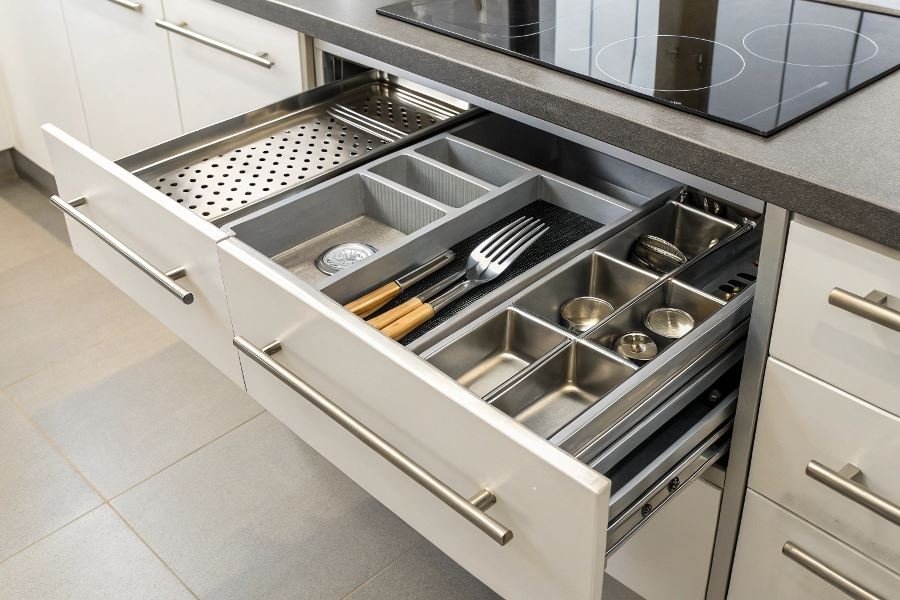
- Flatware drawers: 24 inches wide, 20 inches deep with specialized dividers
These establishments benefit from designated zones with cabinets customized for specific dish types. A typical 200-seat restaurant requires approximately 120-150 linear feet of cabinet space distributed strategically between service areas and kitchen stations.
High-Volume Solutions for Catering Facilities
Catering facilities and banquet halls face the ultimate storage challenge: accommodating service items for hundreds or even thousands of guests. These operations require industrial-strength solutions with cabinets reaching depths of 30 inches and heights of 96 inches or more.
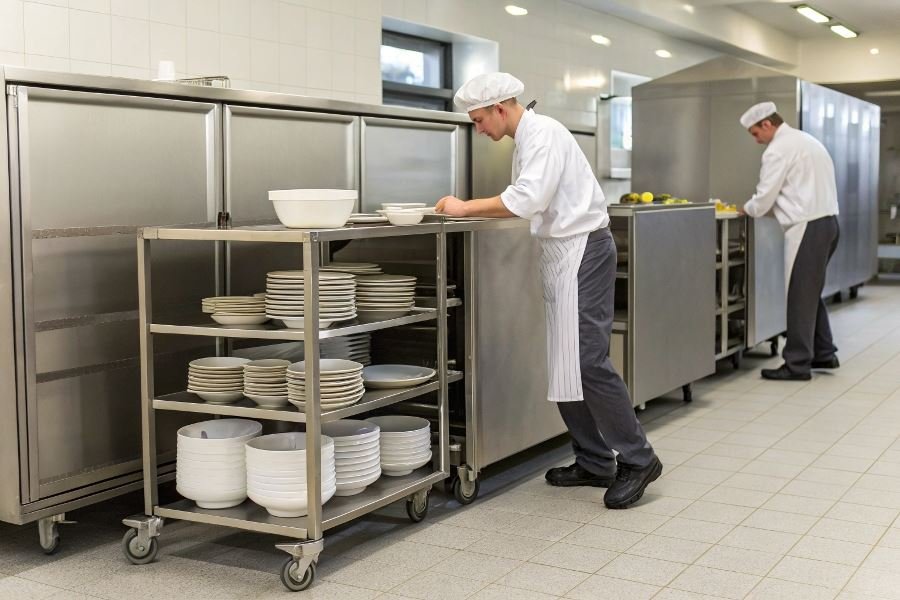
Mobile storage units on heavy-duty casters prove invaluable for these high-volume operations. These units typically measure 36 inches wide by 72 inches high and can store up to 400 place settings in a single cabinet. The ability to reconfigure storage as event needs change provides operational flexibility that fixed cabinetry cannot match.
Multi-Purpose Systems for Hospitality Complexes
Hotels and resorts require perhaps the most sophisticated cabinet systems of all. These establishments must accommodate everything from room service operations to banquet facilities and multiple restaurant concepts.
The most effective approach incorporates modular cabinet systems with standardized dimensions (typically 24 inches deep by 84 inches high) but customizable internal configurations. This standardization allows for interchangeability between departments while specialized inserts accommodate different dish types.
Smart hotels implement RFID tracking systems integrated with their cabinetry to monitor inventory across multiple food service operations, reducing loss and streamlining purchasing decisions.
By tailoring cabinet dimensions to specific operational needs, establishments of any size can dramatically improve efficiency, reduce breakage, and create more effective workflows for their staff.
Bringing Your Cabinet Vision to Life: Implementation Guide
Inventory Assessment: Know Your Dish Collection
Before selecting cabinets for your restaurant, café, or catering business, conduct a thorough inventory assessment. Start by categorizing your dishes by type, size, and frequency of use. Create a detailed spreadsheet documenting dimensions, quantities, and usage patterns of plates, bowls, glassware, and specialty items.
Measurement matters: Use precise measurements—not estimates—when cataloging your inventory. The difference between 10.5″ and 11″ plates can significantly impact shelf spacing requirements.
For accurate assessment, consider these approaches:
- Physical measurement of each dish type with digital calipers
- Stack measurement to determine vertical storage needs
- Weight assessment for structural support requirements
Pro tip: Include a 15-20% buffer in your calculations to accommodate future purchases and seasonal menu changes.
Dimension Standards Across Establishment Types
Different establishment types require tailored cabinet solutions based on service style, volume, and dish variety.
| Establishment Type | Recommended Cabinet Depth | Shelf Height Spacing | Special Considerations |
|---|---|---|---|
| Fine Dining | 16-18″ | 10-12″ | Extra space for chargers and specialty serveware |
| Casual Restaurant | 14-16″ | 8-10″ | Emphasis on stackability |
| Café/Bistro | 12-14″ | 6-8″ | Compact solutions with mug storage |
| Catering | 18-24″ | Variable | Modular systems for changing inventory |
Customization options have expanded dramatically with manufacturers like Rev-A-Shelf and Häfele offering adjustable systems that can be reconfigured as needs change.
Material Selection for Longevity
Cabinet material selection directly impacts durability, maintenance requirements, and budget allocation.
Stainless steel remains the gold standard for commercial kitchens, offering unmatched durability and sanitation benefits. 304-grade stainless steel provides excellent corrosion resistance in most environments, while 316-grade offers superior protection in coastal areas with higher salt exposure.
For front-of-house applications, consider these alternatives:
- Marine-grade plywood with melamine facing (moisture-resistant)
- High-density polyethylene (HDPE) for extreme durability
- Phenolic resin panels for designer aesthetics with commercial-grade performance
Material selection should balance initial investment against total lifecycle cost. Premium materials typically deliver 30-40% longer service life.
Installation Excellence and Accessibility
Proper installation ensures safety, functionality, and compliance with health regulations and ADA requirements.
Key installation considerations include:
- Floor leveling with adjustable feet systems
- Wall anchoring with appropriate load ratings
- Seismic considerations in applicable regions
- Proper ventilation to prevent moisture accumulation
Accessibility requirements demand attention to reach ranges (typically 15-48″ from floor), pull forces (maximum 5 lbs), and clearance spaces. ADA Solutions offers specialized hardware designed specifically for commercial accessibility compliance.
Future-Proofing Your Cabinet Investment
Smart cabinet planning anticipates business evolution and menu development.
Modular systems from manufacturers like Cambro allow for reconfiguration as needs change. Consider incorporating:
- Adjustable shelf systems with 1″ increment options
- Removable dividers for flexible compartmentalization
- Expandable rail systems for growing collections
The most effective cabinet systems balance immediate needs with 3-5 year growth projections, preventing costly renovations during critical business expansion phases.
When designing your cabinet implementation strategy, remember that accessibility drives efficiency. Staff should be able to retrieve and replace items with minimal movement and maximum visibility.
Discover the perfect cabinet dimensions for restaurant dish storage across different establishment types. Learn how to maximize efficiency with properly sized storage solutions tailored to cafés, full-service restaurants, and catering facilities.
Discover the perfect cabinet dimensions for restaurant dish storage across different establishment types. Learn how to maximize efficiency with properly sized storage solutions tailored to cafés, full-service restaurants, and catering facilities.