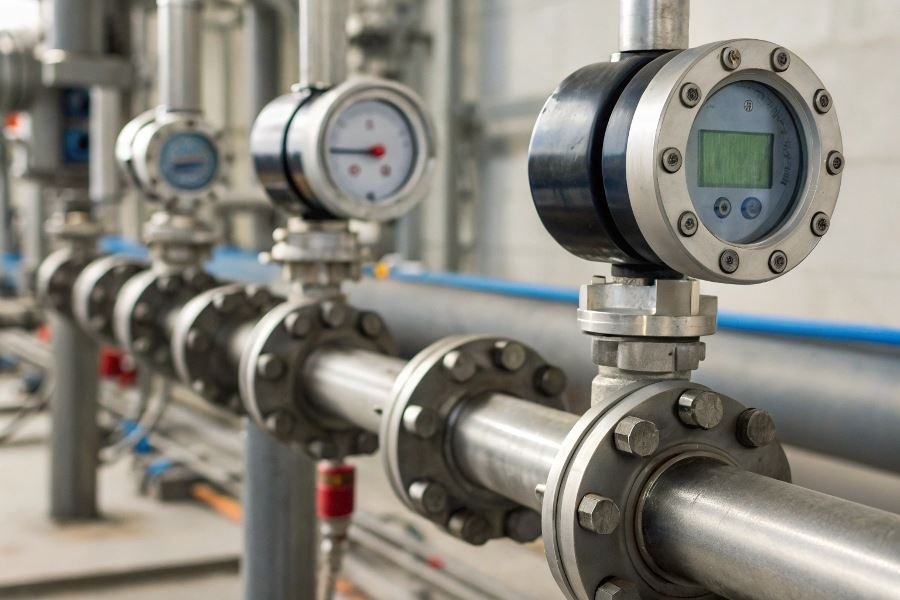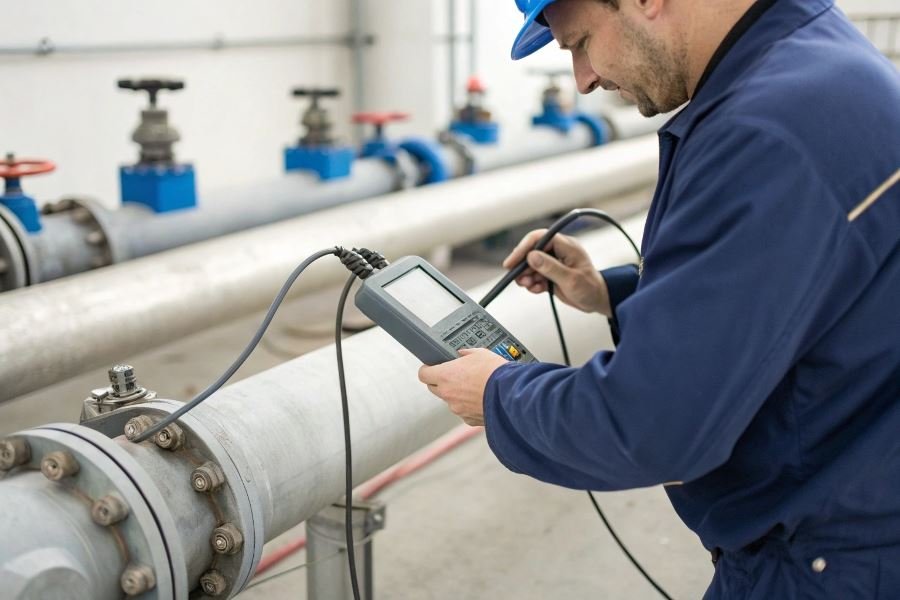
Ever wondered how engineers detect a 2% efficiency drop in a remote pipeline without tearing everything apart? The answer fits in a carrying case and saves millions in downtime.
Portable flow meters represent the frontline diagnostic tools that transform guesswork into precision across critical infrastructure. These compact devices measure fluid movement through pipes and systems with remarkable accuracy, providing immediate insights where permanent installations aren’t practical or cost-effective. They’re essentially the stethoscopes of industrial systems – detecting problems before catastrophic failures occur.
Where precision meets mobility
The versatility of portable flow meters makes them indispensable across multiple sectors:
- Oil & gas operations rely on them to verify custody transfer accuracy and detect costly leaks
- Water management teams deploy them to pinpoint distribution losses and validate system performance
- Manufacturing facilities use them to optimize process efficiency and ensure quality control
“A 3% improvement in flow measurement accuracy translated to $430,000 in annual savings for our refinery operations.” — Engineering Director at a major petroleum company
From bulky beginnings to digital precision
The evolution of these devices tells a fascinating story of technological advancement. Early models from the 1970s required significant expertise and weighed upwards of 40 pounds. Today’s ultrasonic and electromagnetic units offer digital interfaces, wireless connectivity, and can detect flow variations as small as 0.1% while weighing less than 5 pounds.
The current market landscape features sophisticated options that balance durability with precision, offering field technicians unprecedented diagnostic capabilities in challenging environments.
Field-Ready Flow Measurement: The Ultimate Portable Meter Guide
When precision matters in fluid measurement outside the lab, portable flow meters become the industrial professional’s best friend. These compact powerhouses deliver laboratory-grade accuracy in challenging field conditions, making them essential tools for maintenance teams, system auditors, and field engineers.
The landscape of portable flow meters for field diagnostics has evolved dramatically over the past decade, with manufacturers developing increasingly sophisticated models that combine accuracy with rugged portability. Today’s field technicians can choose from ultrasonic, electromagnetic, and thermal mass technologies—each offering distinct advantages for specific applications and fluid types. Let’s examine how these technologies perform when taken beyond controlled environments.
Ultrasonic Portable Flow Meters: Non-Invasive Precision
Ultrasonic flow meters have revolutionized field diagnostics with their clamp-on design that eliminates the need for pipe cutting or system shutdown. These devices operate by sending ultrasonic signals through pipe walls and measuring the time difference as signals travel with and against flow direction.
Key advantages include:
- Non-invasive installation (typically 5-15 minutes)
- Zero pressure drop
- Measurement accuracy of ±0.5-2% in optimal conditions
- Compatibility with pipe sizes from 0.5″ to 200″ diameter
The FLUXUS F601 from Flexim exemplifies modern ultrasonic technology, offering exceptional performance even on challenging materials like HDPE pipes. Its WaveInjector® technology extends measurement capability to extreme temperatures (-310°F to +1100°F), making it suitable for cryogenic applications and high-temperature steam systems.
Field technicians particularly value the ability to verify system performance without interrupting operations, allowing for “hot” diagnostics during peak production periods.
Electromagnetic Flow Meters: Conductive Fluid Specialists
For conductive fluids, electromagnetic (mag) meters provide exceptional accuracy with minimal maintenance requirements. These meters create a magnetic field across the pipe, generating voltage proportional to flow velocity when conductive fluids pass through.
| Feature | Typical Specification | Field Benefit |
|---|---|---|
| Accuracy | ±0.2-0.5% of reading | Precise billing verification |
| Conductivity requirement | 5 μS/cm | Works with most water-based fluids |
| Battery life | 12-24 hours continuous | Full shift operation |
| Data logging | 100,000+ data points | Comprehensive trend analysis |
The Badger Meter M2000 portable electromagnetic system delivers laboratory-grade accuracy in a field-ready package. Its advanced diagnostics can identify electrode coating, empty pipe conditions, and ground loop issues—critical information when troubleshooting system performance.
Field performance highlights:
- Self-verification capabilities reduce calibration frequency
- Unaffected by viscosity, temperature, or density fluctuations
- Excellent for wastewater applications with varying solid content
Thermal Mass Flow Meters: Gas Flow Specialists
When measuring gas flows in the field, thermal mass meters offer distinct advantages. These devices measure the cooling effect of gas flow on a heated element, providing direct mass flow measurement without pressure or temperature compensation.
The Sierra InnovaMass 240i portable thermal mass system exemplifies the technology’s strengths:
- Direct mass flow measurement without additional sensors
- Low-flow sensitivity down to 0.05 ft/sec
- Turndown ratios of 100:1 or better
- Negligible pressure drop across the meter
Thermal mass technology particularly shines in compressed air audits, natural gas consumption verification, and emissions monitoring. Their ability to detect extremely low flows makes them invaluable for leak detection programs.
Field technicians appreciate the technology’s independence from pressure and temperature fluctuations, eliminating the need for compensating calculations that can introduce error.
The diagnostic capabilities of modern thermal mass meters extend beyond simple flow measurement to include flow profile analysis, helping identify upstream disturbances that might affect measurement accuracy.
Mastering Flow Meter Selection for Field Diagnostics
Navigating the selection maze
Choosing the right portable flow meter for field diagnostics isn’t just about picking a device—it’s about finding a precision instrument that becomes your trusted field companion. The selection process demands careful consideration of three critical factors.
First, fluid properties dictate your entire approach. Viscosity, temperature, and chemical composition can make or break measurement accuracy. Highly viscous fluids require meters with larger passages and robust designs, while corrosive chemicals demand specialized materials like PTFE or stainless steel construction.
Second, your accuracy requirements should drive decision-making. Modern portable flow meters offer impressive precision ranging from ±0.5% to ±2.0% of reading. For critical applications like custody transfer or precise process control, ultrasonic clamp-on meters typically deliver the highest accuracy, though at premium price points starting around $4,000.
Third, never underestimate environmental conditions. Field diagnostics often means exposure to dust, moisture, temperature extremes, and vibration. Look for IP65 or higher ratings for dust and water protection, and operating temperature ranges that comfortably exceed your field conditions by at least 15%.
The most expensive flow meter isn’t always the best—the right meter is one that matches your specific application requirements while providing reliable diagnostic data in your actual field conditions.
Top performers in portable diagnostics
The market offers numerous options, but three models consistently outperform in field diagnostic applications:
Flexim FLUXUS F601
This ultrasonic portable powerhouse delivers exceptional versatility with its ability to measure flow through virtually any pipe material without process interruption. Its diagnostic capabilities include:
- Advanced signal processing that identifies pipe wall deposits
- Simultaneous measurement of flow, temperature, and energy
- Exceptional accuracy (±1.0% of reading) even in challenging conditions
The rugged IP65 housing withstands harsh environments, while the 14-hour battery life ensures full-day operation without recharging.
Greyline PDFM 5.1
Perfect for water and wastewater applications, this Doppler-based portable meter excels at measuring difficult liquids containing solids or bubbles. Its diagnostic strengths include:
- Built-in data logger storing up to 300,000 data points
- Automatic detection of signal quality and pipe conditions
- Simple setup with minimal training requirements
At approximately $3,200, it represents excellent value for utilities and municipal applications.
Endress+Hauser Proline Prosonic Flow 93T
This premium transit-time ultrasonic meter offers laboratory-grade accuracy in a field-ready package. Its diagnostic capabilities are unmatched:
- Continuous self-monitoring with automatic error detection
- Comprehensive pipe assessment including wall thickness measurement
- Multi-parameter analysis including density and temperature profiling
Deployment best practices
Maximizing diagnostic value from portable flow meters requires methodical implementation:
Pre-deployment preparation is non-negotiable. Always:
- Verify battery charge and memory capacity
- Calibrate against known standards before field use
- Document baseline measurements for comparison
Installation technique directly impacts measurement quality. Follow these guidelines:
- Select measurement points at least 10 pipe diameters downstream from disturbances
- Clean pipe surfaces thoroughly before sensor attachment
- Apply coupling gel generously for ultrasonic sensors
Maintenance routines ensure long-term reliability:
| Frequency | Action Required |
|---|---|
| Daily | Inspect sensor connections and battery levels |
| Weekly | Clean external surfaces and check for damage |
| Monthly | Verify calibration against standards |
| Quarterly | Update firmware and perform full system diagnostics |
The diagnostic value of these instruments multiplies when you establish consistent measurement protocols across your organization. Document exact sensor placement locations, standardize reporting formats, and implement trend analysis to transform isolated readings into actionable intelligence.
Discover the latest portable flow meter technology for precise field diagnostics across industries. Compare ultrasonic, electromagnetic, and thermal mass models to find the perfect solution for your fluid measurement needs in our comprehensive 2025 guide.
Discover the latest portable flow meter technology for precise field diagnostics across industries. Compare ultrasonic, electromagnetic, and thermal mass models to find the perfect solution for your fluid measurement needs in our comprehensive 2025 guide.