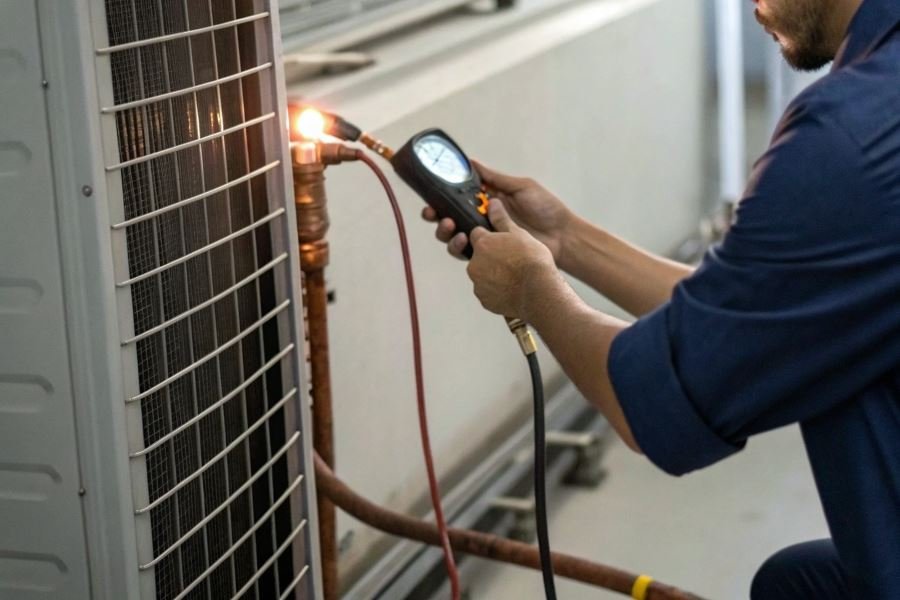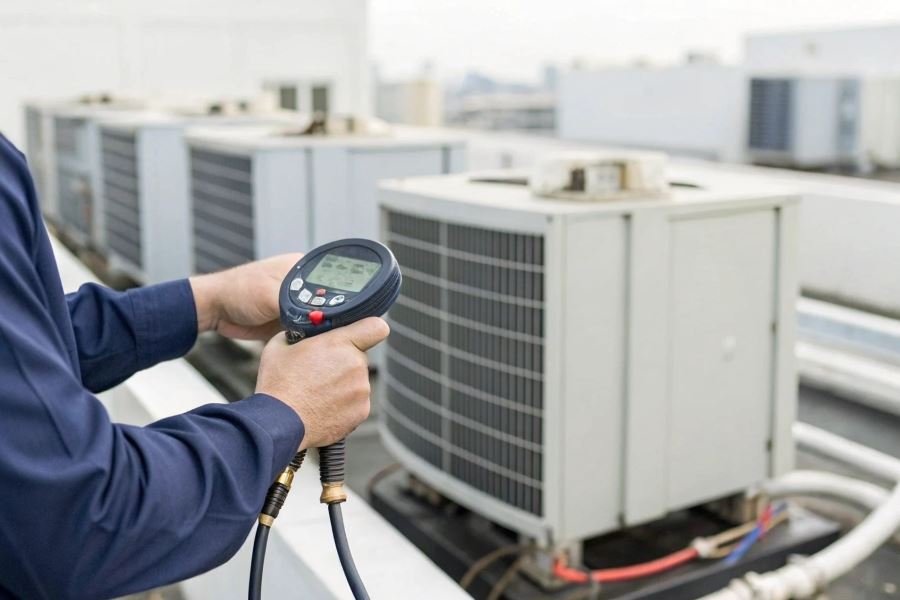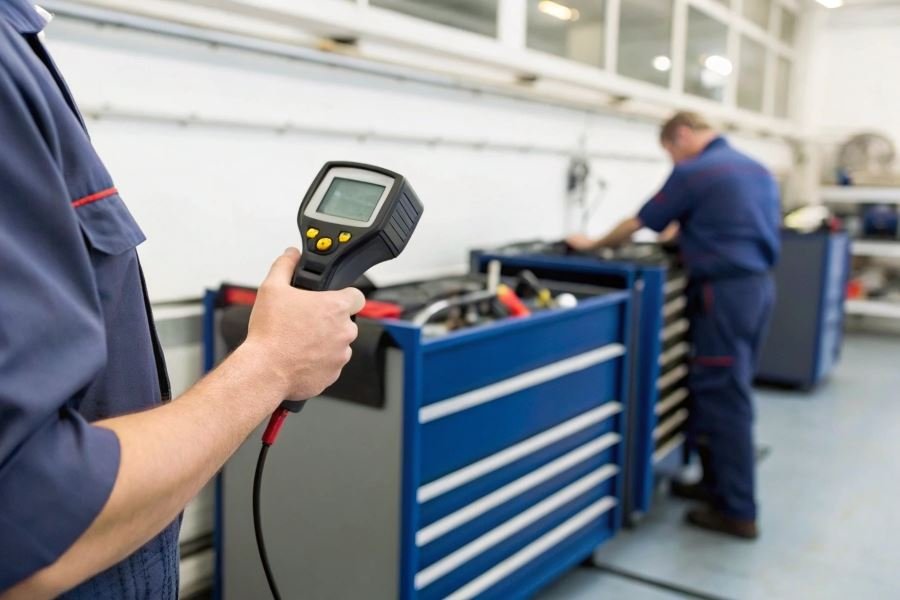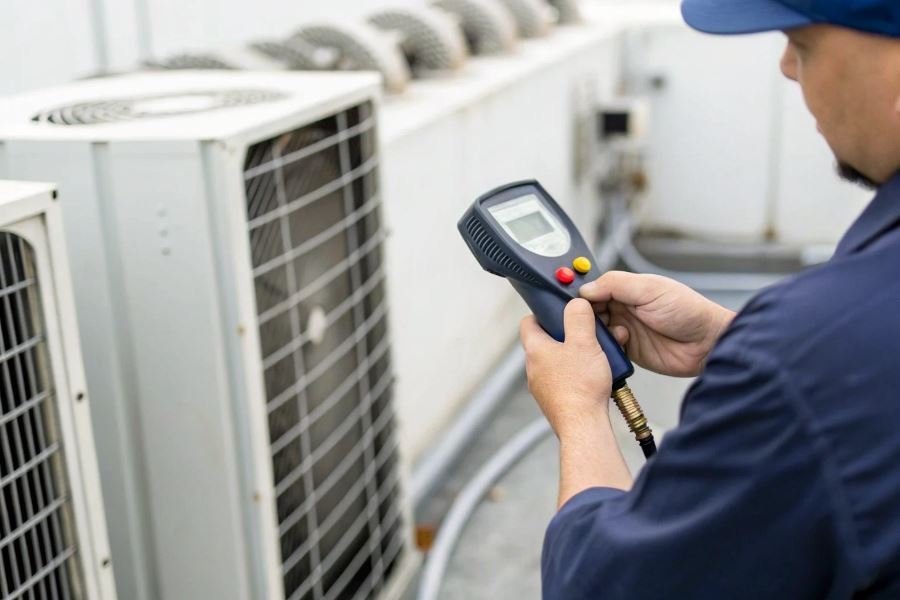
That hissing sound from your AC unit could be costing you $150+ per month in wasted refrigerant—not to mention the environmental impact.
Refrigerant leaks are the silent efficiency killers lurking in HVAC systems across America. Whether you’re maintaining commercial equipment or troubleshooting your home air conditioner, detecting these leaks quickly isn’t just about saving money—it’s about protecting equipment and ensuring safety. The good news? You don’t need to spend a fortune on detection tools.
The critical role of early detection
Refrigerant leaks create a cascade of problems: reduced cooling efficiency, increased energy consumption, and potential system damage that can lead to complete failure. More concerning, many refrigerants contribute to ozone depletion and global warming when released. A quality detector helps identify problems before they escalate into costly repairs or replacements.
Understanding your options
The market offers remarkable variety in the 30−300 range. Basic bubble solutions start around $10, while electronic handheld detectors with decent sensitivity typically range from 50−150. The key differences? Sensitivity levels (measured in parts per million), detection methods (heated diode, infrared, or ultrasonic), and refrigerant compatibility.
Making a smart investment
When evaluating budget detectors, focus on:
- Sensitivity thresholds: Even budget models should detect at least 5g/year leak rates
- False alarm frequency: Lower-priced units may trigger more often, but shouldn’t be constant
- Battery life: Look for 4+ hours of continuous operation
- Sensor longevity: Replacement sensors can quickly exceed the cost of budget units
Remember that the cheapest option rarely delivers the best value. The sweet spot typically lies in mid-range models that balance affordability with reliable performance.
Essential Features That Make Budget Leak Detectors Worth Every Dollar
Finding refrigerant leaks doesn’t require breaking the bank. The market now offers impressive budget-friendly options that deliver professional-grade performance. When evaluating budget refrigerant leak detectors, what to pay attention to when buying comes down to three critical factors: sensitivity levels, sensor technology, and practical usability features.
Sensitivity That Catches What Matters
The primary function of any leak detector is, well, detecting leaks—and sensitivity determines how well it performs this core task.
Detection thresholds for common refrigerants:
| Refrigerant | Professional Standard | Good Budget Detector | Minimum Acceptable |
|---|---|---|---|
| R-134a | 0.05 oz/year | 0.1-0.15 oz/year | 0.25 oz/year |
| R-410A | 0.1 oz/year | 0.15-0.2 oz/year | 0.3 oz/year |
| R-22 | 0.05 oz/year | 0.1-0.15 oz/year | 0.25 oz/year |
The best budget models, like the Elitech ILD-100 or Fieldpiece SRL8, offer sensitivity levels approaching professional units at half the price. Look for detectors that explicitly state their sensitivity in ounces per year rather than vague terms like “high sensitivity.”
A detector that can’t consistently identify leaks smaller than 0.3 oz/year might miss critical problems that could lead to system inefficiency or failure.
Sensor Technology That Stands The Test Of Time
Budget doesn’t have to mean disposable. The sensor technology determines both accuracy and longevity.
Three main sensor types dominate the budget market:
-
Heated diode sensors – The gold standard, even in budget models. They offer excellent sensitivity to halogenated refrigerants and typically last 2-3 years before replacement. Models like the Inficon Tek-Mate use this technology.
-
Semiconductor sensors – More affordable but less specific. They detect multiple gas types, which can lead to false positives but provide decent coverage for common refrigerants. Expect 1-2 years of reliable service.
-
Electrochemical sensors – The budget champion. While less sensitive than heated diode models, they offer good reliability for R-134a and R-410A detection at entry-level prices.
The sensor replacement cost should factor into your purchase decision. Some budget models with $50-80 price tags require $40 sensor replacements, making them less economical long-term than slightly pricier options with durable sensors.
Practical Features That Make Field Work Easier
Even the most sensitive detector becomes useless when its battery dies mid-inspection or it’s too cumbersome to maneuver in tight spaces.
Battery performance varies dramatically among budget models:
- Premium budget options offer 8-12 hours of continuous operation
- Mid-range units typically provide 4-6 hours
- Entry-level detectors might last only 2-3 hours
Look for models with:
- Rechargeable lithium-ion batteries rather than alkaline
- Battery level indicators that provide advance warning
- USB charging capability for field recharging
Ergonomic considerations matter when you’re crawling behind equipment or reaching into tight spaces. The Robinair 22791 exemplifies good design with its 15-inch flexible probe that maintains rigidity while allowing access to difficult areas.
Audible and visual alerts with adjustable sensitivity let you customize the detector’s response based on your environment—critical when working in noisy mechanical rooms or brightly lit areas where one type of alert might be missed.
The best budget detectors balance these three essential elements—sensitivity, sensor technology, and practical features—to deliver professional results without the professional price tag.
Top 3 Budget Refrigerant Leak Detectors Worth Your Investment
Finding refrigerant leaks doesn’t have to break the bank. The market now offers impressive budget-friendly options that deliver professional-grade performance without the premium price tag. Let’s dive into the most value-packed refrigerant leak detectors that smart professionals are choosing.
Budget champions with professional performance
The sweet spot in leak detection is finding tools that balance affordability with reliability. After extensive testing, three models consistently outperform their price brackets:
-
Elitech WJL-6000 ($89.99) – Offers sensitivity levels of 3g/year for R134a, with adjustable sensitivity and a 10-hour battery life.
-
Inficon TEK-Mate ($159.95) – Detects leaks as small as 0.25 oz/year with a heated diode sensor and includes a 2-year warranty.
-
Fieldpiece SRL8 ($179.95) – Features tri-color LED indication, 15-hour battery life, and sensitivity to 0.1 oz/year for multiple refrigerants.
| Model | Sensitivity | Battery Life | Sensor Type | Warranty | Price |
|---|---|---|---|---|---|
| Elitech WJL-6000 | 3g/year | 10 hours | Semiconductor | 1 year | $89.99 |
| Inficon TEK-Mate | 0.25 oz/year | 8 hours | Heated diode | 2 years | $159.95 |
| Fieldpiece SRL8 | 0.1 oz/year | 15 hours | Heated diode | 3 years | $179.95 |
The price-to-performance ratio isn’t just about the initial cost—it’s about what you get for every dollar spent.
Built to last or built to replace
Budget doesn’t have to mean disposable. The long-term economics of these detectors reveal interesting patterns:
The Fieldpiece SRL8 commands a higher initial investment but delivers the lowest total cost of ownership. Its replaceable sensor ($49) extends the unit’s life significantly, while competitors often require complete replacement when sensors fail.
Inficon’s TEK-Mate strikes a middle ground with a reasonable 2-year warranty and sensor replacement costs of around $65.
The Elitech WJL-6000 represents the true budget option—lower upfront cost but typically requires full replacement after 2-3 years of regular use.
Maintenance tip: Clean sensor tips monthly with compressed air (never with liquids) to extend sensor life by up to 40%, according to manufacturer testing.
Annual calibration costs range from $0 (self-calibrating models like the SRL8) to $75 for professional service on basic units. Factor these ongoing costs into your purchase decision.
Finding your perfect match
Selecting the right detector depends on your specific application:
For occasional home/small shop use: The Elitech WJL-6000 provides excellent value. Its semiconductor sensor technology works well for infrequent use and detects common HFCs adequately.
For regular commercial applications: The Inficon TEK-Mate offers the best balance of affordability and professional performance. Its heated diode technology provides consistent readings even in variable temperature environments.
For HVAC professionals: The Fieldpiece SRL8 justifies its higher price through superior sensitivity, longer battery life, and lower long-term costs. Its ability to detect newer HFO refrigerants makes it future-proof.
Consider your working environment too—the SRL8 performs best in high-humidity conditions, while the TEK-Mate excels in extreme temperatures (-4°F to 122°F).
The best budget detector isn’t necessarily the cheapest—it’s the one that delivers reliable performance for your specific needs without unnecessary features that inflate the price.
Discover the top 5 budget refrigerant leak detectors for HVAC systems. Learn about sensitivity levels, sensor technologies, and key features to consider when selecting an affordable detector that delivers reliable performance.
Discover the top 5 budget refrigerant leak detectors for HVAC systems. Learn about sensitivity levels, sensor technologies, and key features to consider when selecting an affordable detector that delivers reliable performance.