Ever watched a receipt printer churn out 500 tickets during a lunch rush, only to jam at customer 501? That moment of panic as the line grows and your tech fails is what separates good equipment from great. The difference isn’t just convenience—it’s survival.
Behind every successful high-volume operation stands a receipt printer that simply refuses to quit. These unsung heroes of the commercial world power through thousands of transactions daily in bustling retail stores, packed restaurants, and 24-hour healthcare facilities. They’re not just printing paper; they’re printing money, patient information, and customer satisfaction.
What truly defines reliability in these demanding environments? First, print speed matters—measured in millimeters per second, the fastest models now reach 350mm/s, nearly double what was standard just five years ago. But speed without durability creates a ticking time bomb. The best printers feature print heads rated for 150+ kilometers of printing and auto-cutters that withstand 2+ million cuts.
Connectivity options have evolved dramatically, with modern reliable printers offering multiple redundancies: Ethernet, Bluetooth, USB, and cloud printing capabilities. This ensures that when one system fails, another takes over seamlessly.
The market has responded to these demands with specialized solutions. Thermal printing dominates for its speed and silence, while impact printers persist in environments requiring duplicates. The newest trend? Smart receipt printers with built-in processing power that continue functioning even when your main POS system crashes—a feature that pays for itself during the first system failure.
Top 3 Receipt Printers That Won’t Let You Down
When your business depends on printing hundreds—or even thousands—of receipts daily, equipment failure isn’t just an inconvenience; it’s a potential revenue disaster. The most reliable receipt printers for intensive use need to withstand constant operation while maintaining print quality and speed. Let’s dive into the workhorses that keep high-volume businesses running smoothly.
Thermal Titans for Non-Stop Operations
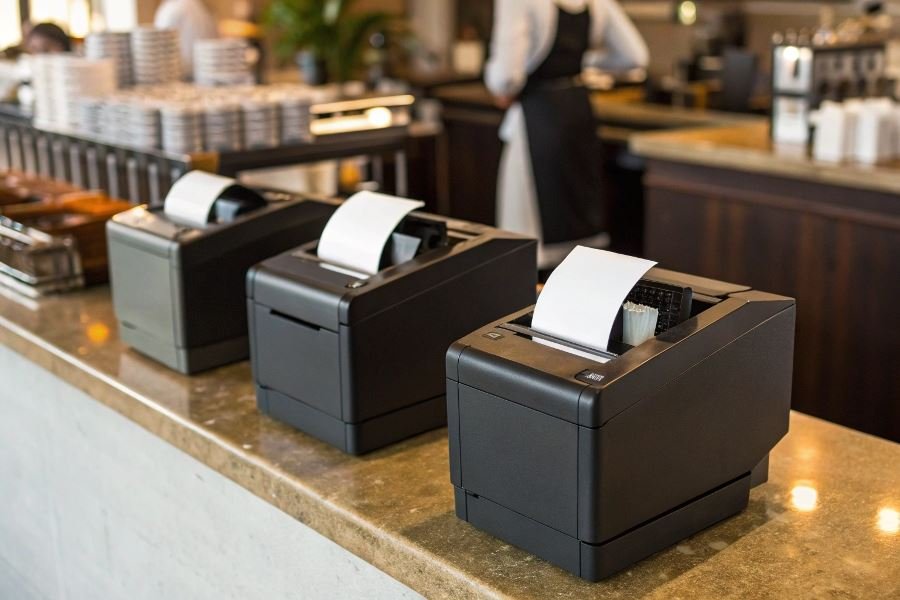
Thermal receipt printers dominate high-volume environments for good reason—they’re fast, quiet, and maintenance-friendly. Without ink cartridges to replace, these machines keep churning out receipts when others would falter.
The Epson TM-T88VII stands as the undisputed champion in this category. With print speeds reaching 500mm/second and a mean time between failures (MTBF) of 600,000 hours, it’s engineered for businesses that never sleep. Its auto-cutter is rated for 3 million cuts—roughly equivalent to 6-7 years of intensive daily use.
Runner-up Star Micronics TSP143IV delivers impressive 300mm/second printing with a 60 million line printhead life. Its tool-less maintenance design means less downtime when paper jams inevitably occur.
| Printer Model | Print Speed | MTBF | Printhead Life |
|---|---|---|---|
| Epson TM-T88VII | 500mm/sec | 600,000 hours | 200 km |
| Star TSP143IV | 300mm/sec | 360,000 hours | 60 million lines |
| Citizen CT-S751 | 350mm/sec | 500,000 hours | 150 km |
Impact Printers That Weather Any Storm
When environmental conditions turn hostile—kitchens with high humidity, dusty warehouses, or extreme temperatures—impact printers prove their worth. These mechanical warriors use physical pins striking an ink ribbon, making them impervious to heat issues that plague thermal printers.
The Epson TM-U220B remains the gold standard for demanding conditions. Its 180 million character printhead and ability to function in temperatures from 5° to 45°C make it ideal for kitchen environments. The dual-color printing capability (black/red) helps highlight important order information.
For truly punishing environments, the OKI ML1120 industrial-grade impact printer handles vibration, dust, and temperature fluctuations while maintaining legible receipts after 200 million character impressions.
Mobile Marvels for Field Operations
Intensive use isn’t confined to fixed locations. Field service technicians, delivery personnel, and mobile vendors need receipt printers that combine reliability with portability.
The Zebra ZQ630 leads this category with military-grade drop specifications (5ft/1.5m) and IP54 rating against dust and water splashes. Its 6800mAh battery supports full-shift printing—up to 500 receipts on a single charge. The reinforced housing withstands the inevitable bumps of daily field use.
For more budget-conscious operations, the Brother RJ-4250WB offers impressive durability with 6ft drop protection and IP54 rating. Its 3000mAh battery handles approximately 300 receipts per charge, while supporting multiple connectivity options including Bluetooth, WiFi, and USB.
What separates these elite printers from standard options is their engineering focus on continuous operation. Components like thermal printheads, auto-cutters, and paper feed mechanisms are reinforced to handle the repetitive stress of printing thousands of receipts daily. The initial investment might be higher, but the reduced downtime and extended service life deliver substantial ROI for businesses that can’t afford register delays.
Maximizing Your Receipt Printer Investment
The true cost beyond the price tag
When selecting receipt printers for high-volume environments, the sticker price tells only a fraction of the story. The Total Cost of Ownership (TCO) encompasses everything from initial purchase to eventual replacement. Thermal printers from Epson and Star Micronics typically offer lower TCO despite higher upfront costs, with thermal paper averaging 0.02−0.03 per receipt versus 0.04−0.06 for impact printing.
A comprehensive TCO analysis should include:
| Cost Component | Thermal Printers | Impact Printers |
|---|---|---|
| Initial Investment | 200−400 | 150−300 |
| Paper Cost (50,000 receipts) | 1, 000−1,500 | 2, 000−3,000 |
| Ribbon Replacement | $0 | 300−500 annually |
| Power Consumption | 1.5-2.5W standby | 4-7W standby |
| Average Lifespan | 5-7 years | 7-10 years |
The Epson TM-T88VII boasts a remarkable 500,000-hour MTBF (Mean Time Between Failures), translating to approximately 57 years of theoretical continuous operation. While no printer lasts that long in practice, this metric indicates exceptional reliability for intensive environments processing hundreds of transactions daily.
Maintenance strategies that pay dividends
The difference between a printer that lasts three years versus seven often comes down to maintenance discipline.
For thermal printers:
- Weekly cleaning of the thermal head using isopropyl alcohol wipes prevents paper dust buildup
- Quarterly sensor cleaning ensures accurate paper detection and prevents false paper-out errors
- Annual internal dust removal using compressed air prevents overheating
Impact printers require additional attention:
- Monthly ribbon inspection and replacement when print begins to fade
- Bi-annual print head alignment to maintain print quality
- Lubrication of moving parts according to manufacturer specifications
The Star Micronics TSP143IIIU includes a self-cleaning function that extends print head life by approximately 30% compared to models without this feature.
Future-proofing in a changing retail landscape
Receipt printers represent a long-term investment that must adapt to evolving business needs. Key future-proofing considerations include:
-
Connectivity options beyond traditional interfaces. The Citizen CT-S310II offers USB, Ethernet, Bluetooth, and cloud printing capabilities, ensuring compatibility with next-generation POS systems.
-
Software development kits (SDKs) that allow customization as your business grows. Manufacturers like Bixolon provide robust SDKs that support integration with emerging technologies.
-
Digital receipt capabilities that bridge physical and digital experiences. The Square Terminal printer allows simultaneous printing and digital receipt delivery, accommodating changing customer preferences.
-
Firmware updateability to address security vulnerabilities and add features. The Epson OmniLink TM-T88VI supports remote firmware updates, extending functional lifespan.
The most future-proof printers aren’t necessarily the most expensive, but those designed with adaptability at their core.
By carefully evaluating TCO, implementing rigorous maintenance protocols, and selecting models with future-ready features, businesses can transform receipt printers from disposable peripherals into strategic assets that deliver reliability through years of intensive use.
Discover the top 5 industrial-grade receipt printers built for high-volume business environments. Compare thermal, impact, and mobile options that deliver reliability, durability, and performance when you need it most.
Discover the top 5 industrial-grade receipt printers built for high-volume business environments. Compare thermal, impact, and mobile options that deliver reliability, durability, and performance when you need it most.