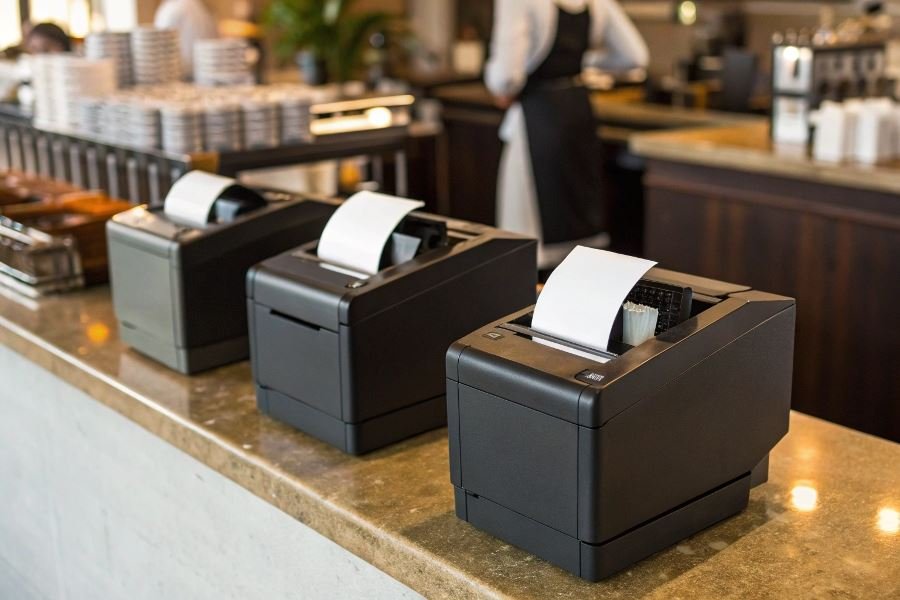
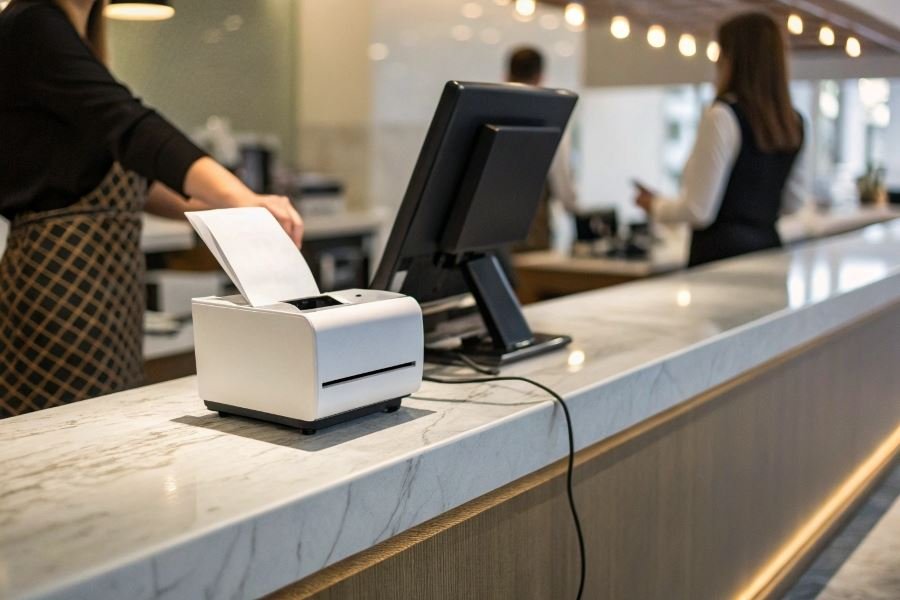
Every transaction tells a story—but who’s telling it better: the whisper-quiet thermal printer or the chattering dot matrix?
Behind every purchase receipt in your wallet lies a fascinating technological battle that most business owners never consider until their printer fails during the Saturday rush. Receipt printers might seem mundane, but they represent the final touchpoint between businesses and customers—a critical moment of truth that happens billions of times daily across America.
Thermal and dot matrix technologies emerged from distinctly different paths. While dot matrix printers dominated the 1980s with their distinctive mechanical hammers striking ribbons against paper, thermal printing quietly evolved from fax machine technology. By the early 1990s, thermal printers began gaining traction in retail environments, offering silent operation that dot matrix couldn’t match.
The technological landscape today
The market has spoken clearly: thermal printers now command approximately 75% of the point-of-sale printer market, with dot matrix holding steady in specific niches. This shift reflects more than preference—it represents fundamental business calculations around speed, noise, and operational costs.
What’s particularly interesting is how different sectors have adopted these technologies. Restaurants and boutique retailers overwhelmingly prefer thermal for its silent operation and graphic capabilities, while logistics companies and environments requiring multiple copies still rely on dot matrix’s impact technology.
The printing technology you choose doesn’t just produce receipts—it shapes customer experience, affects employee satisfaction, and impacts your bottom line in ways that extend far beyond the initial purchase price.
The Battle of Receipt Printers: Thermal vs. Dot Matrix
Print quality and performance metrics
When businesses choose receipt printers, they’re making a decision that impacts daily operations for years to come. The comparison of thermal printers and dot matrix receipt printers reveals stark differences in fundamental performance areas. Thermal printers produce crisp, high-resolution text at 203-300 dpi, while dot matrix printers typically max out at 72-144 dpi, creating that distinctive “dotty” appearance we’ve all seen.
Speed differences are equally dramatic. Modern thermal printers like the Epson TM-T88VII zip through receipts at 450mm/second, while even the fastest dot matrix printers struggle to exceed 5-7 lines per second. This translates to approximately 40-60 receipts per hour difference in high-volume environments. Perhaps most noticeable is noise level—thermal printers operate at a whisper-quiet 45-50 dB, while dot matrix printers announce each transaction at 70-80 dB with their characteristic mechanical chattering.
Cost considerations across time
Initial investment versus operational expenses presents one of the most interesting contrasts. Thermal printers typically cost $200-350 upfront, while dot matrix models average $150-250. However, this initial price advantage quickly evaporates when examining long-term costs.
| Cost Factor | Thermal Printers | Dot Matrix Printers |
|---|---|---|
| Initial Hardware | $200-350 | $150-250 |
| Paper (yearly) | $300-450 | $200-300 |
| Ribbon/Ink (yearly) | $0 | $150-300 |
| Power Consumption | Low | Moderate |
| Maintenance (yearly) | $50-100 | $100-200 |
Dot matrix printers require ongoing ribbon replacements costing $15-25 each, with busy locations needing 10+ ribbons annually. Thermal printers eliminate this expense entirely but require special thermal paper that costs 15-30% more than standard paper.
Durability and maintenance realities
The lifespan and maintenance requirements of these technologies differ substantially. Dot matrix print heads typically last for 200-300 million characters before replacement, which translates to 3-7 years in average business settings. Their mechanical nature means more moving parts that can fail, but also makes them field-repairable with basic tools.
Thermal printheads generally last for 50-100km of printed receipts (approximately 2-5 years) before quality degradation occurs. While they have fewer moving parts, when thermal printheads fail, the entire mechanism typically requires replacement rather than repair. Maintenance for thermal printers primarily involves regular cleaning with alcohol wipes to prevent dust buildup that can degrade print quality.
Environmental impact assessment
Sustainability considerations increasingly influence purchasing decisions. Thermal printers consume approximately 40-60% less electricity than dot matrix printers. However, thermal paper contains BPA or BPS chemicals that make it non-recyclable in many municipalities and potentially harmful to environmental and human health.
Dot matrix printers use standard paper that’s fully recyclable, giving them an edge in waste management. Their ribbons, however, eventually become landfill waste, creating a different environmental concern.
Paper requirements and receipt longevity
Perhaps the most critical practical difference lies in receipt longevity. Thermal paper receipts begin fading within 6-12 months under normal conditions and can become completely illegible when exposed to heat, sunlight, or certain chemicals. For businesses where receipts serve as warranty documentation or tax records, this presents a significant limitation.
Dot matrix receipts, printed with impact technology and ink ribbons on standard paper, maintain legibility for 5+ years under normal conditions, making them superior for archival purposes despite their less appealing aesthetic qualities.
Making the Right Receipt Printer Choice
Where thermal printing technology shines
Thermal printers have revolutionized point-of-sale environments where speed and silence are paramount. In busy retail settings, Square and similar POS thermal printers deliver receipts in seconds—typically 6-12 inches per second—without the mechanical noise that can disrupt customer interactions.
Restaurants, coffee shops, and boutique retailers benefit most from thermal technology’s compact footprint and minimal maintenance requirements. With no ink cartridges to replace, these printers offer lower operational costs in environments with high transaction volumes but moderate receipt retention needs.
The clarity of thermal printing makes it ideal for businesses that rely on scannable barcodes or QR codes. Modern thermal printers from manufacturers like Epson deliver crisp 203-300 dpi resolution, ensuring that digital scanning remains reliable even on smaller receipt formats.
Thermal printers excel when receipt longevity is measured in months rather than years, and when operational efficiency trumps archival requirements.
Healthcare settings and hospitality businesses particularly value thermal printing’s ability to produce clean, smudge-free text without waiting for ink to dry—critical when handling patient information or guest folios that require immediate handling.
When dot matrix printers prove superior
Despite technological advances, dot matrix printers remain indispensable in specific scenarios. Environments with extreme temperature variations—like outdoor kiosks in Minnesota winters or Arizona summers—challenge thermal paper’s heat-sensitive chemistry, while dot matrix printing remains stable across temperature ranges.
Businesses requiring long-term document retention find Epson’s impact printers invaluable. Insurance agencies, legal offices, and financial institutions that must maintain records for 7+ years benefit from impact printing’s permanence, as thermal receipts can fade significantly within 1-3 years depending on storage conditions.
Multi-part forms represent another dot matrix stronghold. When simultaneous copies are needed—as with delivery confirmations, work orders, or contracts—impact printers create multiple carbon copies in a single pass, a feat impossible with thermal technology.
The durability factor cannot be overlooked. In industrial environments, warehouses, and kitchens where receipts face moisture, heat, and rough handling, dot matrix output withstands conditions that would quickly degrade thermal paper.
The evolving landscape of receipt technology
The receipt printing market is experiencing fascinating shifts. Hybrid printers that combine thermal and impact technologies in single units are gaining traction, allowing businesses to optimize for both speed and durability based on transaction type.
Environmental considerations are reshaping both technologies. Newer thermal papers eliminate controversial BPA and BPS chemicals, while dot matrix manufacturers have developed more energy-efficient impact mechanisms that reduce power consumption by up to 30% compared to older models.
The most significant evolution may be digital receipts, which are supplementing rather than replacing physical options. Square and other POS providers now offer seamless email and text receipt delivery alongside traditional printing, creating flexibility that accommodates customer preferences.
For businesses making the selection today, the decision increasingly depends not on which technology is “better” but on specific operational requirements. Thermal printers dominate where transaction speed and quiet operation matter most, while dot matrix printers remain essential where durability, multi-part forms, and long-term archiving are non-negotiable priorities.
Discover the definitive comparison between thermal and dot matrix receipt printers. Explore print quality, speed, costs, durability, and sustainability to determine which technology best suits your business needs in today's competitive market.
Discover the definitive comparison between thermal and dot matrix receipt printers. Explore print quality, speed, costs, durability, and sustainability to determine which technology best suits your business needs in today's competitive market.