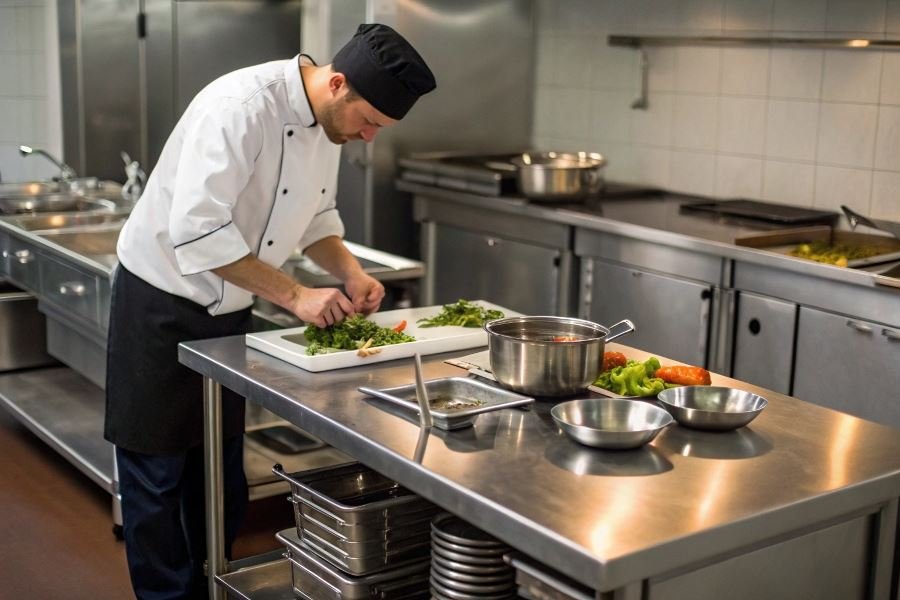
Ever watched a kitchen during the dinner rush? It’s a symphony of controlled chaos where every surface matters. Production tables aren’t just furniture—they’re command centers where culinary magic happens, mistakes are prevented, and efficiency is born.
Behind every perfectly plated dish lies an unsung hero: the production table where it was assembled. Restaurant owners who’ve upgraded their prep surfaces report up to 30% faster service times and significantly reduced kitchen accidents. The right table doesn’t just support your food—it supports your entire operation.
When selecting production tables for your restaurant kitchen, you’re making decisions that will impact everything from food safety to staff morale. The National Restaurant Association found that properly designed work surfaces can reduce cross-contamination incidents by up to 40%—a statistic that should make every restaurant owner take notice.
Three factors dominate the selection process: material quality, ergonomic design, and spatial efficiency. Stainless steel remains the gold standard for its durability and sanitation properties, but innovations in composite surfaces are gaining traction for specialized applications. The height, accessibility, and workflow integration of your tables will determine whether your kitchen staff thrives or merely survives during peak hours.
Remember that production tables aren’t just about preparation—they’re about precision. Every inch of space, every surface material choice, and every design element will either enhance or hinder your kitchen’s performance for years to come.
The Physical Backbone of Restaurant Efficiency
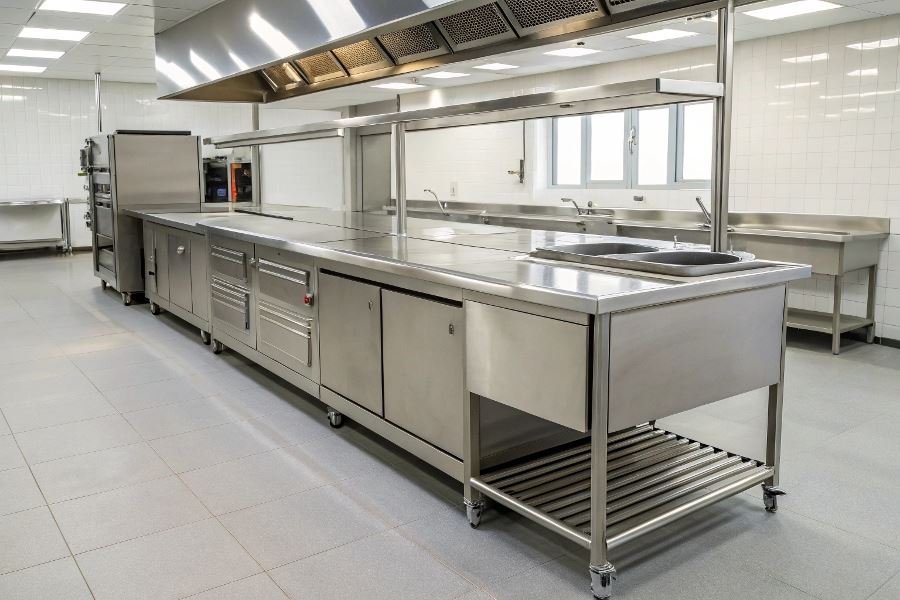
When professional chefs step into their kitchen, they demand workspaces that can handle the heat—literally and figuratively. Production tables form the backbone of any successful restaurant kitchen, serving as the stage where culinary magic happens. Selecting the right table isn’t just about having a flat surface; it’s about creating an environment where efficiency meets durability.
Establishing proper criteria for choosing a production table for a restaurant requires understanding the intense demands of commercial food preparation. These workhorses must withstand constant use, exposure to moisture, temperature fluctuations, and chemical cleaning agents—all while maintaining food safety standards and supporting workflow efficiency.
Material Matters: Not All Surfaces Are Created Equal
Stainless steel reigns supreme in professional kitchens, but the grade makes all the difference:
- 304 stainless steel (18/8): Contains 18% chromium and 8% nickel, offering superior corrosion resistance and durability
- 430 stainless steel: Less expensive but more susceptible to corrosion in high-moisture environments
The investment in 304-grade stainless steel typically pays dividends through years of additional service life.
For specialized preparation areas, other materials have their place:
| Material | Best Application | Key Considerations |
|---|---|---|
| Maple butcher block | Pastry preparation, dough work | Requires regular oiling and sanitizing |
| Composite surfaces | Prep areas requiring temperature stability | Resistant to stains but can be damaged by sharp objects |
| Galvanized steel | Dry storage areas | More affordable but not suitable for direct food contact |
Sizing Up Success: Dimensions That Drive Workflow
The perfect production table dimensions depend entirely on your kitchen’s layout and operational needs. Standard depths typically run 24-36 inches, while lengths vary from 48-96 inches. Height considerations are particularly crucial:
- Standard working height: 34-36 inches
- Specialized tasks: May require adjustable heights (30-40 inches)
Workflow efficiency demands that tables be sized to accommodate:
- Number of staff working simultaneously
- Equipment placement requirements
- Specific preparation tasks
- Available kitchen space
A properly sized production table eliminates unnecessary movement, reducing staff fatigue and increasing productivity by up to 30%.
Structural Features That Supercharge Functionality
Beyond basic dimensions, structural elements dramatically impact a table’s utility:
Undershelving options transform storage capabilities:
- Solid undershelves for maximum storage
- Slotted shelves for air circulation
- Wire shelving for visibility and drainage
Backsplashes (typically 4-10 inches high) serve multiple critical functions:
- Prevent liquids from damaging walls
- Create a sanitary barrier
- Provide mounting points for utensils or equipment
Adjustable components deliver customization where it matters most:
- Leveling feet accommodate uneven floors
- Height-adjustable work surfaces prevent ergonomic issues
- Removable cutting boards allow for proper sanitization
The most effective production tables incorporate integrated features that streamline operations:
- Drawer systems for utensil storage
- Knife racks for safety and accessibility
- Drop-in cold wells for ingredient storage
- Cutting board slots for food safety compliance
Selecting production tables with these physical characteristics creates a foundation for kitchen excellence that will continue delivering value long after the initial investment has been recovered.
Beyond Basics: Advanced Evaluation Framework for Restaurant Production Tables
Meeting Food Safety Regulations Head-On
Restaurant production tables aren’t just workplace surfaces—they’re critical control points in your food safety system. The FDA Food Code and NSF International certification represent the gold standard for food preparation surfaces. NSF-certified stainless steel tables meet rigorous standards for material safety, cleanability, and resistance to bacterial growth. These certifications aren’t just bureaucratic checkboxes; they’re your defense against cross-contamination and foodborne illness outbreaks.
Material matters immensely here. While 304-grade stainless steel commands a premium, its superior corrosion resistance makes it ideal for acidic food preparation. The 430-grade alternative offers cost savings but sacrifices some chemical resistance—a critical consideration for establishments handling citrus or tomato-based preparations.
“The difference between a good production table and a great one isn’t just what you can see—it’s how it performs under health department scrutiny.”
Modern health codes increasingly emphasize coved corners and seamless construction. These design elements eliminate microscopic harboring points for bacteria that traditional welded corners create. Vollrath and John Boos have pioneered these sanitation-forward designs that make compliance dramatically easier.
Financial Intelligence: The True Cost Calculation
The sticker price is merely the opening chapter in your production table’s financial story. Smart operators calculate Total Cost of Ownership (TCO) across a 7-10 year horizon. A premium Eagle Group table priced at $1,200 might deliver twice the service life of a $700 economy model—translating to significant long-term savings.
Consider this comparative breakdown:
| Feature | Economy Model | Premium Investment |
|---|---|---|
| Initial Cost | $700 | $1,200 |
| Expected Lifespan | 3-5 years | 8-10 years |
| Annual Maintenance | $120 | $75 |
| 10-Year TCO | $1,900+ | $1,950 |
| Downtime Risk | High | Minimal |
The hidden costs often eclipse the purchase price. Inferior tables require more frequent repairs, create workflow inefficiencies, and potentially trigger costly health code violations. Durability translates directly to operational reliability—a critical factor during peak service periods when equipment failure isn’t an option.
Strategic Implementation: Timing and Integration
The implementation timeline for new production tables deserves careful orchestration. Most restaurant equipment suppliers require 2-4 weeks for delivery, but custom configurations can extend this to 6-8 weeks. Plan your installation during seasonal slowdowns to minimize operational disruption.
Integration with existing equipment demands precise measurement and workflow analysis. The ideal production table height should match adjacent workstations (typically 34-36 inches) to prevent ergonomic issues and workflow bottlenecks. Dimensional compatibility with existing undershelf refrigeration units or heating elements can dramatically enhance productivity.
Modular systems offer compelling advantages for growing operations. Advance Tabco’s modular components allow for reconfiguration as menu offerings evolve, providing strategic flexibility without requiring complete replacement. This adaptability represents significant value for concepts in development phases or seasonal operations.
When evaluating integration potential, consider not just physical dimensions but also workflow patterns. A production table that forces awkward movements or creates cross-contamination risks undermines your kitchen’s efficiency regardless of its material quality or price point.
Discover the top 10 criteria for selecting the perfect restaurant production table. Learn how material quality, size requirements, and structural features impact kitchen efficiency, food safety, and workflow optimization in commercial food preparation.
Discover the top 10 criteria for selecting the perfect restaurant production table. Learn how material quality, size requirements, and structural features impact kitchen efficiency, food safety, and workflow optimization in commercial food preparation.