Remember when “home security” meant a basic alarm that blared if someone jimmied your door lock? Those days are firmly behind us. Today’s smart security and fire alarm systems don’t just detect threats—they analyze them, communicate with you, and even take autonomous action to protect what matters most.
The evolution has been nothing short of remarkable. The first electronic security systems emerged in the 1850s, with inventors like Edwin Holmes pioneering electric alarm systems in Boston. Fast forward through the hardwired systems of the mid-20th century to the wireless revolution of the 1980s, and we’ve now entered an era where artificial intelligence and machine learning form the backbone of home and business protection.
Smart integration has transformed everything. Modern systems don’t operate in isolation—they’re ecosystems where motion sensors communicate with cameras, which talk to your smartphone, which connects to emergency services if needed. This interconnectedness creates a security mesh that’s far more powerful than the sum of its parts.
The market has responded enthusiastically. North American smart security adoption has grown at a compound annual rate exceeding 15% since 2020, with particularly strong growth in systems that integrate both security and fire protection. Why? Because these systems deliver what traditional setups never could: contextual awareness.
“The difference between traditional and smart security systems is like comparing a security guard who can only yell ‘Stop!’ to one who can identify the threat, call for backup, and guide you to safety—all simultaneously.”
The Intelligent Guardian: Core Features of Smart Security Systems
Detection Technologies That Never Sleep
Smart security and fire alarm systems have revolutionized how we protect our homes and businesses through sophisticated detection technologies that work tirelessly around the clock. Modern motion sensors don’t just detect movement—they analyze it. Advanced PIR (Passive Infrared) sensors can now distinguish between pets and people, virtually eliminating false alarms that plagued earlier systems. Heat detection has evolved to identify abnormal temperature patterns rather than simple thresholds, allowing systems to differentiate between your oven preheating and an actual fire emergency.
The features and advantages of smart security and fire alarm systems extend far beyond simple alerts. Today’s smoke detectors employ photoelectric and ionization technologies in tandem, capturing both smoldering and fast-flaming fires with remarkable precision. Carbon monoxide detectors have become standard components, silently monitoring for this odorless killer with electrochemical sensors that can detect CO levels as low as 10 parts per million—well before they reach dangerous concentrations.
Multi-sensor integration creates a comprehensive safety net that’s greater than the sum of its parts. When these technologies work in concert, they create a virtually impenetrable shield:
| Sensor Type | Detection Capability | Response Time | False Alarm Rate |
|---|---|---|---|
| Advanced Motion | Human vs. animal distinction | 0.25 seconds | Under 1% |
| Thermal | Temperature anomalies | 3-5 seconds | Under 2% |
| Photoelectric Smoke | Smoldering fires | 20-50 seconds | Under 3% |
| Carbon Monoxide | Levels from 10 ppm | 60-90 seconds | Under 0.5% |
Remote Control at Your Fingertips
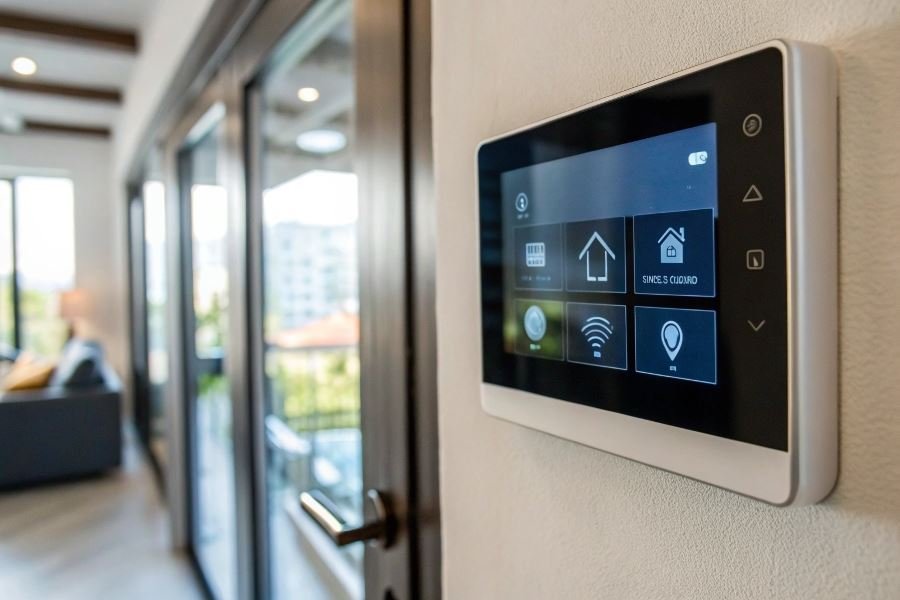
The smartphone has become the command center for modern security systems. Through apps from providers like SimpliSafe and Ring, homeowners can monitor their property from anywhere on earth with an internet connection. These interfaces don’t just display camera feeds—they provide comprehensive system status, alert histories, and granular control over individual components.
The ability to receive real-time notifications has transformed how we respond to potential threats. Whether you’re in a meeting across town or vacationing across the globe, you’ll know instantly if a door opens unexpectedly or smoke is detected. More importantly, you can take immediate action—checking camera feeds, communicating through two-way audio, or even disarming the system for a verified visitor.
Automated Responses That Save Lives
When seconds count, automated response protocols make all the difference. Modern systems don’t just sound alarms—they execute pre-programmed emergency protocols:
- Sequential verification reduces false alarms by confirming threats through multiple sensors
- Zoned responses target specific areas without disrupting the entire property
- Graduated alerts escalate from silent monitoring to full alarm based on threat assessment
The most significant advancement may be direct connections to emergency services. Systems from ADT and Vivint maintain continuous monitoring centers that can dispatch fire, police, or medical assistance without requiring homeowner intervention. Some municipalities now offer priority response to verified smart alarm activations, reducing response times by precious minutes.
Smart systems learn from experience, analyzing patterns to distinguish between normal activities and genuine threats. This machine learning capability means your system becomes more accurate over time, adapting to your household’s unique patterns and reducing nuisance alarms while maintaining vigilance against real dangers.
The ROI Revolution: Smart Security and Fire Alarm Systems
Smart security and fire alarm systems aren’t just fancy tech upgrades—they’re strategic investments that deliver measurable returns. Let’s dive into how these systems transform protection paradigms while simultaneously strengthening bottom lines.
Always-on protection that never sleeps
Modern smart security systems have fundamentally reimagined what “protection” means. Unlike traditional systems that simply sound an alarm, today’s intelligent solutions create an omnipresent security ecosystem.
The 24/7 monitoring capabilities mean your property is never truly unattended. When a smoke detector activates at 3 AM or motion sensors trigger during a holiday weekend, these systems spring into action—sending instant alerts to your smartphone and, if configured, directly to monitoring centers staffed by security professionals.
“The average response time for traditional security systems is 7-8 minutes. Smart systems can cut this down to seconds when it comes to notification—and that time difference can be everything in emergency situations.”
This constant vigilance translates into tangible benefits: faster emergency response times, reduced false alarms through AI-powered verification, and the psychological advantage of always knowing your property’s status, whether you’re across town or across continents.
The financial upside of smarter security
The ROI calculation for smart security extends far beyond preventing theft. Insurance companies have taken notice of these systems’ effectiveness, with many offering substantial premium discounts—typically 5-20% for properties equipped with comprehensive smart security solutions.
Prevention economics tell an even more compelling story. Consider these statistics:
| Incident Type | Average Cost Without Smart System | Potential Savings |
|---|---|---|
| Water Damage | $11,098 per incident | 70-90% reduction |
| Fire Damage | $12,635 per residential incident | 50-80% reduction |
| Burglary | $2,661 per incident (plus business disruption) | 40-60% reduction |
Early detection through smart smoke detectors, water sensors, and security cameras doesn’t just minimize damage—it often prevents catastrophic losses entirely. A $1,500 investment in smart fire detection can prevent tens of thousands in potential damage.
For businesses, the calculus becomes even more favorable when factoring in avoided downtime. When a small water leak is detected before it floods an inventory storage area or server room, the savings extend far beyond the immediate repair costs.
Building for tomorrow with scalable systems
Perhaps the most overlooked advantage of smart security and fire alarm systems is their inherent adaptability. Unlike traditional hardwired systems that require expensive retrofitting to expand, modern smart systems are designed for growth.
This scalability manifests in several ways:
- Modular expansion: Add components as needs evolve without replacing existing infrastructure
- Software updates: Gain new features and capabilities without hardware replacements
- Cross-platform integration: Connect with Google Home, Amazon Alexa, and business management systems
The integration capabilities extend beyond convenience features. Smart security systems now serve as foundational infrastructure for broader automation initiatives. Temperature sensors that protect against freezing pipes can also optimize HVAC efficiency. Motion detectors that watch for intruders can help analyze foot traffic patterns in retail environments.
This future-proofing aspect means today’s investment continues delivering returns as technology evolves, rather than becoming obsolete. The system you install today becomes more valuable tomorrow as it integrates with emerging technologies and adapts to your changing security needs.
Discover how smart security and fire alarm systems provide comprehensive protection through advanced detection, remote monitoring, and automated responses. Learn about cost savings and integration benefits for modern property protection.
Discover how smart security and fire alarm systems provide comprehensive protection through advanced detection, remote monitoring, and automated responses. Learn about cost savings and integration benefits for modern property protection.