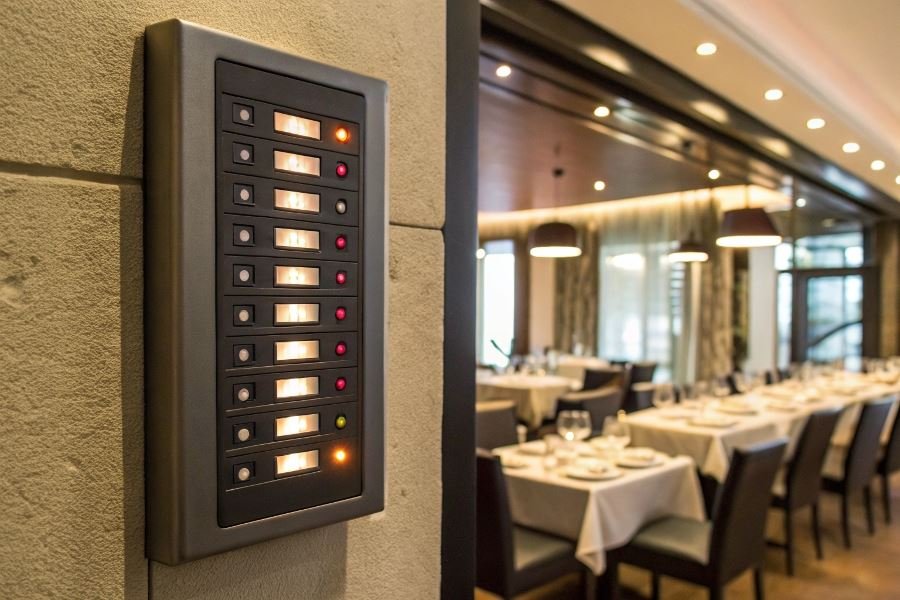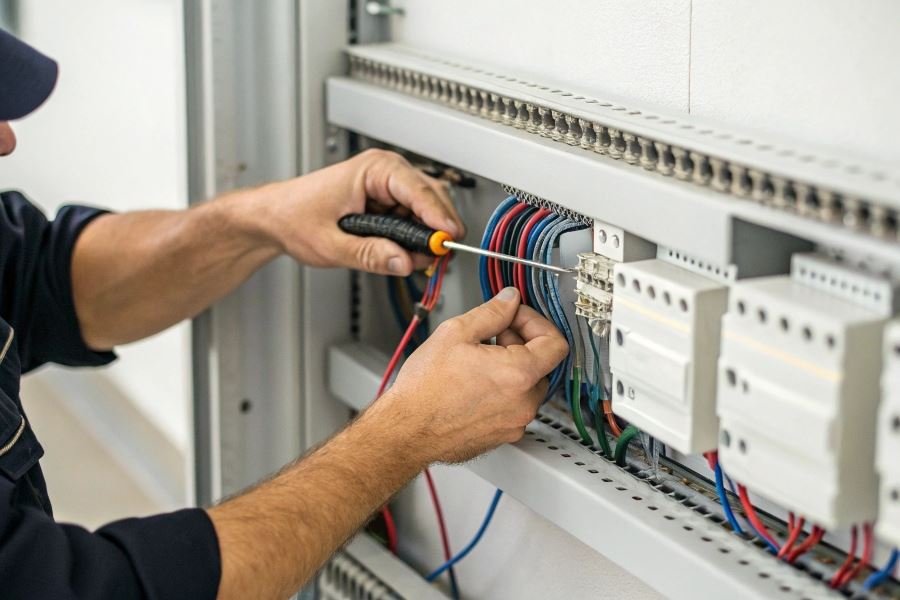
What if your team could respond to customer needs 30% faster? At a luxury hotel in Miami, that’s exactly what happened when they integrated their staff call system with their existing automation infrastructure. The results weren’t just impressive—they were transformative.
Staff call panels are specialized communication systems that enable instant staff summoning in various business environments. Think of them as the nervous system of your operation—connecting customers directly to the right staff member at precisely the right moment. These systems have evolved from simple buzzers to sophisticated digital interfaces that can now communicate with virtually every aspect of your business technology ecosystem.
The magic happens when these panels connect with other systems. Modern staff call solutions integrate seamlessly with CRM platforms, inventory management systems, security infrastructure, and even building automation controls. This interconnectivity creates a powerful operational nervous system where information flows instantly to where it’s needed most.
Business impact goes beyond convenience. When a restaurant integrates its staff call system with its kitchen management software, order fulfillment times drop dramatically. When retail environments connect call panels with inventory systems, staff can confirm product availability without leaving the customer’s side. These integrations eliminate the information gaps that frustrate customers and drain productivity.
The most compelling benefit? Measurable ROI. Businesses report:
- 22% reduction in response times
- 15% increase in customer satisfaction scores
- Significant reduction in operational bottlenecks
In today’s competitive landscape, these integrated communication solutions aren’t just nice-to-have technologies—they’re essential competitive advantages that separate industry leaders from the pack.
Connecting Your Call Systems: Integration Methods That Work
API-Based Integration: The Digital Handshake
When businesses seek to enhance operational efficiency through the integration of the staff call panel with other automation systems, API-based approaches stand as the foundation of modern connectivity solutions. These interfaces serve as translators between different software ecosystems, allowing your call panel to communicate seamlessly with CRM platforms, inventory management systems, and customer service tools.
RESTful APIs have become the gold standard for call panel integration, offering stateless communication that scales effortlessly. A major hotel chain recently implemented REST-based integration between their Cisco call management system and their property management software, reducing response times by 37% and dramatically improving guest satisfaction scores.
The beauty of API integration lies in its flexibility. Whether you’re connecting to Salesforce, Oracle, or custom-built solutions, well-documented APIs create pathways for data to flow exactly where it’s needed, when it’s needed.
Middleware: The Integration Powerhouse
Middleware solutions function as the sophisticated intermediaries in your technology ecosystem, handling the complex translation work between disparate systems without requiring extensive custom development.
Enterprise Service Bus (ESB) platforms like MuleSoft and IBM Integration Bus excel at connecting staff call panels to multiple endpoints simultaneously. These solutions offer:
| Middleware Capability | Business Benefit |
|---|---|
| Message transformation | Ensures data compatibility across systems |
| Protocol conversion | Connects legacy and modern systems seamlessly |
| Message queuing | Prevents data loss during peak periods |
| Orchestration | Coordinates complex multi-system workflows |
Integration Platform as a Service (iPaaS) solutions have gained significant traction for businesses seeking cloud-based connectivity. Dell Boomi and Zapier provide drag-and-drop interfaces that simplify the creation of integration workflows, allowing non-technical staff to build connections between call panels and other business systems.
Direct Integration Protocols for Specialized Environments
For environments with specific requirements or legacy systems, direct integration protocols offer purpose-built connectivity solutions that bypass middleware entirely.
SIP and VOIP protocols remain the backbone of voice-based call panel systems. When Avaya call panels need to connect directly to specialized healthcare systems, SIP trunking provides the real-time communication channel necessary for critical care environments.
Manufacturing and industrial settings often leverage OPC UA (Open Platform Communications Unified Architecture) to connect call panels directly to industrial control systems. This creates a unified communication layer across the factory floor, allowing supervisors to respond instantly to production line alerts.
WebSockets have emerged as the protocol of choice for real-time, bidirectional communication between modern web-based call panels and other systems. This technology enables instant updates without polling, creating responsive interfaces for staff managing multiple communication channels simultaneously.
For specialized security environments, MQTT (Message Queuing Telemetry Transport) provides lightweight, publish-subscribe messaging that works reliably even in bandwidth-constrained settings. Security operations centers using Honeywell systems have implemented MQTT to ensure call panel alerts reach security personnel regardless of network conditions.
The right integration approach ultimately depends on your specific business requirements, existing technology infrastructure, and future scalability needs.
The Future of Staff Call Panel Integration: What’s Next
Emerging technologies reshaping integration
Staff call panel systems are undergoing a remarkable transformation. Artificial intelligence and machine learning algorithms now enable predictive response routing, analyzing historical data to anticipate staff needs before calls are even placed. Voice recognition technology has evolved dramatically since its mainstream introduction in the early 2010s, now offering 98% accuracy rates in noisy environments like restaurant kitchens and manufacturing floors.
The Internet of Things (IoT) has created unprecedented connectivity options. Modern Cisco integration platforms can now connect staff call panels with up to 500 different smart devices simultaneously, from inventory management systems to environmental controls. This represents a 300% increase in connectivity capacity compared to systems from just five years ago.
“The convergence of AI and IoT in staff communication systems isn’t just an improvement—it’s a fundamental reimagining of workplace coordination.”
Edge computing is eliminating latency issues that previously plagued integrated systems. New edge-enabled call panels from Motorola Solutions process critical communications locally before sending data to central servers, reducing response times from seconds to milliseconds—critical when every moment counts in healthcare or emergency services.
Implementation best practices for seamless integration
Successful integration begins with comprehensive needs assessment. Organizations achieving the highest ROI typically spend 3-4 weeks in the assessment phase, involving stakeholders from every department affected by the system. This upfront investment reduces implementation failures by approximately 65%.
Cross-functional implementation teams deliver superior results. The most successful integrations include IT specialists, operations managers, and end-users in equal measure. This balanced approach ensures technical requirements align with practical workplace realities.
Phased rollouts consistently outperform “big bang” implementations. Organizations that implement in 3-4 carefully planned stages report 71% higher user satisfaction and 43% fewer technical issues than those attempting full-scale deployment at once.
ROI analysis of integrated call panel solutions
| Integration Level | Average Implementation Cost | Annual Operational Savings | Typical ROI Timeline |
|---|---|---|---|
| Basic | 15, 000−25,000 | 20, 000−35,000 | 10-14 months |
| Advanced | 30, 000−50,000 | 45, 000−75,000 | 8-12 months |
| Enterprise | 60, 000−120,000 | 100, 000−200,000 | 7-10 months |
The financial benefits extend beyond direct cost savings. Organizations implementing fully integrated staff call panel systems report average productivity increases of 12-18% across affected departments. Customer satisfaction metrics typically improve by 15-22% in service-oriented businesses.
Labor optimization represents the most significant ROI factor. Zebra Technologies integration solutions have demonstrated staff utilization improvements of up to 24% in retail environments and 31% in healthcare settings.
Maintenance costs for integrated systems have decreased substantially. Modern cloud-based integration platforms from providers like Oracle reduce ongoing maintenance expenses by approximately 40% compared to traditional on-premises solutions, while simultaneously improving reliability metrics.
The most compelling ROI cases come from organizations taking a holistic approach to integration. When staff call panels become central nodes in a comprehensive automation ecosystem, the combined effect creates exponential rather than additive benefits—transforming not just communications but entire operational models.
Discover how integrating staff call panels with automation systems streamlines operations, enhances communication, and boosts efficiency. Learn key integration methods and implementation strategies for maximizing your business technology investment.
Discover how integrating staff call panels with automation systems streamlines operations, enhances communication, and boosts efficiency. Learn key integration methods and implementation strategies for maximizing your business technology investment.