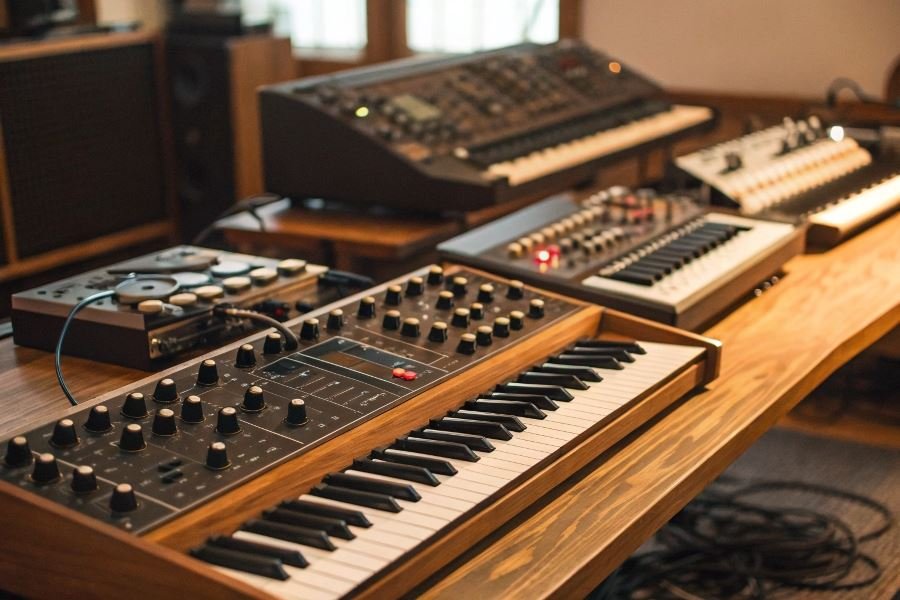
Ever wondered how those otherworldly sounds in your favorite tracks are created? Behind every hypnotic bassline and ethereal pad lies a powerful tool: the synthesizer module.
Synthesizer modules are the building blocks of electronic sound creation—specialized components that generate, modify, or control audio signals. Unlike all-in-one keyboards, these modular units offer unprecedented flexibility, allowing musicians and sound designers to construct custom instruments that perfectly match their creative vision. Each module serves a specific function: oscillators create raw tones, filters sculpt the sound’s character, and envelope generators control how sounds evolve over time.
The journey of synthesizer technology is nothing short of remarkable. From the massive modular systems of the 1960s that filled entire rooms to today’s compact Eurorack format that dominates the market, synthesizers have undergone dramatic transformation. What once required technical expertise and substantial investment is now accessible to creators at various skill levels and budgets.
The evolution of sound architecture
The modular synthesis renaissance began around 2010, with manufacturers like Make Noise and Mutable Instruments pioneering innovative designs that combined vintage warmth with modern precision. Today’s landscape features hundreds of module makers, from boutique artisans crafting hand-built modules to established companies producing cutting-edge digital hybrids.
Finding your perfect sonic companion
Choosing the right synthesizer module isn’t merely about specifications—it’s about finding tools that speak to your musical language. Whether you’re crafting cinematic soundscapes, producing dance tracks, or exploring experimental territories, your module selection will fundamentally shape your creative possibilities. The perfect module becomes an extension of your artistic voice, inspiring new directions rather than limiting your expression.
The Technical Heart of Synthesizer Modules
When diving into the world of synthesizer modules, understanding the technical characteristics becomes your compass for navigating countless options. The difference between a good module and the perfect module often lies in these specifications that determine not just sound quality, but also how the module integrates into your existing setup.
Sound generation represents the fundamental starting point when evaluating key characteristics when choosing a synthesizer module. Each method creates distinctly different sonic personalities that can dramatically shape your music. Analog synthesis uses continuous voltage-controlled oscillators to generate warm, imperfect waveforms with natural variations that many musicians prize for their organic quality. Digital synthesis, by contrast, offers pristine mathematical precision, allowing for perfect reproduction and complex algorithms impossible in the analog domain. Moog modules exemplify the rich, fat tones of analog, while Native Instruments has mastered digital precision.
Hybrid synthesizers combine both worlds, using digital control systems to manage analog sound generation components. Wavetable synthesis, pioneered by PPG in the early 1980s, stores single-cycle waveforms in tables that can be scanned through, creating evolving timbres impossible with traditional methods.
Connectivity: The Social Life of Your Module
A synthesizer module’s connectivity options determine how well it plays with others in your setup. Modern modules typically offer multiple interface standards:
| Connection Type | Typical Use | Advantages |
|---|---|---|
| CV/Gate | Analog control | Direct, low-latency signal path |
| MIDI | Digital communication | Standardized, widespread compatibility |
| USB | Computer integration | Convenient for DAW control |
| Audio I/O | Signal routing | Determines integration flexibility |
The number and type of inputs and outputs directly impact workflow possibilities. Modules with extensive connectivity like those from Expert Sleepers excel at bridging different systems, while others prioritize simplicity with focused connection options.
Polyphony: How Many Voices Can Speak at Once
Polyphony capabilities determine how many notes your synthesizer can play simultaneously—a critical factor that affects everything from performance options to sound design possibilities.
Monophonic modules play just one note at a time, forcing a decision: will the newest note take priority (last note priority), or will the first-pressed note remain until released (first note priority)? This limitation becomes a creative feature in lead and bass lines where note articulation matters tremendously.
Paraphonic synthesis offers a middle ground, using a single filter for multiple oscillators. This allows playing chords, but with all notes sharing the same amplitude envelope—creating a distinctive sound when notes overlap.
True polyphonic modules allocate complete voice circuits for each note, allowing independent articulation. Voice allocation algorithms determine how these voices are assigned when you exceed the available polyphony. Some modules use sophisticated voice stealing techniques that analyze note age and importance, while others follow simpler round-robin approaches.
The Sequential Prophet series demonstrates how polyphony evolved from the groundbreaking five-voice Prophet-5 to modern modules offering 16+ voices, each with independent filters, envelopes, and modulation options.
Understanding these technical characteristics ensures you select a synthesizer module that not only sounds exceptional but integrates seamlessly with your creative process and existing equipment.
Performance and Usability That Defines Your Sound
When selecting a synthesizer module, the technical specifications only tell half the story. The true measure of any synth lies in how it performs under your fingertips and how seamlessly it integrates into your creative workflow. Let’s explore the critical performance and usability characteristics that separate merely adequate modules from truly exceptional ones.
Interface Design That Speaks Your Language
The interface of a synthesizer module represents the crucial meeting point between your musical ideas and their sonic realization. The best interfaces achieve a delicate balance—providing immediate access to essential parameters while maintaining a logical organization for deeper sound design.
Knob-per-function designs like those found in the Moog Mother-32 offer immediate tactile control, eliminating menu-diving and fostering a more intuitive relationship with sound creation. In contrast, modules like the Elektron Digitone employ context-sensitive encoders and clear visual feedback systems that maximize functionality in compact spaces.
The accessibility of programming directly impacts how likely you are to explore a synthesizer’s full potential rather than relying on presets.
For complex systems, look for:
- Logical parameter grouping
- Clear visual feedback
- Intuitive navigation between pages
- Shortcut functions for common operations
- Comprehensive but readable displays
Modulation Capabilities That Breathe Life Into Sound
A synthesizer’s modulation architecture determines whether it produces static, lifeless tones or dynamic, evolving soundscapes. Modern modules have dramatically expanded modulation possibilities beyond the basic LFOs and envelopes of vintage designs.
| Modulation Type | Function | Impact on Sound Design |
|---|---|---|
| LFOs | Cyclical parameter changes | Creates movement and rhythm |
| Envelopes | Time-based parameter shaping | Defines sound articulation |
| Step Sequencers | Precise parameter automation | Enables complex patterns |
| Random Generators | Unpredictable variations | Adds organic qualities |
| Cross-modulation | Modulation sources affecting each other | Creates complex, evolving textures |
The Make Noise Maths exemplifies modulation flexibility, functioning as envelope generators, LFOs, and complex function generators simultaneously. Meanwhile, the Arturia MicroFreak offers a modulation matrix that allows virtually any parameter to be controlled by any modulation source.
Sound design flexibility extends beyond modulation to include:
- Multiple synthesis methods within one module
- Extensive filter options with character variations
- Ability to process external audio
- Comprehensive effects integration
- Patch memory depth and organization
Build Quality That Stands The Test Of Time
The physical construction of a synthesizer module directly impacts both its reliability and the quality of the musical experience it provides.
Premium components translate to more precise control, consistent performance, and significantly longer service life.
When evaluating build quality, consider:
- Control feel and precision – Smooth potentiometers and solid encoders provide more accurate parameter adjustments and tactile satisfaction
- Chassis construction – Robust metal enclosures like those on the Sequential Prophet Rev2 protect internal components and reduce electromagnetic interference
- Connection quality – Gold-plated connectors and reinforced jacks prevent signal degradation and mechanical failure
- Power supply design – Clean, stable power delivery prevents noise issues and component stress
- Component selection – Premium capacitors and resistors in the signal path contribute to superior sound quality
The reliability factor becomes particularly crucial for touring musicians and studios where downtime means lost revenue. Manufacturers like Elektron and Vermona have built reputations on creating instruments that maintain performance integrity through years of intensive use.
Remember that the most powerful synthesizer module is the one that inspires you to create consistently. The perfect balance of interface accessibility, modulation depth, and physical reliability creates an instrument that disappears into your creative process rather than interrupting it.
Discover the essential technical and performance characteristics for selecting the perfect synthesizer module. Learn about sound generation methods, connectivity options, interface design, and how to balance features with budget constraints.
Discover the essential technical and performance characteristics for selecting the perfect synthesizer module. Learn about sound generation methods, connectivity options, interface design, and how to balance features with budget constraints.