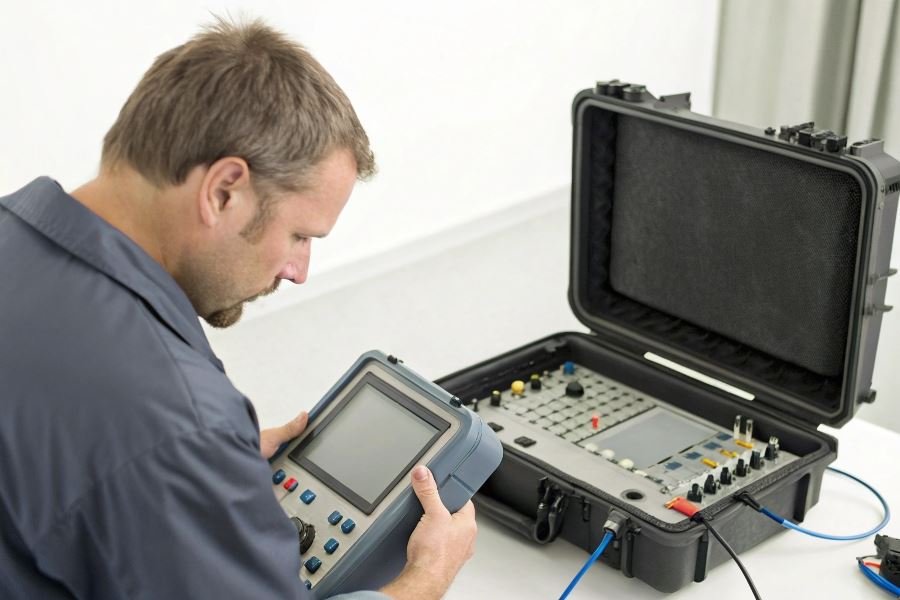
Ever wondered why some measurements are trusted implicitly while others raise eyebrows? The difference often lies in proper calibration—the unsung hero of measurement accuracy that separates professionals from amateurs.
Voltage and current calibrators represent the gold standard in electrical measurement verification, serving as the critical reference points against which all other instruments are judged. These sophisticated devices generate precise electrical values that allow technicians to verify, adjust, and maintain the accuracy of measurement equipment across industries—from manufacturing to aerospace, utilities to medical devices.
At their core, calibrators function as exceptionally stable sources of electrical signals. A quality voltage calibrator can produce anything from microvolts to hundreds of volts with accuracy measured in parts per million, while current calibrators deliver precisely controlled currents from nanoamps to dozens of amperes. This remarkable precision doesn’t happen by accident—it results from meticulous engineering and adherence to established calibration hierarchies.
Why selection matters: Choosing the wrong calibrator is like bringing a butter knife to a surgical procedure. The consequences range from minor inconsistencies to catastrophic failures, particularly in applications where lives or millions of dollars hang in the balance. The National Institute of Standards and Technology (NIST) maintains the primary standards in the US, with a chain of traceability flowing down to the instruments on your workbench.
“The cost of poor calibration isn’t measured in dollars spent, but in confidence lost.”
Understanding calibration traceability
Traceability—the unbroken chain of comparisons to national standards—forms the backbone of meaningful calibration. Without it, measurements exist in isolation, lacking the universal validity that modern industry demands. Every professional-grade calibrator should come with documentation linking its performance to these recognized standards, typically through ISO/IEC 17025 accredited laboratories.
Matching Calibrators to Your Measurement Mission
When selecting voltage and current calibrators, the decision-making process resembles a precision engineering challenge itself. The right calibrator transforms your measurement capabilities, while the wrong one introduces frustration and uncertainty into your workflow. Understanding how to evaluate these instruments based on your specific application needs separates measurement professionals from casual users.
The features of selection for different tasks when choosing voltage and current calibrators depend primarily on three critical factors: accuracy specifications, range capabilities, and environmental considerations. Each application—whether it’s calibrating sensitive medical equipment, validating industrial control systems, or certifying aerospace components—demands a unique balance of these attributes.
Precision Matters: Accuracy and Uncertainty
Accuracy specifications represent the cornerstone of calibrator selection. For high-precision laboratory work, look for calibrators offering uncertainties in the range of ±0.002% or better. The Fluke 5730A multifunction calibrator, for example, delivers base voltage accuracies of 3.5 ppm, making it suitable for calibrating 6½-digit multimeters.
For industrial applications, mid-range accuracies of ±0.01% to ±0.05% typically suffice. However, remember that published specifications tell only part of the story:
The true measure of a calibrator’s performance isn’t its best-case accuracy, but its performance under your specific measurement conditions.
Consider these critical uncertainty factors:
- Temperature coefficients (how accuracy changes with ambient temperature)
- Long-term stability (drift over time)
- Output noise (especially important for low-level measurements)
- Loading effects (how the device under test affects calibrator performance)
Range and Resolution: Meeting Measurement Demands
| Application Type | Typical Voltage Range | Typical Current Range | Minimum Resolution |
|---|---|---|---|
| Electronics Lab | 0-1000V | 0-10A | 1µV, 0.1µA |
| Industrial | 0-1000V | 0-20A | 10µV, 1µA |
| Field Service | 0-600V | 0-10A | 100µV, 10µA |
Range requirements vary dramatically across applications. Calibrating sensitive analog circuits might require microvolts and nanoamps, while power system testing demands hundreds of volts and tens of amps. The Keysight 3458A digital multimeter, for instance, requires a calibrator capable of extremely low-noise microvolt outputs.
Resolution capabilities must match your most demanding measurement scenarios. For calibrating 8½-digit multimeters, you’ll need voltage resolution down to 0.1µV and current resolution to 0.1nA. For general industrial calibration, 1µV and 0.1µA typically suffice.
Portability vs. Performance: Environmental Realities
Field technicians face fundamentally different challenges than laboratory metrologists. The Transmille 3041 portable calibrator weighs under 15 pounds while delivering laboratory-grade performance, making it ideal for on-site calibrations.
When evaluating portable calibrators, consider:
- Battery life – Minimum 8 hours for a full workday
- Environmental specifications – Operating temperature range, humidity tolerance
- Physical durability – Shock resistance, ingress protection
- Warm-up time – Critical when moving between locations
Laboratory bench-top models like the Fluke 5522A prioritize stability and accuracy over portability, featuring temperature-controlled reference circuits and extensive shielding against electromagnetic interference.
The environmental conditions where you’ll use your calibrator dramatically impact performance. Temperature variations of just 1°C can degrade accuracy specifications by a factor of two or more in some instruments, making temperature compensation capabilities essential for field units.
Unlocking Advanced Calibration Power
Multi-function calibrators that do it all
Today’s calibration challenges demand versatility. Multi-function calibrators have evolved dramatically, offering comprehensive testing capabilities that eliminate the need for multiple instruments. The Fluke 754 Documenting Process Calibrator exemplifies this evolution, handling temperature, pressure, voltage, current, and resistance in a single unit.
What makes these powerhouses exceptional is their ability to:
- Simulate and measure across multiple parameters simultaneously
- Provide accuracy levels reaching ±0.01% of reading
- Operate in harsh field conditions with robust construction
- Reduce equipment investment by 60-70% compared to single-function alternatives
The integration factor matters enormously. When selecting a multi-function calibrator, evaluate whether it truly integrates functions or merely combines them. True integration means the calibrator understands relationships between parameters—like temperature and resistance—enabling more sophisticated testing scenarios.
The difference between a collection of functions and true integration is the difference between owning tools and mastering a craft.
Documentation capabilities for regulated environments
In FDA-regulated industries, pharmaceutical manufacturing, and aerospace applications, the mantra remains: if it isn’t documented, it didn’t happen. Modern calibrators have responded with robust documentation features that transform compliance from burden to advantage.
The Beamex MC6 Advanced Field Calibrator exemplifies this evolution with:
| Documentation Feature | Compliance Benefit |
|---|---|
| As-found/as-left data capture | Audit-ready evidence |
| Electronic signatures | 21 CFR Part 11 compliance |
| Automated error calculation | Elimination of human error |
| Customizable test templates | Standardized procedures |
Automation capabilities extend beyond mere convenience. Automated calibration sequences reduce human error by up to 90% while cutting calibration time by 50-75%. This translates directly to operational efficiency and compliance confidence.
Connectivity reshaping calibration workflows
The isolated calibrator is becoming extinct. Today’s calibration workflows demand seamless connectivity and software integration that transforms data into actionable intelligence.
Modern calibrators offer:
Wireless connectivity options including Bluetooth, Wi-Fi, and even cellular connections for remote locations. The Endress+Hauser MC6-T temperature calibrator can transmit results instantly from field locations to central databases.
Cloud integration enabling real-time calibration status monitoring across facilities. This visibility transforms maintenance from reactive to predictive, with some systems reducing unexpected downtime by up to 45%.
API accessibility allowing calibration data to flow into enterprise asset management systems. This integration eliminates data silos, creating a single source of truth for instrument performance.
Software ecosystems have become as important as hardware specifications. When evaluating calibrators, consider not just the device but the entire data ecosystem it participates in. The GE Druck PACE 6000 pressure controller/calibrator offers exemplary software integration that connects calibration activities directly to maintenance planning systems.
The most advanced calibrators now incorporate machine learning algorithms that analyze calibration trends, predicting when instruments will drift out of specification before failures occur—transforming calibration from a compliance activity to a strategic advantage.
Discover how to select the ideal voltage and current calibrator for your specific measurement needs. Learn about accuracy specifications, range capabilities, and advanced features that ensure precision in industrial calibration tasks.
Discover how to select the ideal voltage and current calibrator for your specific measurement needs. Learn about accuracy specifications, range capabilities, and advanced features that ensure precision in industrial calibration tasks.