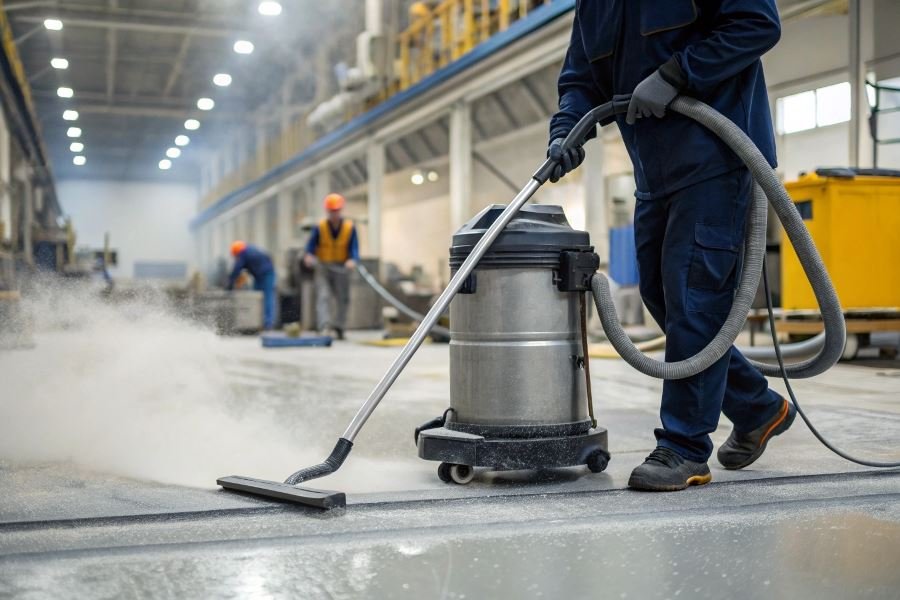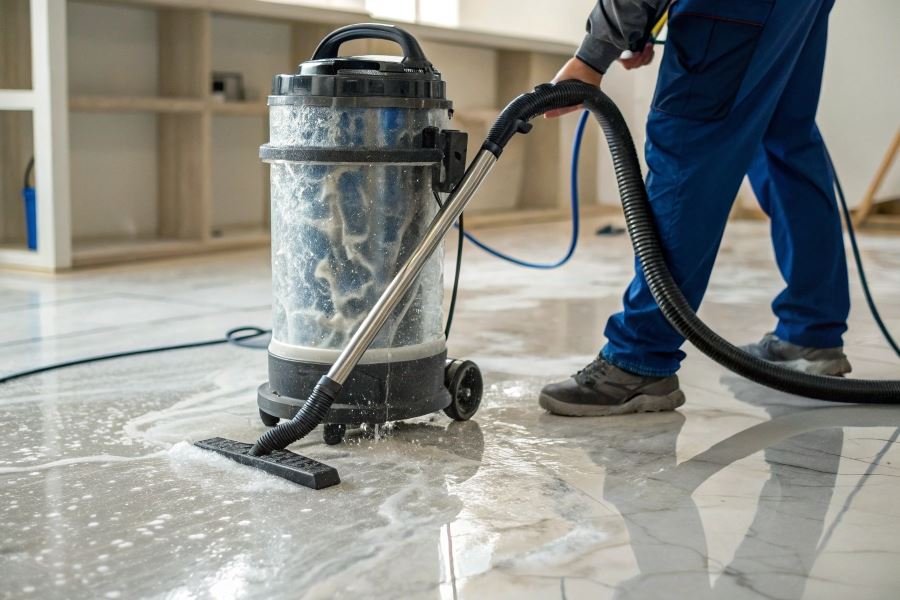
Ever walked into a manufacturing plant after a major spill and wondered how they clean up gallons of liquid without shutting down for days? The answer isn’t an army of mops—it’s industrial wet vacuum technology that can extract 75 gallons of liquid in under 10 minutes.
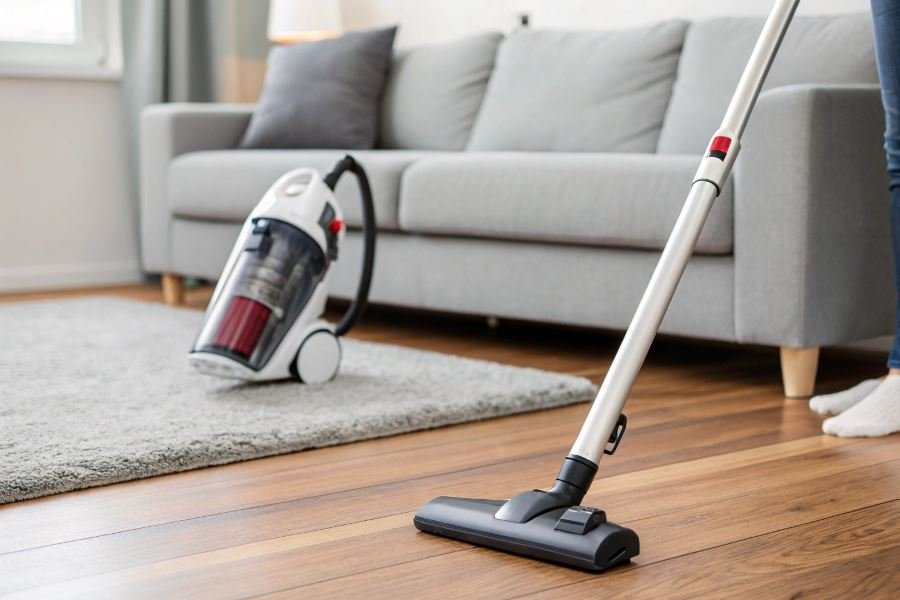
Industrial vacuum cleaners for wet cleaning represent specialized equipment designed to handle what ordinary cleaning tools simply cannot. These powerhouses tackle liquids, sludge, and wet debris with remarkable efficiency across manufacturing floors, warehouses, and commercial spaces. Unlike their residential counterparts, industrial wet vacuums aren’t just scaled-up versions of what you’d use at home—they’re engineered from the ground up for continuous operation in demanding environments.
Beyond household cleaning: industrial-grade differences
The gap between household and industrial wet vacuums extends far beyond size. Industrial models feature:
- Tank capacities ranging from 10 to 200+ gallons (compared to 1-5 gallons in household units)
- Motor systems designed for 8+ hours of continuous operation
- Filtration technology that captures particles down to 0.3 microns
- Construction materials resistant to chemicals, oils, and corrosive substances
Industry-specific applications
Wet industrial vacuums serve distinct purposes across sectors:
“In food processing, wet vacuums must meet stringent sanitation requirements while handling organic waste. In metalworking, the same equipment might need to collect cutting fluids and metal shavings without damage to internal components.”
From pharmaceutical clean rooms to automotive manufacturing, these machines adapt to unique environmental challenges. Chemical plants rely on them for hazardous material recovery, while construction sites use them to manage water intrusion and concrete slurry—demonstrating their remarkable versatility across the industrial landscape.
Essential Features for Industrial Wet Vacuum Selection
When diving into the world of heavy-duty cleaning equipment, understanding the critical components that make industrial vacuum cleaners effective for wet cleaning can save you thousands in operational costs and countless hours of frustration. These powerhouse machines aren’t just oversized versions of your home vacuum—they’re specialized tools engineered for demanding environments.
The process of evaluating industrial vacuum cleaners for wet cleaning: features of selection requires careful consideration of several key specifications that directly impact performance and longevity. Professional cleaning contractors and facility managers who’ve spent years in the field know that three critical elements determine whether your investment will shine or disappoint: tank design, motor capability, and filtration technology.
Tank Capacity and Construction Materials
The heart of any wet vacuum is its collection tank. Size matters—but so does what it’s made from.
Capacity considerations should align with your specific application needs:
- Small operations: 5-15 gallon tanks offer maneuverability
- Medium facilities: 15-30 gallon tanks balance capacity and mobility
- Large industrial settings: 30+ gallon tanks minimize emptying frequency
Tank construction materials directly impact durability and chemical resistance:
| Material | Advantages | Best Applications |
|---|---|---|
| Stainless Steel | Corrosion resistant, sanitizable | Food processing, pharmaceutical |
| Polyethylene | Lightweight, impact resistant | General industrial, construction |
| Polypropylene | Chemical resistant, affordable | Chemical handling environments |
The Nilfisk S3 series exemplifies how premium stainless steel construction extends service life in harsh environments, while Karcher NT models demonstrate how rotomolded polyethylene can withstand significant abuse without cracking.
Suction Power and Motor Specifications
The muscle behind wet vacuum performance comes from its motor system. Don’t be fooled by marketing hype—understand the metrics that matter.
Airflow (CFM) typically ranges from 90-200 CFM in industrial models. This measurement indicates how much air the vacuum moves and directly affects liquid pickup speed. For heavy liquid recovery, look for 150+ CFM.
Water lift (measured in inches) reveals suction strength—critical for lifting water through hoses:
- 80-100 inches: Suitable for basic applications
- 100-130 inches: Standard industrial performance
- 130+ inches: Heavy-duty liquid recovery
Motor configuration affects both performance and maintenance costs:
- Single-stage motors deliver higher airflow
- Multi-stage motors provide greater water lift
- Bypass motors separate cooling air from working air, extending life when handling wet materials
The DeWalt DXV series demonstrates how bypass motor technology prevents premature failure during extended wet operation.
Filtration Systems and Water Separation Technology
The unsung hero of wet vacuum performance is its filtration system. This component determines whether water stays where it belongs and whether fine particles are captured effectively.
Float mechanisms prevent motor damage by automatically shutting off suction when the tank reaches capacity. Look for:
- Multi-stage float systems that provide reliable shutdown
- Electronic water-level sensors in premium models
Water separation efficiency varies dramatically between models:
- Basic cyclonic separation
- Advanced multi-cyclone technology
- Specialized demisting chambers in premium units
Filter options for wet applications include:
- Washable polyester filters for general use
- HEPA filtration for environments requiring particulate control
- Specialized chemical-resistant filters for hazardous materials
The Milwaukee wet/dry vacuums showcase innovative filter placement that maintains airflow even as water levels rise, while Makita models feature quick-change filter systems that minimize downtime during transitions between wet and dry applications.
The Power Trio: Industrial Vacuum Cleaners for Wet Cleaning
When facility maintenance demands serious liquid handling capabilities, not just any vacuum will do. Industrial wet vacuum cleaners represent specialized equipment engineered to tackle the messiest situations with efficiency and safety. Let’s dive into the three dominant categories that define this market and explore what makes each one shine in its respective domain.
Single-phase champions for everyday challenges
Single-phase industrial vacuum cleaners represent the workhorses of the wet cleaning world. Operating on standard 110-120V power supplies, these machines deliver impressive performance without requiring specialized electrical infrastructure.
Key selection factors:
- Suction power typically ranging from 2,000 to 3,000 watts
- Tank capacities between 15-40 gallons
- Mobility features including robust casters and ergonomic handles
- Noise levels (look for units under 75 dB for noise-sensitive environments)
These units excel in retail spaces, small workshops, and medium-sized facilities where occasional spills and regular maintenance cleaning are the norm. The Nilfisk ATTIX 33 series exemplifies this category with its balance of power and maneuverability.
The ideal single-phase vacuum offers the perfect balance between power consumption and cleaning performance—sufficient muscle without tripping breakers.
Three-phase powerhouses for industrial demands
When continuous operation and maximum suction power become non-negotiable requirements, three-phase industrial vacuum cleaners enter the conversation. These machines connect to 208-460V three-phase power systems common in manufacturing facilities and industrial settings.
Selection criteria for heavy-duty applications:
- Motor power ranging from 4 to 25 HP (3-18.5 kW)
- Reinforced filtration systems with automatic cleaning mechanisms
- Tank capacities from 50 to 200+ gallons
- Construction materials (stainless steel for corrosive environments)
| Feature | Standard Model | Heavy-Duty Model | Ultra-Industrial |
|---|---|---|---|
| Motor Power | 4-7 HP | 10-15 HP | 20+ HP |
| Tank Capacity | 50-75 gal | 100-150 gal | 150-200+ gal |
| Airflow | 300 CFM | 500 CFM | 700+ CFM |
| Filter Area | 2-3 m² | 3-5 m² | 5-8 m² |
The Delfin DG VL 185 represents this category’s capabilities with its robust construction and continuous duty cycle design.
Specialized solutions for hazardous environments
When dealing with hazardous materials or explosive atmospheres, specialized industrial vacuum cleaners become essential safety equipment rather than mere cleaning tools.
Critical selection factors:
- ATEX/explosion-proof certifications for specific zone classifications
- HEPA/ULPA filtration with 99.995% efficiency at 0.3 microns
- Material-specific features (conductive components for combustible dust)
- Containment systems for toxic substance collection and disposal
These specialized units often feature:
- Grounding systems to prevent static electricity buildup
- Sealed collection systems for hazardous waste containment
- Specialized filters for particular contaminants (mercury, lead, asbestos)
- Documentation capabilities for regulatory compliance
The Ruwac NA35 series demonstrates how these specialized machines integrate safety features with powerful wet collection capabilities for environments where standard equipment would create unacceptable risks.
When selecting between these three categories, the decision ultimately hinges on application requirements, facility infrastructure, and safety considerations. The right industrial vacuum cleaner transforms wet cleaning from a dreaded chore into a streamlined process that protects both facilities and the people who maintain them.
Discover the essential features of industrial wet vacuum cleaners for professional cleaning tasks. Learn how to select the right model based on tank capacity, suction power, and filtration systems for optimal performance in various industrial environments.
Discover the essential features of industrial wet vacuum cleaners for professional cleaning tasks. Learn how to select the right model based on tank capacity, suction power, and filtration systems for optimal performance in various industrial environments.