What if I told you the difference between a safe winter drive and a dangerous skid could come down to a simple choice between liquid and solid? When temperatures plummet and roads transform into potential hazards, the science behind what keeps us safe becomes critically important.
The fight against ice formation involves two distinct approaches: anti-icing (preventing ice before it forms) and deicing (removing ice after it’s formed). This distinction is crucial—prevention typically requires 4-5 times less material than remediation, making anti-icing both economically and environmentally superior.
The science of ice prevention
At its core, anti-icing works by lowering the freezing point of water. When solutions with lower freezing points than water are applied to surfaces, they create a barrier that prevents ice crystal formation. This process, called freezing point depression, is the fundamental principle behind all anti-icing agents.
Liquid anti-icing agents: Precision in application
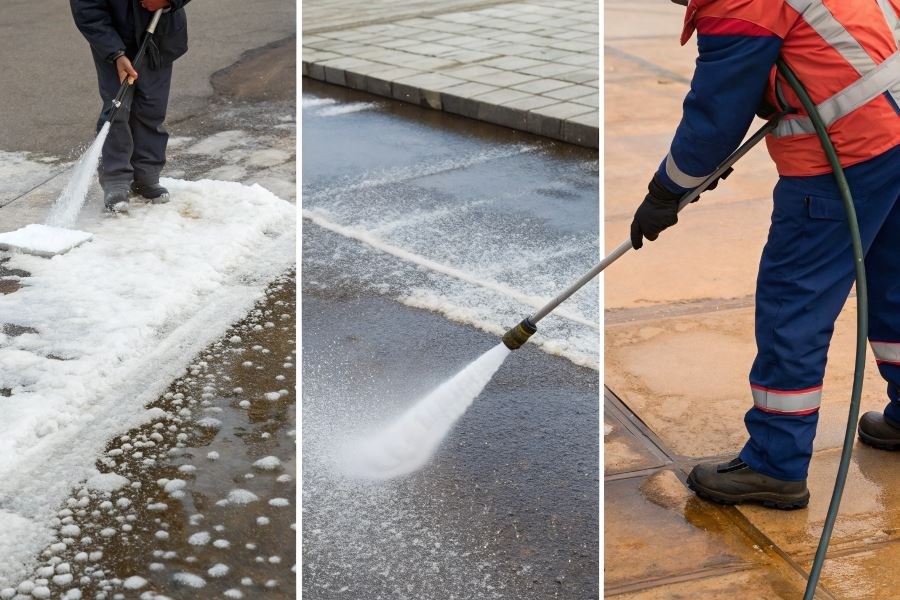
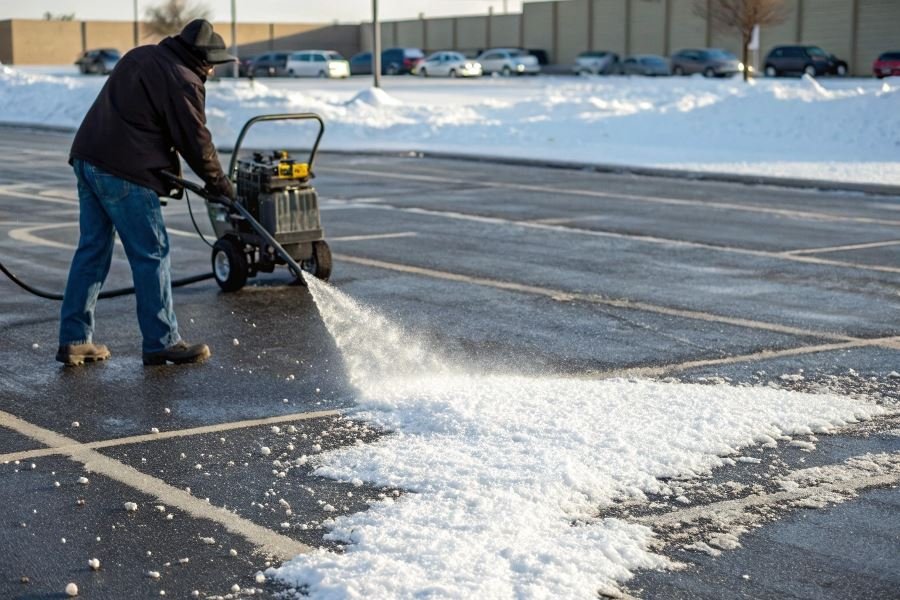
Liquid agents—primarily salt brines, magnesium chloride, and calcium chloride solutions—offer remarkable versatility. These solutions typically contain 23-32% salt concentration and are applied using specialized spray equipment at rates of 20-50 gallons per lane mile.
Key advantage: Liquid solutions immediately begin working upon contact with the pavement, creating a bond-breaking layer that prevents ice from adhering to surfaces. They can be applied up to 72 hours before a storm, making them ideal for proactive maintenance.
Granular anti-icing: The traditional approach
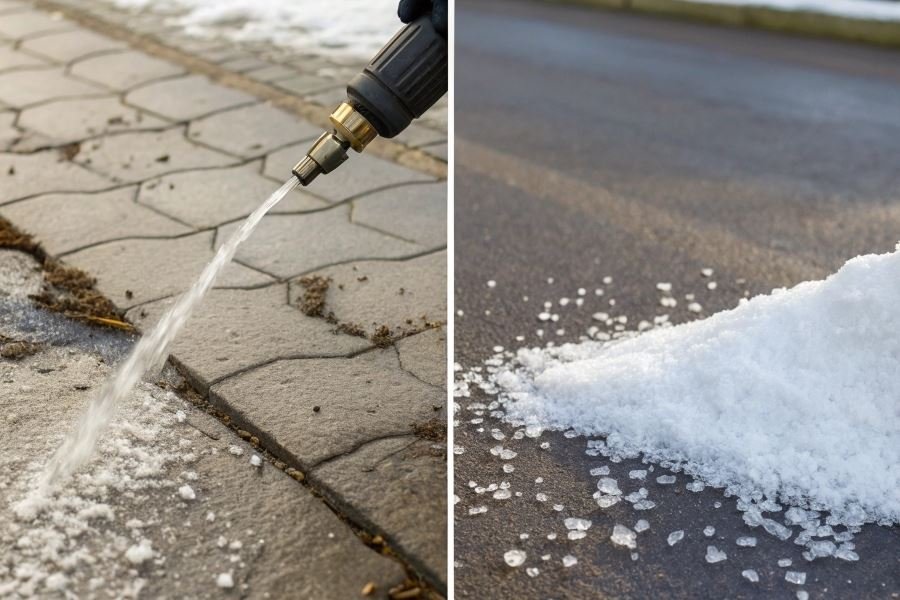
Granular agents—rock salt (sodium chloride), calcium chloride pellets, and sand-salt mixtures—work through a different mechanism. These solid materials must first absorb moisture to create a brine solution that then lowers the freezing point.
“Granular materials require moisture activation, which means they work best when there’s already some precipitation or humidity present,” explains the American Public Works Association’s winter maintenance guidelines.
Application typically involves truck-mounted spreaders distributing 100-300 pounds per lane mile, with effectiveness varying based on temperature and moisture conditions.
The effectiveness question isn’t simply which form is better—it’s about which form is right for specific conditions. The answer lies in understanding both the science and the practical application methods of these critical winter safety tools.
The Battle of the Melters: Liquid vs Granular Anti-Icing Agents
Temperature Performance: The Breaking Point
When winter strikes, the effectiveness of your anti-icing strategy hinges critically on temperature. Liquid anti-icing agents typically activate faster at moderate cold temperatures (20°F to 32°F/-6°C to 0°C), creating an immediate barrier between pavement and precipitation. Their ability to spread evenly and begin working instantly gives them a distinct advantage in these conditions.
The debate around liquid vs granular anti-icing agents: which is more effective often centers on extreme temperature performance. When thermometers plunge below 15°F (-9°C), granular products like calcium chloride and magnesium chloride demonstrate superior melting capacity. These crystalline warriors continue working effectively down to -25°F (-32°C) in some formulations, while many liquid solutions become significantly less effective below 10°F (-12°C).
Temperature performance testing by the Strategic Highway Research Program revealed that granular sodium chloride loses effectiveness below 15°F (-9°C), while enhanced liquid formulations containing calcium chloride maintained 60% effectiveness down to 0°F (-18°C).
Precipitation Battles: Snow vs Ice vs Sleet
The type and intensity of precipitation dramatically alter the effectiveness equation:
| Precipitation Type | Liquid Advantage | Granular Advantage |
|---|---|---|
| Light Snow | High (preventative) | Low (may blow away) |
| Heavy Snow | Medium | High (longer-lasting) |
| Freezing Rain | Very High | Medium |
| Sleet | Medium | High |
| Black Ice | Very High | Low |
Liquid agents excel in freezing rain scenarios, creating a protective barrier that prevents ice bonding. Their ability to remain in place during rainfall gives them a significant edge over granulars, which can wash away before fully activating.
For heavy snowfall exceeding 1 inch per hour, granular products demonstrate superior staying power. The crystalline structure allows for a time-released melting effect, continuing to work as snow accumulates. This persistent action makes granular options preferable during extended winter storms.
Surface Compatibility: Not All Pavement Is Created Equal
The effectiveness of anti-icing treatments varies dramatically across different infrastructure types:
Highway systems benefit from liquid pre-treatments applied up to 48 hours before expected storms. The Minnesota Department of Transportation documented a 33% reduction in accident rates on highways pre-treated with liquid sodium chloride brine compared to untreated or granular-treated sections during equivalent storm conditions.
Walkways and pedestrian areas present unique challenges. Granular agents provide visual confirmation of treatment and offer better traction enhancement—a critical safety factor. However, they pose greater risks to vegetation and can be tracked into buildings, damaging flooring.
Airport runways demand specialized solutions. Potassium acetate-based liquid deicers dominate this sector due to their non-corrosive properties and FAA approval. These specialized formulations outperform traditional granular options by 40% in runway friction tests while minimizing aircraft corrosion risks.
The most effective winter maintenance programs increasingly implement hybrid approaches—using liquid pre-treatments followed by strategic granular application during storms. This combination leverages the preventative power of liquids with the longevity and visual confirmation benefits of granulars, creating a comprehensive defense against winter’s worst.
Making Dollars and Sense of Anti-Icing Agents
When winter’s icy grip threatens safety and mobility, choosing between liquid and granular anti-icing agents becomes a critical decision with significant financial and environmental implications. The right choice can save thousands of dollars while minimizing environmental impact—but the wrong one might leave you spinning your wheels both literally and financially.
The true cost equation
Initial investment in anti-icing systems varies dramatically between liquid and granular applications. Liquid systems typically require more substantial upfront capital—specialized storage tanks, pumping equipment, and spray systems can range from $5,000 for basic setups to over $100,000 for comprehensive municipal systems. Granular spreaders, by comparison, generally start around $2,000 for walk-behind models and reach $25,000 for truck-mounted professional units.
However, the operational math tells a different story:
| Cost Factor | Liquid Agents | Granular Agents |
|---|---|---|
| Application rate | 20-50 gallons per lane mile | 100-300 pounds per lane mile |
| Reapplication frequency | Lower (preventative) | Higher (reactive) |
| Equipment maintenance | Higher complexity | Lower complexity |
| Labor hours | Fewer applications needed | More frequent application |
The efficiency advantage of liquid solutions becomes apparent when calculating season-long expenses. While granular materials may cost less per ton, their higher application rates and frequency requirements often result in 20-30% higher material costs over a complete winter season.
Environmental footprint matters
The sustainability equation extends beyond immediate costs:
Liquid anti-icing agents typically deliver superior environmental performance through:
- Precise application that reduces overall chemical usage by up to 30%
- Lower chloride loading in watersheds due to better adherence to road surfaces
- Reduced material waste from overapplication and bounce-and-scatter
Granular agents, while improving in formulation, still face challenges:
- Higher total material usage
- Greater potential for waterway contamination
- More physical displacement into roadside vegetation
Many municipalities have discovered that switching to liquid applications has reduced their total salt usage by 25-40%, significantly decreasing environmental impact while simultaneously cutting costs.
Matching solutions to specific scenarios
The most successful anti-icing programs recognize that neither option represents a universal solution. Consider these optimization strategies:
-
Temperature-based selection: Liquid brines perform optimally at temperatures above 15°F, while certain granular products maintain effectiveness down to -25°F
-
Traffic patterns matter: High-volume roadways benefit from liquid pre-treatment, while granular applications may be more suitable for low-traffic areas where material displacement is minimal
-
Hybrid approaches: Many agencies have adopted “pre-wetted” granular systems using equipment from manufacturers like Epoke or SnowEx that combine benefits of both methods
-
Infrastructure considerations: Facilities with limited storage capacity may find granular options more practical despite higher application costs
The most cost-effective programs typically employ strategic combinations of both agent types based on specific weather forecasts, traffic conditions, and temperature trends.
Smart organizations are increasingly adopting data-driven approaches to anti-icing, using weather monitoring systems to optimize application timing and rates—often reducing material usage by an additional 15-20% regardless of which agent type is selected.
The ultimate decision requires balancing immediate budget constraints against long-term operational efficiency and environmental responsibility—a calculation that increasingly favors liquid solutions for many applications, despite their higher initial investment requirements.
Discover which anti-icing method works best for your needs with our comprehensive comparison of liquid vs granular agents. Learn about performance differences across temperatures, surfaces, and precipitation types to make informed winter safety decisions.
Discover which anti-icing method works best for your needs with our comprehensive comparison of liquid vs granular agents. Learn about performance differences across temperatures, surfaces, and precipitation types to make informed winter safety decisions.