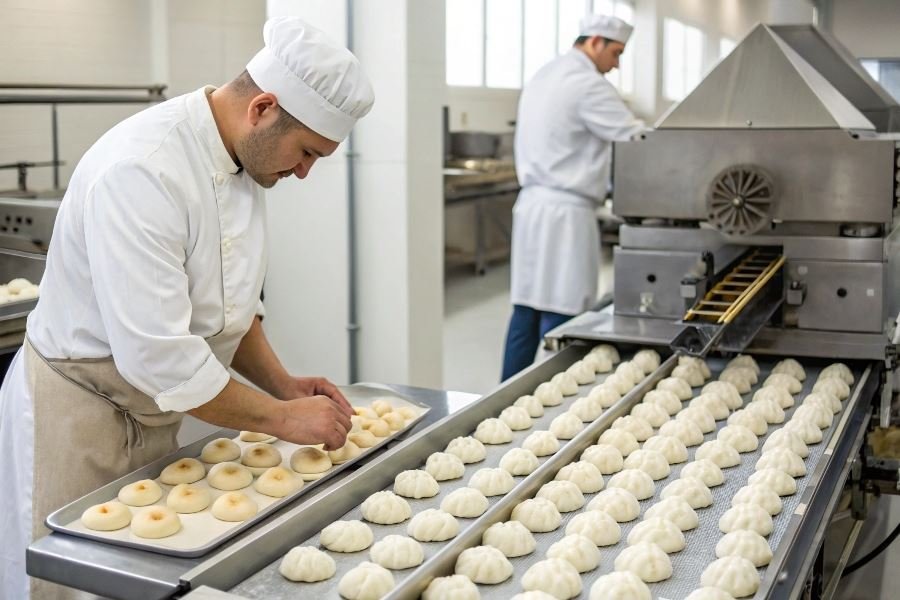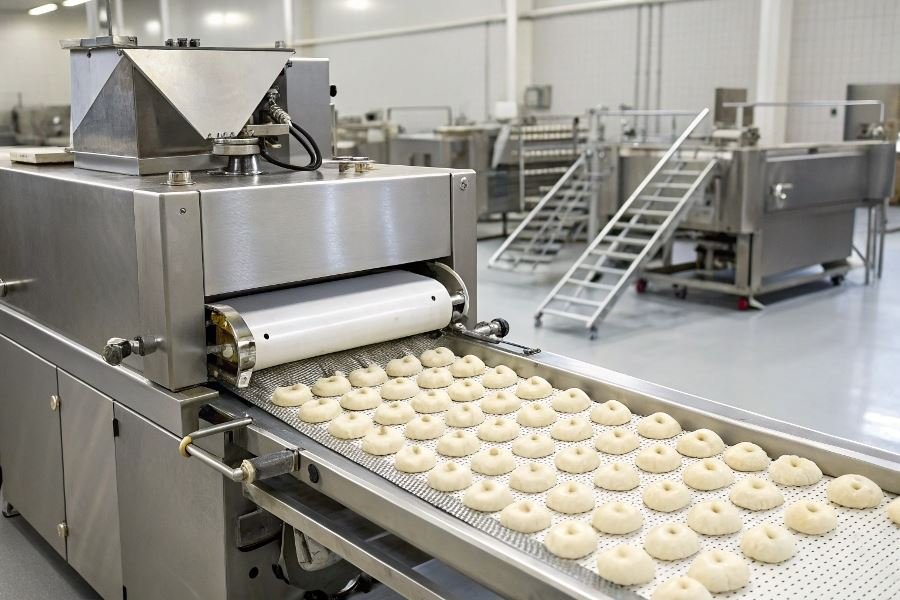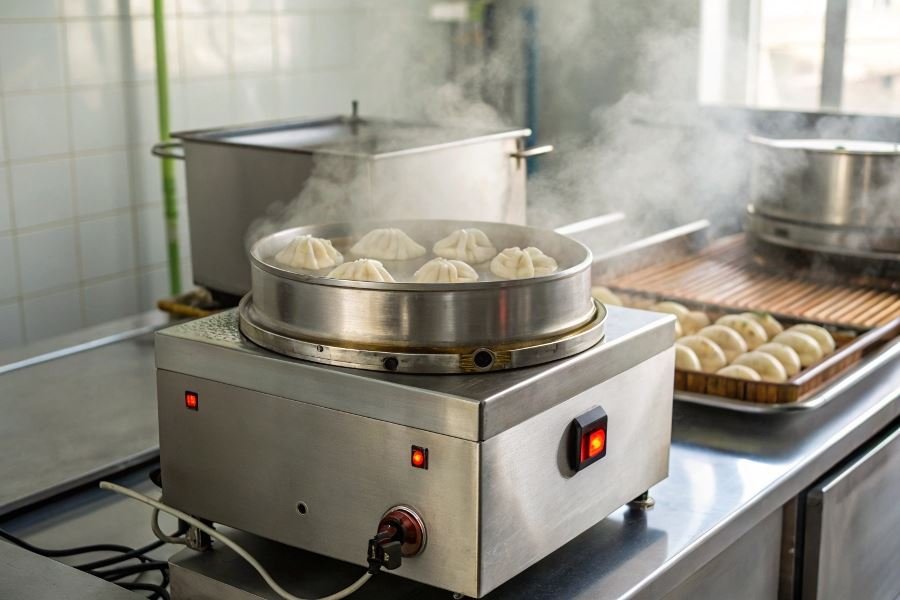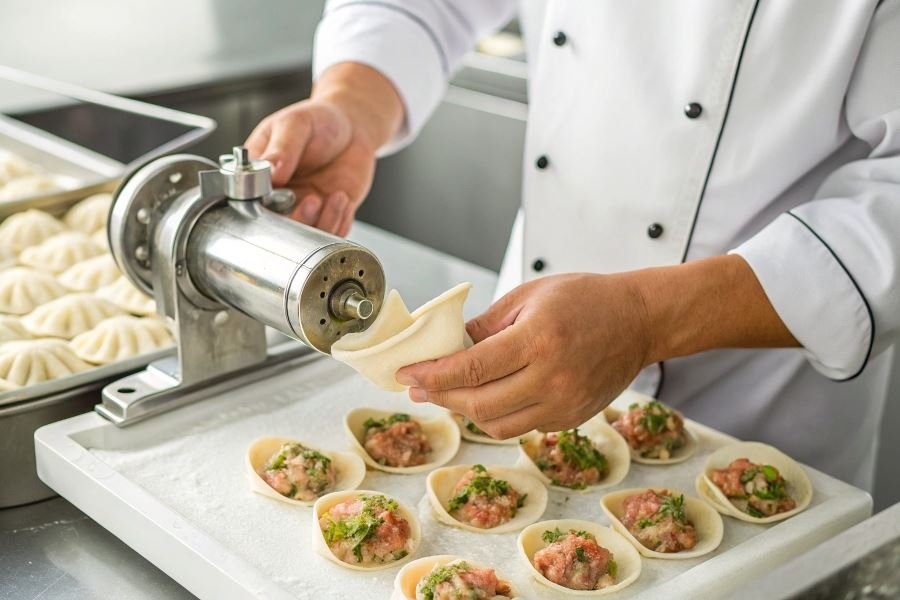
Ever watched a master chef fold dumplings by hand? Now imagine that precision and care automated at 6,000 dumplings per hour. The gap between artisanal quality and industrial efficiency has never been narrower, thanks to revolutionary advances in commercial dumpling technology.
The journey of dumpling machinery began in the 1960s with basic mechanical presses, but today’s equipment represents a quantum leap forward. Modern dumpling machines don’t just form dough – they’re sophisticated systems that delicately handle everything from traditional meat mixtures to challenging vegetable fillings with varying moisture content and texture profiles.
Why matching your machine to your filling matters more than you think
The relationship between dumpling machine and filling is like a dance partnership – when perfectly matched, the results are spectacular. When mismatched? Disaster. A machine designed for firm meat fillings might struggle with juicy vegetable mixtures, leading to leakage, inconsistent product quality, and costly downtime.
“The most expensive dumpling machine isn’t necessarily the right one – it’s about finding equipment that speaks the same language as your filling.”
When evaluating professional dumpling equipment, three factors stand above all others:
Filling compatibility factors
- Viscosity handling range – Can it process both dense meat fillings and looser vegetable mixtures?
- Temperature control precision – Critical for maintaining filling integrity during processing
- Customizable pressure settings – Essential for adapting to different filling densities
The most successful dumpling operations understand that production excellence begins with equipment selection that respects the unique properties of each filling type. The right machine doesn’t force your recipe to adapt – it adapts to your recipe.
Technical Specifications That Make or Break Your Dumpling Machine
When selecting equipment for commercial dumpling production, the technical specifications determine not just your output quality but your entire operation’s efficiency. Dumpling machines have evolved dramatically since their introduction to food manufacturing in the 1960s, with modern systems offering unprecedented precision and versatility.
The selection process for dumpling machines requires careful consideration of filling types and production needs. Dumpling machines for different types of fillings: features of selection must account for everything from meat consistency to vegetable particle size, as these variables significantly impact machine performance and final product quality. A machine perfectly calibrated for ground pork might struggle with chunky vegetable mixtures or delicate seafood fillings.
Production Capacity: Matching Output to Demand
Production capacity represents the cornerstone specification when evaluating dumpling equipment. Modern industrial machines range from:
| Capacity Level | Output (pieces/hour) | Ideal Business Type |
|---|---|---|
| Entry-level | 1,200-3,000 | Small restaurants, specialty shops |
| Mid-range | 3,000-8,000 | Medium food service, local distributors |
| High-volume | 8,000-20,000+ | Large manufacturers, wholesale suppliers |
Throughput consistency matters as much as maximum capacity. The Anko Food Machine HLT-700XL, for example, maintains 97% efficiency even during 12-hour production runs, while some competitors drop below 85% efficiency after 8 hours of continuous operation.
Filling Mechanism Precision for Texture Variations
The filling mechanism represents the heart of any dumpling machine, with significant variations based on filling consistency:
- Auger systems excel with homogeneous fillings like ground meat or pureed vegetables
- Piston mechanisms handle chunky mixtures with particles up to 12mm
- Hybrid delivery systems accommodate both smooth and textured fillings
The latest machines from Sammic incorporate adaptive pressure sensors that automatically adjust to filling viscosity, preventing the common issues of filling leakage or dough tearing when switching between different filling types.
Dough Handling Capabilities Across Machine Types
Dough handling capabilities vary dramatically between machine categories:
- Sheet-fed systems process pre-rolled dough sheets, offering excellent thickness consistency
- Integrated dough mixers combine mixing and forming, saving space but sometimes sacrificing texture control
- Extrusion-based machines create dough sheets on demand, reducing waste but requiring precise flour quality
The Rheon V4 Encrusting Machine stands out with its patented stress-free dough handling system that maintains gluten development while minimizing tearing—critical when working with delicate wrappers for soup dumplings or gyoza.
Customization Options for Product Differentiation
Modern dumpling machines offer unprecedented customization capabilities:
- Size variability ranging from mini-dumplings (8g) to oversized options (50g+)
- Shape profiles including traditional half-moons, triangles, squares, and specialty forms
- Sealing patterns that range from simple crimps to elaborate decorative edges
The Yamato SD-97 provides 32 programmable presets for different dumpling styles, allowing producers to switch between products in under 3 minutes—a significant advantage for operations producing multiple dumpling varieties.
When evaluating these specifications, remember that the ideal machine balances technical capabilities with your specific production requirements and filling characteristics. The most advanced machine isn’t necessarily the right choice if it doesn’t align with your particular dumpling style and business scale.
Specialized Dumpling Machines That Transform Production
Industrial Powerhouses for Meat and Vegetable Fillings
High-volume industrial dumpling machines represent the backbone of large-scale production facilities where consistency meets efficiency. The Rheon Cornucopia KN550 stands out with its remarkable 12,000 dumplings per hour capacity while maintaining precise filling weights within 1% variance. This machine incorporates a specialized meat-handling system with temperature control that keeps fillings between 28-40°F—critical for food safety and optimal texture.
What separates premium industrial machines from standard equipment is their sophisticated filling distribution technology. The Anko SD-97W utilizes a multi-piston injection system that ensures even distribution of chunky vegetable and meat mixtures without damaging the integrity of ingredients. Its adaptive pressure sensors automatically adjust to filling density changes, preventing the dreaded “empty pocket” syndrome that plagues lesser machines.
The difference between mediocre and exceptional dumplings often comes down to how evenly the filling distributes within the wrapper—a factor determined almost entirely by machine calibration.
Industrial machines also feature robust cleaning systems. The JET-100 Pro incorporates a CIP (Clean-In-Place) system that reduces sanitation time by 65% compared to manual cleaning, a critical factor when switching between meat and vegetable fillings to prevent cross-contamination.
Mastering Liquid Fillings with Specialized Equipment
Liquid and semi-liquid fillings present unique challenges that standard dumpling machines simply cannot handle. The Yamato LF-430 employs a revolutionary cold-chamber injection system that maintains filling temperatures as low as 33°F while preventing leakage through its proprietary “seal-before-fill” technology. This machine excels with soup dumplings (xiaolongbao), achieving a remarkable 99.3% seal integrity rate.
The HLT FluidForm 2000 takes a different approach with its pressurized filling chamber that creates a vacuum seal around each dumpling before injection. This prevents the common “blow-out” issue when dealing with high-moisture fillings like custards or fruit compotes. Its precision nozzles can adjust from 1mm to 8mm diameter, accommodating fillings from liquid broths to chunky fruit mixtures.
Temperature control becomes paramount with these specialized machines. The Daifuku LiquidPro features zone-specific cooling that maintains different temperatures throughout the production line—keeping wrappers at room temperature while fillings remain chilled, preventing premature cooking or congealing.
Versatility Champions with Adjustable Systems
Multi-purpose dumpling machines represent the sweet spot for medium-scale operations requiring flexibility. The Sammic MP-350 features interchangeable filling heads that can be swapped in under three minutes, allowing producers to switch between meat, vegetable, and liquid fillings without extensive downtime. Its digital pressure control system offers 50 programmable presets for different filling consistencies.
The Rheon KN400 exemplifies adaptability with its modular design. Operators can adjust wrapper thickness from paper-thin (0.5mm) to substantial (3mm) while simultaneously controlling filling ratios from 30% to 70% of total dumpling weight. This versatility makes it ideal for producing everything from delicate wontons to substantial piroshki.
| Machine Model | Filling Types | Production Speed | Changeover Time | Price Range |
|---|---|---|---|---|
| Rheon KN550 | Meat/Vegetable | 12,000/hour | 45 minutes | $85,000-120,000 |
| Yamato LF-430 | Liquid/Semi-liquid | 8,000/hour | 30 minutes | $65,000-90,000 |
| Sammic MP-350 | Multi-purpose | 6,500/hour | 3 minutes | $45,000-70,000 |
The most advanced multi-purpose machines incorporate AI-driven filling systems. The Anko FX-2000 uses optical recognition to analyze filling consistency in real-time, automatically adjusting injection pressure and wrapper tension to maintain perfect dumpling formation regardless of filling variations.
When selecting the right machine, consider not just current production needs but future expansion plans. The most successful operations invest in equipment that can grow with their business, balancing immediate requirements with long-term versatility.
Discover how to select the perfect dumpling machine based on your filling requirements. Compare technical specifications, production capacity, and specialized features for meat, vegetable, and liquid fillings to maximize efficiency and product quality.
Discover how to select the perfect dumpling machine based on your filling requirements. Compare technical specifications, production capacity, and specialized features for meat, vegetable, and liquid fillings to maximize efficiency and product quality.