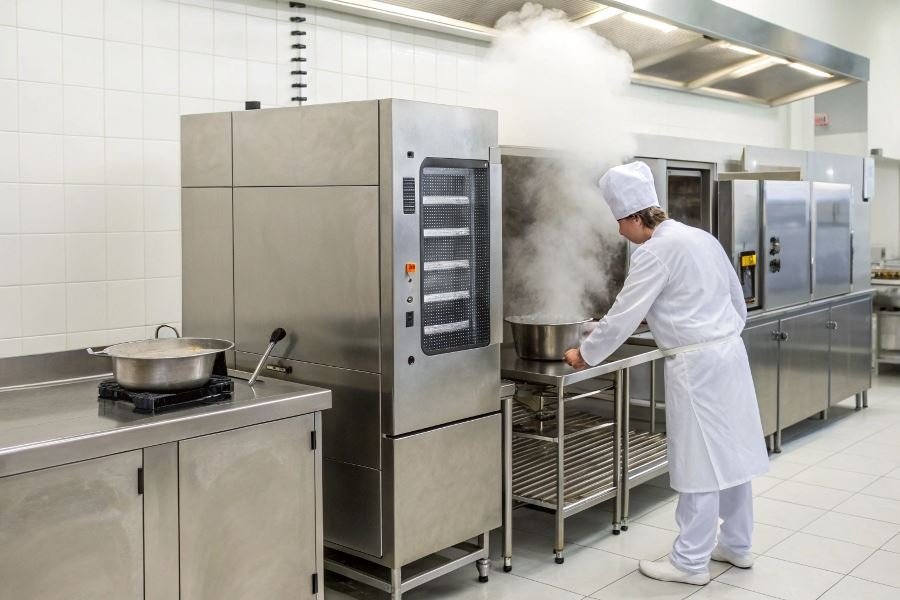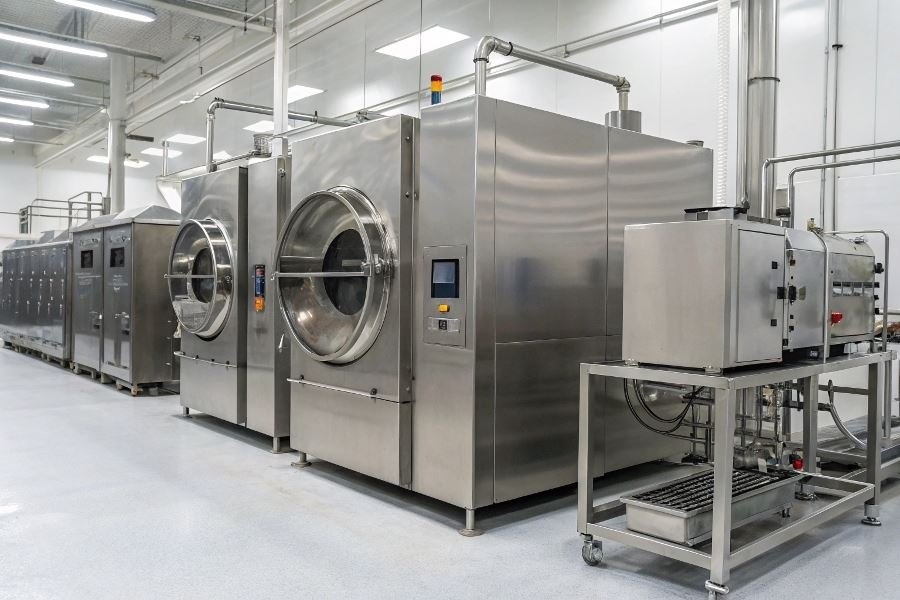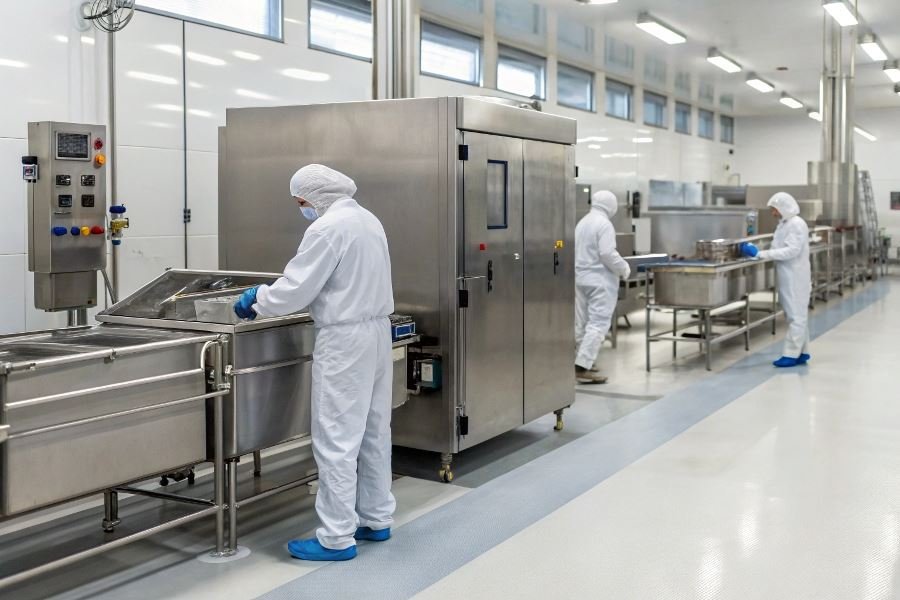
Did you know that foodborne illnesses affect approximately 48 million Americans annually? Behind every safe food product stands an unsung hero: the industrial sterilizer. These powerhouse machines are what stand between consumers and potentially dangerous microorganisms.
Food safety isn’t just about regulations—it’s about trust. When customers purchase your products, they’re placing their health in your hands. Effective sterilization creates that foundation of trust while extending shelf life and preserving flavor profiles that define your brand.
The science of sterility: More than just heat
At its core, sterilization is about eliminating microorganisms through controlled processes. While heat remains the most recognized method, modern sterilization encompasses a spectrum of approaches:
- Thermal processing: Using steam, hot water, or dry heat to denature proteins in microorganisms
- Chemical treatments: Employing agents like hydrogen peroxide or peracetic acid
- Radiation: Utilizing gamma rays, electron beams, or UV light to disrupt microbial DNA
- High-pressure processing: Applying extreme pressure to inactivate pathogens while maintaining food quality
Selecting the right sterilization system: Critical considerations
Choosing appropriate sterilization technology requires balancing multiple factors:
“The perfect sterilizer doesn’t exist—but the perfect sterilizer for your specific operation absolutely does.”
Your selection should account for:
- Product sensitivity: How heat, pressure, or chemicals affect taste, texture, and nutritional value
- Production volume: Throughput requirements that match your operational scale
- Energy efficiency: Long-term operational costs beyond initial investment
- Regulatory compliance: Meeting FDA, USDA, and international standards
- Validation capabilities: Systems that provide verifiable, documented results
Sterilization Technologies That Define Food Safety Standards
The battle against microbial contamination in food processing facilities never ends. Sterilization technologies serve as the frontline defense, ensuring products reach consumers safely while maintaining quality and extending shelf life. A comprehensive understanding of types of sterilizers for the food industry: comparison and features reveals that each technology offers distinct advantages depending on the specific application, product sensitivity, and operational requirements.
Thermal Sterilization: The Time-Tested Champion
Thermal sterilization remains the backbone of food safety protocols, utilizing heat in various forms to eliminate pathogens.
Steam sterilization delivers exceptional penetration power through pressurized steam chambers, typically operating at 121°C (250°F) for 15-20 minutes. This method excels with canned goods and retort pouches, achieving commercial sterility while maintaining a relatively gentle impact on nutritional profiles.
Hot water immersion systems provide more uniform heating for irregularly shaped containers, though they typically require longer processing times than steam. These systems shine when handling delicate products like fruit preserves where rapid temperature changes might compromise texture.
Dry heat sterilizers operate at higher temperatures (160-180°C) for extended periods, making them ideal for:
| Application | Processing Time | Temperature Range |
|---|---|---|
| Glassware | 2-4 hours | 160-170°C |
| Metal utensils | 1-2 hours | 170-180°C |
| Powdered ingredients | 30-60 minutes | 150-160°C |
Chemical Sterilization: Precision Without Heat
When heat-sensitive products demand alternative approaches, chemical sterilizers offer powerful solutions without thermal stress.
Hydrogen peroxide systems have revolutionized aseptic packaging, delivering a 6-log reduction in bacterial spores within seconds. Modern systems vaporize 35% H₂O₂ solution at temperatures around 80°C, creating a potent antimicrobial environment that leaves no harmful residues after decomposition to water and oxygen.
Peracetic acid (PAA) combines the oxidizing power of hydrogen peroxide with acetic acid, creating a broad-spectrum sanitizer effective against bacteria, yeasts, molds, and viruses even at low temperatures. Food processors particularly value PAA for clean-in-place (CIP) systems and surface sanitization at concentrations between 80-200 ppm.
Chlorine-based solutions, while declining in popularity due to environmental concerns, still play a role in specific applications:
“The efficacy of chlorine compounds depends heavily on pH control—maximum antimicrobial activity occurs between pH 6.0 and 7.5, where hypochlorous acid predominates.”
Radiation Sterilization: The Non-Contact Powerhouse
The most technologically advanced sterilization methods employ various forms of radiation, offering non-contact treatment options with distinct operational profiles.
UV sterilization systems utilize short-wavelength ultraviolet light (typically 254nm) to disrupt microbial DNA, preventing reproduction. These systems excel in water treatment, air purification, and surface decontamination with minimal energy requirements and no chemical residues. Modern UV-C LED systems have dramatically reduced footprints while increasing energy efficiency by 40% compared to traditional mercury lamps.
Gamma irradiation harnesses high-energy photons from radioactive isotopes (typically Cobalt-60) to penetrate packaging and eliminate pathogens throughout the entire product. This technology, established in commercial food applications since the 1960s, provides unmatched penetration depth for bulk processing of spices, dried herbs, and certain meat products.
Electron beam technology delivers precisely controlled doses of accelerated electrons, offering faster processing times than gamma irradiation with the ability to be switched off when not in use. The technology’s limitation lies in its reduced penetration depth (approximately 5cm), making it ideal for surface treatments and thin products.
Making the Right Sterilization Choice for Your Food Operation
Tailoring Sterilization to Food Types
Selecting the optimal sterilizer requires matching technology to specific food characteristics. For low-acid foods like vegetables and meats, retort sterilizers and UHT systems deliver the high temperatures needed to eliminate Clostridium botulinum spores. The Allpax retort systems excel with canned goods, while dairy products benefit from the rapid heating cycles of Tetra Pak UHT systems.
Acidic foods (pH below 4.6) like fruit juices and pickled products can use gentler approaches. Pasteurization or hot-fill techniques preserve flavor profiles while ensuring safety. For premium juices, JBT FoodTech flash pasteurization systems maintain nutritional integrity while extending shelf life.
Temperature-sensitive products like fresh-cut produce respond best to chemical treatments or cold plasma technology. The Ecolab Tsunami system uses peroxyacetic acid at concentrations that eliminate pathogens without compromising product quality.
Economic Realities of Sterilization Investments
Sterilization technology represents a significant capital expenditure, but ROI calculations must consider multiple factors:
| Sterilization Method | Initial Investment | Operating Costs | Expected Lifespan | Typical ROI Timeline |
|---|---|---|---|---|
| Retort Systems | $250,000-800,000 | Moderate | 15-20 years | 3-5 years |
| UHT Systems | $500,000-2M+ | High | 10-15 years | 2-4 years |
| Irradiation | $1M-5M+ | Low | 20+ years | 5-8 years |
| Cold Plasma | $200,000-500,000 | Low | 8-12 years | 3-5 years |
Beyond equipment costs, factor in maintenance requirements, energy consumption, and labor needs.
The true economic picture emerges when considering product loss reduction. Advanced sterilization systems from Steriflow can reduce product rejection rates by up to 15% compared to older technologies, creating substantial savings for high-volume operations.
Energy efficiency varies dramatically between technologies. Modern ohmic heating systems consume up to 70% less energy than conventional retorts, potentially saving mid-sized processors $50,000-100,000 annually in utility costs.
The Sterilization Horizon
The food sterilization landscape is evolving rapidly with several emerging technologies:
Pulsed electric field (PEF) processing is gaining traction for liquid products. The Diversified Technologies PEF systems preserve fresh flavors while achieving 5-log pathogen reductions without thermal damage.
High-pressure processing (HPP) continues its expansion beyond guacamole and juices into prepared meals. The Hiperbaric systems now offer throughput rates making them viable for larger operations.
Perhaps most promising is the integration of AI-driven process control. Smart sterilization systems from JBT Avure now adjust parameters in real-time based on product characteristics, optimizing both safety and quality.
The most successful food processors don’t just select sterilization technology—they integrate it into a comprehensive food safety and quality system.
As regulatory requirements tighten globally, investing in flexible, upgradable sterilization technology provides both compliance assurance and market access advantages. The ideal system balances immediate needs with adaptability for tomorrow’s challenges.
Discover the most effective sterilization methods for food processing with our comprehensive comparison of thermal, chemical, and radiation systems. Learn how to select the optimal technology for your specific products and production needs.
Discover the most effective sterilization methods for food processing with our comprehensive comparison of thermal, chemical, and radiation systems. Learn how to select the optimal technology for your specific products and production needs.