Ever wondered why some foods in your pantry last for months while others spoil within days—even when they’re stored side by side? The answer might be hanging right in front of you: your shelving system.
Food storage isn’t just about having enough space—it’s about creating an ecosystem that preserves nutrients, prevents contamination, and ultimately saves you money. When properly organized, the right shelving system can extend food freshness by up to 40% compared to improper storage methods.
The foundation of effective food preservation begins with understanding what makes an ideal storage environment. Temperature consistency, air circulation, moisture control, and material safety all play crucial roles in maintaining food quality. These aren’t just preferences—they’re scientific necessities that directly impact what ends up on your plate.
“The difference between amateur and professional food storage isn’t just organization—it’s infrastructure.” – James Beard Award-winning chef Thomas Keller
Beyond safety concerns, thoughtful shelving creates efficiency. Studies show that well-organized kitchens reduce food waste by nearly 25%, simply by making inventory visible and accessible. The right shelving solution transforms food storage from a mundane necessity into a strategic advantage for your household economy.
When selecting storage solutions, three factors deserve your closest attention:
- Material compatibility with different food types
- Structural integrity under varying weight loads
- Adaptability to changing storage needs
The perfect shelving system doesn’t just store your food—it becomes an active participant in preserving its quality and extending its usable life.
The Smart Shopper’s Guide to Food Storage Shelving
When setting up a pantry or storage area, the criteria for choosing shelves for food storage often gets overlooked until you’re dealing with sagging shelves or contaminated ingredients. The right shelving system doesn’t just organize—it preserves your investment in groceries and protects your family’s health.
Food-safe materials that stand the test of time
The foundation of any quality food storage system begins with materials that won’t introduce chemicals or contaminants to your food. Stainless steel reigns supreme in professional kitchens for good reason: it’s non-porous, resistant to bacteria, and virtually indestructible. Metro shelving systems offer NSF-certified options that prevent rust and corrosion even in humid environments.
For those preferring a warmer aesthetic, solid hardwood shelving treated with food-grade mineral oil provides a natural alternative. Avoid particleboard or MDF shelving for food storage—these materials can release formaldehyde and deteriorate quickly when exposed to moisture.
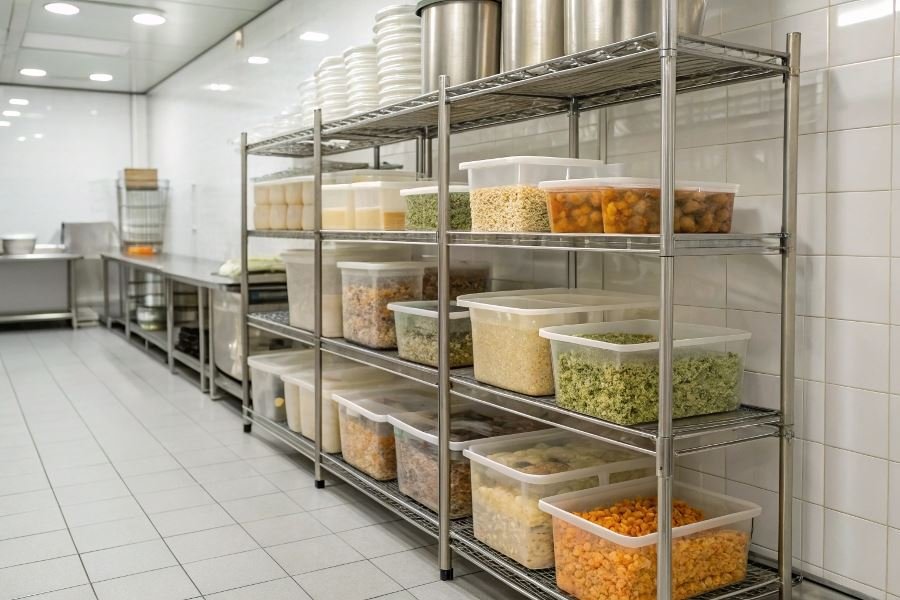
Wire shelving deserves special mention: its open design promotes air circulation, reducing moisture buildup that leads to mold. However, ensure any coating is FDA-approved epoxy rather than standard paint that might chip into food items.
Load capacity: when strength equals safety
Nothing creates a bigger kitchen disaster than a collapsed shelf full of canned goods and glass containers. Professional-grade shelving typically lists weight capacities per shelf:
| Shelving Type | Typical Weight Capacity | Best For |
|---|---|---|
| Light-duty wire | 250-300 lbs | Packaged foods, lightweight items |
| Medium-duty steel | 500-800 lbs | Canned goods, appliances |
| Heavy-duty commercial | 800-1500+ lbs | Bulk storage, commercial use |
The difference between adequate and exceptional shelving often comes down to reinforcement methods. Look for units with corner brackets, cross-bracing, or double-welded joints. Gladiator shelving systems feature innovative weight distribution technology that prevents the middle-shelf sag common in budget options.
Stability also depends on proper installation. Freestanding units should include adjustable leveling feet for uneven floors, while wall-mounted systems need appropriate anchors rated for at least twice your anticipated load.
Dimensional intelligence for maximum storage
The most overlooked aspect of shelving selection is dimensional optimization. Standard shelving depths (12″, 16″, 18″, and 24″) each serve different purposes:
- 12″ depth: Perfect for single-row can storage or spice organization
- 16-18″ depth: Ideal for most pantry items, allowing visibility without wasted space
- 24″ depth: Reserved for bulk storage where items can be stacked two-deep
Vertical spacing between shelves deserves equal attention. The industry standard of 18″ works for general storage, but customizable systems from Elfa allow you to adjust shelf heights to accommodate everything from tall cereal boxes to squat jars.
Smart space utilization also means considering modular components:
- Pull-out drawers for small items that would otherwise get lost
- Hanging baskets for produce that needs air circulation
- Door-mounted racks that transform wasted space into valuable storage
The vertical clearance between your tallest items and the next shelf should be at least 2-3 inches to allow for easy retrieval without disturbing neighboring items. This seemingly small detail dramatically improves the functionality of your storage system.
By selecting shelving with appropriate materials, sufficient strength, and optimized dimensions, you transform food storage from a mundane necessity into a strategic advantage for household management.
Beyond Basic Shelving: Advanced Food Storage Solutions
The Breathing Room: Ventilation Essentials
Proper airflow isn’t just a nice-to-have feature—it’s the difference between fresh ingredients and spoilage. Quality food storage shelving systems incorporate strategic ventilation patterns that prevent moisture buildup and extend shelf life.
Wire shelving from manufacturers like Metro excels here, with open designs allowing air to circulate freely around stored items. This becomes particularly crucial for fresh produce, where trapped moisture accelerates decay. Studies show properly ventilated storage can extend produce freshness by up to 40%.
Temperature consistency also depends heavily on ventilation. In pantries and storage areas, air stratification can create hot spots that accelerate food degradation. Well-designed shelving minimizes these variations through:
- Perforated solid shelving
- Slotted shelf mats
- Adequate spacing between shelves
For commercial environments, NSF-certified shelving units provide the gold standard in food-safe ventilation design, preventing cross-contamination while maintaining optimal airflow.
Flexibility That Grows With You
The most sophisticated storage systems adapt to changing needs without requiring replacement. Adjustability transforms static shelving into dynamic solutions that accommodate seasonal inventory shifts and evolving storage requirements.
True adjustability goes beyond basic height settings. Look for systems offering:
| Feature | Benefit | Application |
|---|---|---|
| Micro-adjustments | Precise height control in 1″ increments | Maximizes vertical space |
| Tool-free adjustment | Quick reconfiguration | Seasonal storage changes |
| Modular components | System expansion capability | Growing collections |
| Weight-rated adjustability | Safety at various heights | Heavy canning storage |
Cambro and Uline offer particularly versatile systems with accessories that transform basic shelving into specialized storage. Dividers, label holders, and mobile conversion kits extend functionality without requiring complete system replacement.
Clean Machine: Maintenance Matters
Even the most advanced shelving becomes problematic when cleaning becomes a chore. Sophisticated food storage systems incorporate design elements specifically addressing sanitization and maintenance.
Material selection drives maintenance requirements. While stainless steel from Regency commands premium pricing, its non-porous surface resists bacterial growth and withstands aggressive cleaning agents. Epoxy-coated options balance affordability with reasonable cleaning ease.
The most effective storage system is one you can actually keep clean without heroic effort.
Consider these maintenance-friendly features:
- Removable shelf mats for dishwasher cleaning
- Smooth, crevice-free surfaces that prevent food particle accumulation
- Corrosion-resistant materials that withstand food acids and cleaning solutions
- Quick-release mechanisms for complete disassembly
For high-humidity environments like refrigerated storage, look for antimicrobial protection built into the shelving material. These additives inhibit bacterial growth between cleanings, providing an additional safety buffer.
The most advanced systems also incorporate design elements that make inspection simple—visibility from multiple angles ensures nothing hides in corners or behind supports. This transparency simplifies inventory management while ensuring cleanliness standards remain consistently high.
Discover the top 10 essential criteria for selecting food storage shelves that maximize safety, organization, and preservation. Learn about material options, weight capacity, ventilation, and maintenance requirements for optimal pantry solutions.
Discover the top 10 essential criteria for selecting food storage shelves that maximize safety, organization, and preservation. Learn about material options, weight capacity, ventilation, and maintenance requirements for optimal pantry solutions.