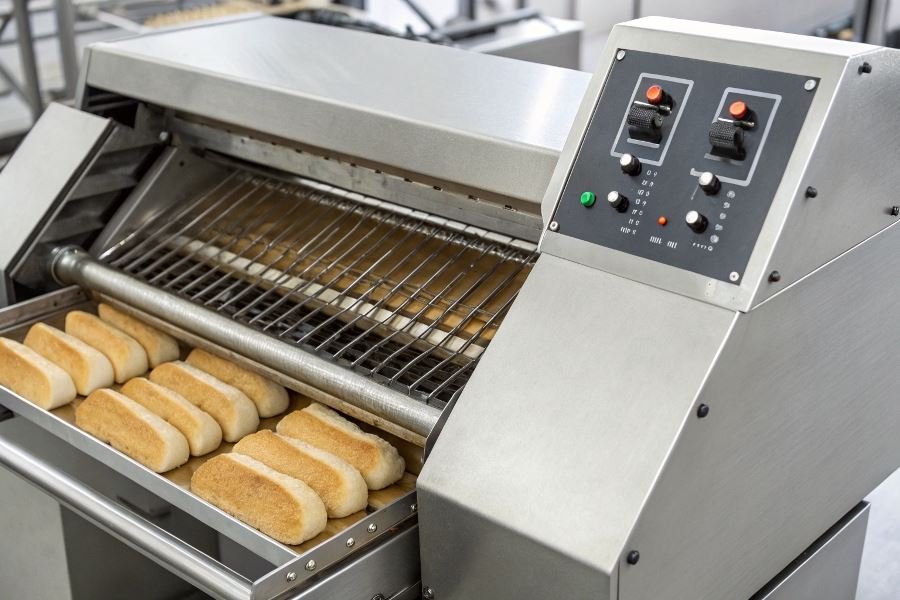
Ever watched a small grinder struggle with a mountain of bread, smoke rising as it desperately tries to keep up? Or invested in an industrial behemoth that consumes more electricity than it produces value for your modest needs? These costly mismatches happen daily in bakeries and food processing facilities across America.
The power rating of your bread grinder isn’t just another specification—it’s the heartbeat of your production line. Whether you’re processing day-old bread into crumbs for a small restaurant or supplying a regional food manufacturer with tons of consistent product, selecting the right power level determines both your operational efficiency and your bottom line.
Power directly influences three critical factors: grinding speed, particle consistency, and equipment longevity. A 2-horsepower unit might perfectly serve a boutique operation producing specialty crumbs, while commercial facilities often require 7.5HP or more to maintain continuous production without overheating or mechanical strain.
“The most expensive grinder isn’t always the right one—it’s about matching capability to requirement.”
Your power requirements depend on a constellation of factors: daily volume, desired particle size, bread moisture content, and operational patterns. Artisan bakeries processing 50-100 pounds daily need fundamentally different equipment than industrial operations handling thousands of pounds in continuous shifts.
Remember: underpowered grinders lead to inconsistent output and premature equipment failure, while overpowered units waste capital and energy. The sweet spot lies in understanding your specific production profile.
Right-Sizing Your Bread Grinder Power for Small to Medium Operations
When setting up a bread production operation, selecting the appropriate power for your bread grinder isn’t just a technical decision—it’s the foundation of your entire production efficiency. The difference between a 500W and 1500W grinder can mean the difference between smooth operations and constant bottlenecks.
For small bakeries and home-based operations, understanding how to choose the power of a bread grinder for different production volumes becomes critical to both your product quality and your bottom line. The right-sized grinder prevents unnecessary electricity costs while ensuring you’re never caught short during production peaks.
Power Ranges for Small-Scale Production
Small to medium bread production typically requires grinders in the 500W-1500W range, but the specific needs vary dramatically:
- 500W-800W: Ideal for home use and micro-bakeries producing up to 10kg daily
- 800W-1200W: Sweet spot for small commercial bakeries (10-30kg daily)
- 1200W-1500W: Necessary for medium operations approaching 50kg daily output
A 500W unit from KitchenAid might perfectly serve a home baker producing artisanal loaves for farmers’ markets, while a dedicated bakery supplying multiple cafés would quickly find this underpowered.
The Production Volume Calculation Formula
Determining optimal grinder power isn’t guesswork—it’s mathematics:
Required Power (W) = Daily Production (kg) × Grinding Factor × Safety Margin
Where:
- Grinding Factor averages 20W per kg for soft grains, 25W for mixed, and 30W for hard grains
- Safety Margin should be 1.2-1.5 to account for peak demands
| Daily Production | Grain Type | Recommended Power |
|---|---|---|
| 5-10kg | Soft | 500-750W |
| 15-25kg | Mixed | 800-1200W |
| 30-50kg | Hard/Mixed | 1200-1500W |
Remember that these calculations assume standard operation cycles of 15-20 minutes on, 10 minutes rest.
Balancing Power and Efficiency
Higher power doesn’t always mean better performance. A 1500W Mockmill grinder might process grain faster than a 1000W model, but consider these efficiency factors:
- Heat generation: Higher-powered units generate more heat, potentially affecting flour quality
- Energy consumption: A 1500W unit running at 80% capacity often outperforms a 1000W unit at 100%
- Startup costs: Higher-powered units typically cost $200-500 more upfront
- Longevity: Running a grinder consistently at maximum capacity reduces its operational lifespan
For a small bakery producing 25kg daily, the annual operating cost difference between a properly-sized 1000W unit versus an oversized 1500W grinder can exceed $300 in electricity alone.
Practical Scaling Considerations
When your production approaches the upper limit of your grinder’s capacity, consider these alternatives before upgrading:
- Batch processing: Spreading grinding throughout the day rather than all at once
- Cooling periods: Implementing mandatory rest periods between batches
- Supplemental units: Adding a second smaller unit for specialty grains rather than replacing your primary grinder
The most cost-efficient operations often employ multiple right-sized units rather than a single high-powered grinder, providing both redundancy and flexibility as production demands fluctuate.
Powering Up: Industrial Bread Grinders for Commercial Production
When scaling up to large commercial bread production, the humble bread grinder transforms from kitchen helper to production powerhouse. The right industrial-grade equipment can make the difference between consistent quality and costly downtime.
Industrial-scale power requirements
Commercial bread production demands serious muscle. Industrial bread grinders typically operate in the 1500W-3000W+ range, with top-tier models pushing 5000W for the most demanding environments.
Power tiers for commercial production:
| Production Volume | Recommended Power | Typical Throughput |
|---|---|---|
| Medium Commercial | 1500W-2000W | 100-200 lbs/hour |
| Large Commercial | 2000W-3000W | 200-400 lbs/hour |
| Industrial Scale | 3000W+ | 400+ lbs/hour |
The Hobart FP150 with its 1.5 horsepower motor (approximately 1100W) represents the entry point for serious commercial applications, while the Robot Coupe R23 with its 4000W motor handles the most demanding production environments.
Power requirements increase exponentially with production volume—doubling your output often requires more than double the power rating to maintain efficiency.
Continuous operation capabilities
Commercial bread production rarely stops, making duty cycle perhaps the most overlooked specification when selecting equipment.
Duty cycle refers to how long a machine can operate continuously before requiring a cooldown period. Industrial-grade grinders should offer at least a 70% duty cycle, with premium models boasting 100% continuous operation capabilities.
Look for these cooling system indicators:
- Forced air cooling systems with dedicated fans
- Heat dissipation fins on motor housing
- Thermal overload protection that prevents catastrophic failure
The Dito Sama TRK45 features a sophisticated cooling system that allows for true 24/7 operation—essential for bakeries that never sleep.
Industry insight: A bread grinder rated for continuous operation at 75% capacity will outlast one running at 100% capacity by an average of 3-4 years, representing significant ROI for commercial operations.
Advanced features for high-powered operations
When investing in commercial-grade equipment, advanced features translate directly to operational efficiency and product consistency.
Variable speed control isn’t just a nice-to-have—it’s essential for adapting to different dough types. Premium models like the Univex SRM80+ offer 5-10 speed settings, allowing precise control over the final product texture.
Automated feeding systems become critical at scale. The difference between manually feeding ingredients and an automated hopper system can represent 30-40% labor savings in high-volume operations.
Digital controls with programmable presets allow for consistency across shifts and operators. The Sammic CK-8 offers touchscreen interfaces with up to 20 programmable recipes, ensuring your signature bread maintains consistent quality regardless of who’s operating the equipment.
Heavy-duty construction materials matter more as power increases. Look for:
- Stainless steel grinding mechanisms
- Hardened steel gears rather than nylon
- Cast aluminum housings for heat dissipation
- Reinforced drive shafts to handle torque demands
The investment in commercial-grade bread grinding equipment pays dividends through increased production capacity, consistent quality, and reduced maintenance downtime—the three pillars of profitable commercial baking operations.
Discover how to select the perfect bread grinder power for your production scale, from small bakeries to industrial operations. Learn to match wattage requirements with daily output for optimal efficiency and quality results.
Discover how to select the perfect bread grinder power for your production scale, from small bakeries to industrial operations. Learn to match wattage requirements with daily output for optimal efficiency and quality results.