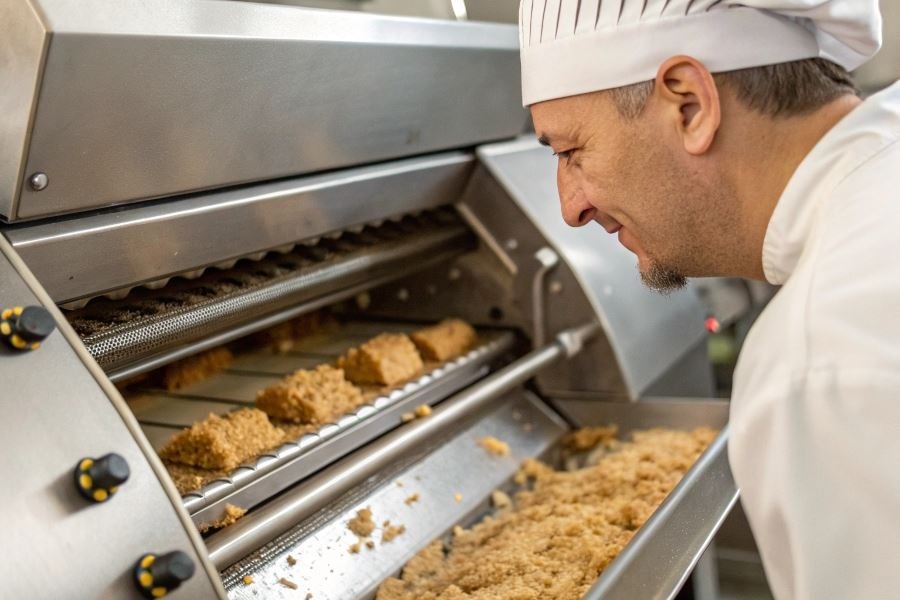
Ever wondered what happens to day-old bread before it becomes those perfect breadcrumbs coating your favorite restaurant’s chicken parmesan? Behind every consistent crumb lies sophisticated engineering that’s transforming commercial bakeries worldwide.
The humble bread grinder stands as the unsung hero in modern food processing facilities. These powerhouse machines convert surplus bread products into valuable ingredients, reducing waste while creating essential components for countless recipes. Leading manufacturers have transformed what was once a simple mechanical process into a precision science, with equipment that can process hundreds of pounds per hour while maintaining exact particle specifications.
The backbone of commercial food processing
Bread grinders serve as critical infrastructure in bakeries and food manufacturing facilities. They’re not merely waste reduction tools—they’re profit centers that convert excess product into marketable ingredients. A single industrial grinder can process what would otherwise be thousands of dollars in wasted product monthly.
“The difference between premium and standard grinding equipment isn’t just about throughput—it’s about consistency, sanitation, and operational efficiency.”
Evaluating excellence in grinding technology
When assessing manufacturers, industry professionals focus on several critical factors:
- Processing capacity – Output volumes ranging from 50 to 1,000+ pounds per hour
- Particle size control – Precision settings for everything from fine dust to coarse crumbs
- Sanitation features – Tool-free disassembly and food-grade materials
- Energy efficiency – Reduced power consumption without sacrificing performance
From mechanical to digital precision
The evolution of bread grinding technology has been remarkable. Early models relied on simple mechanical processes, while today’s equipment incorporates digital controls, automated feeding systems, and programmable particle sizing. These advancements have dramatically improved consistency while reducing labor requirements—a critical advantage in today’s challenging staffing environment.
Industry Leaders in Commercial Bread Grinding Equipment
When production demands precision and consistency, the equipment you choose becomes the backbone of your operation. The best manufacturers of bread grinders for the food industry have established their reputations through decades of innovation, reliability, and understanding the unique challenges bakers face daily. Let’s examine the three manufacturers that consistently outperform the competition in commercial bread grinding solutions.
JAC: Belgian Craftsmanship Meets Modern Efficiency
JAC stands as Belgium’s premier answer to specialized bakery equipment needs. Founded in 1946, this family-owned business has transformed from a small workshop into a global leader without compromising their commitment to quality.
Their bread grinders feature:
- Adjustable blade systems that accommodate various bread types from soft brioche to crusty artisanal loaves
- Whisper-quiet operation despite powerful motors
- Stainless steel construction that meets stringent food safety standards
JAC’s standout model, the PICOMATIC, processes up to 200 loaves per hour while maintaining consistent crumb texture—critical for large-scale breadcrumb production. Their machines typically include self-cleaning mechanisms that reduce maintenance downtime by approximately 40% compared to competitors.
Oliver: American Engineering for Industrial-Scale Operations
When volume and durability become non-negotiable requirements, Oliver Manufacturing delivers American-made industrial bread grinding solutions that withstand the demands of 24/7 production environments. Since their founding in 1930, Oliver has specialized in heavy-duty equipment built for longevity.
Their bread grinding technology features:
| Feature | Benefit |
|---|---|
| Hardened steel blades | 3x longer lifespan before replacement |
| Modular design | Quick part replacement without full system shutdown |
| Variable speed controls | Customizable output from fine to coarse |
Oliver’s 797-Series grinders process up to 1,200 pounds of bread per hour while maintaining temperature control that prevents moisture loss—a crucial factor in maintaining product quality for packaged breadcrumbs.
Erika Record: European Precision for Premium Results
Erika Record Baking Equipment brings premium European bread grinding technology to operations that refuse to compromise on quality. Their Swiss-engineered systems have earned devotion from artisanal bakeries and industrial producers alike.
What distinguishes Erika Record’s offerings:
- Dual-stage grinding process that preserves the natural characteristics of specialty breads
- Programmable settings that store up to 50 custom grinding profiles
- Integrated cooling systems that prevent heat-related quality degradation
Their flagship EBG-400 model incorporates optical sorting technology that automatically removes burnt pieces or foreign materials—a game-changer for maintaining consistent color and quality in premium breadcrumb production.
Each of these manufacturers offers specialized solutions depending on your production volume, space constraints, and quality requirements. While JAC excels in bakery-specific applications, Oliver dominates high-volume industrial settings, and Erika Record delivers unmatched precision for premium products. The investment in quality grinding equipment typically pays dividends through improved product consistency, reduced waste, and lower maintenance costs over the equipment’s operational lifespan.
Selecting the Right Bread Grinder Manufacturer for Your Business
When investing in bread grinding equipment, the manufacturer you choose can make or break your production efficiency. The best bread grinder manufacturers don’t just sell machines—they provide solutions tailored to your specific food processing challenges.
Aligning grinding capacity with production demands
The perfect bread grinder matches your production volume requirements precisely. Industry leaders like JAC Machines offer scalable solutions ranging from compact units processing 200 pounds per hour to industrial behemoths handling 2,000+ pounds hourly.
Consider your current needs, but plan for future growth. A manufacturer like Diosna provides modular systems that can be upgraded rather than replaced entirely when your production scales up.
Production volume requirements typically fall into three categories:
| Production Level | Hourly Capacity | Recommended Manufacturer Type |
|---|---|---|
| Small Bakery | 100-300 lbs/hr | Specialized boutique manufacturers |
| Mid-sized Operation | 300-1,000 lbs/hr | Mid-tier equipment specialists |
| Industrial Scale | 1,000+ lbs/hr | Enterprise-level manufacturers |
The grinding mechanism matters tremendously. Oliver Packaging specializes in roller mills that produce consistent crumb size—critical for breadcrumb coating applications—while Bühler Group excels with hammer mills that offer versatility for various bread types.
Maintenance support and parts availability
The true cost of a bread grinder extends far beyond the purchase price. Evaluate manufacturers based on their after-sale support infrastructure.
Parts availability is non-negotiable. Leading manufacturers like Bakon USA maintain extensive parts inventories and offer next-day shipping for critical components, minimizing costly downtime.
Consider these maintenance factors when selecting a manufacturer:
- Preventative maintenance programs (look for manufacturers offering scheduled service packages)
- Technical support availability (24/7 vs. business hours only)
- Warranty terms (industry leaders typically offer 2-3 year coverage)
- Training programs for your maintenance staff
Fritsch stands out by offering remote diagnostic capabilities, allowing their technicians to troubleshoot issues without an on-site visit—potentially saving thousands in emergency service calls.
ROI analysis for premium manufacturers
Premium bread grinder manufacturers command higher prices, but the return on investment often justifies the additional upfront cost.
When conducting ROI analysis, factor in these often-overlooked elements:
- Energy efficiency: High-end manufacturers like WP Bakery Group design grinders that consume up to 30% less electricity than budget alternatives.
- Yield optimization: Premium grinders from Rondo typically waste 2-5% less product through more precise grinding control.
- Downtime reduction: Quality manufacturers build machines with mean-time-between-failure rates 3-4 times longer than economy models.
The cheapest grinder is rarely the most economical in the long run.
A comprehensive ROI calculation should include:
| Factor | Premium Manufacturer Advantage | Annual Savings Potential |
|---|---|---|
| Energy Costs | 20-30% reduction | 3, 000−8,000 |
| Maintenance | 40-50% fewer service calls | 4, 000−12,000 |
| Product Waste | 2-5% yield improvement | 10, 000−50,000 |
| Operational Lifespan | 5-7 years additional service | Depreciation advantages |
The most successful food processors view their bread grinder not as an expense but as a strategic investment. By selecting a manufacturer that aligns with your specific production needs, maintenance capabilities, and long-term financial goals, you position your operation for sustainable growth and profitability.
Discover the top 3 commercial bread grinder manufacturers - JAC, Oliver, and Erika Record. Compare features, capacity, and ROI to find the perfect industrial bread grinding solution for your bakery's production needs.
Discover the top 3 commercial bread grinder manufacturers - JAC, Oliver, and Erika Record. Compare features, capacity, and ROI to find the perfect industrial bread grinding solution for your bakery's production needs.