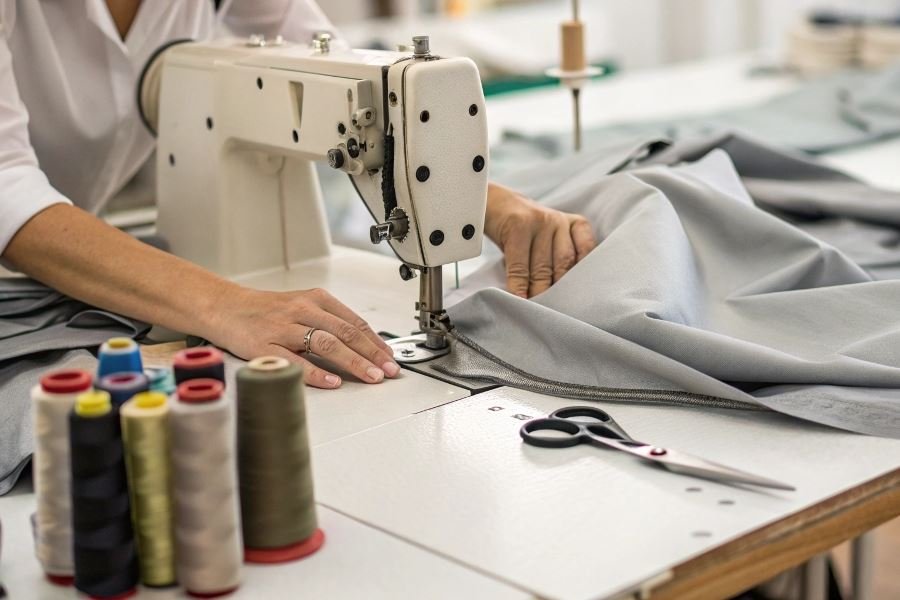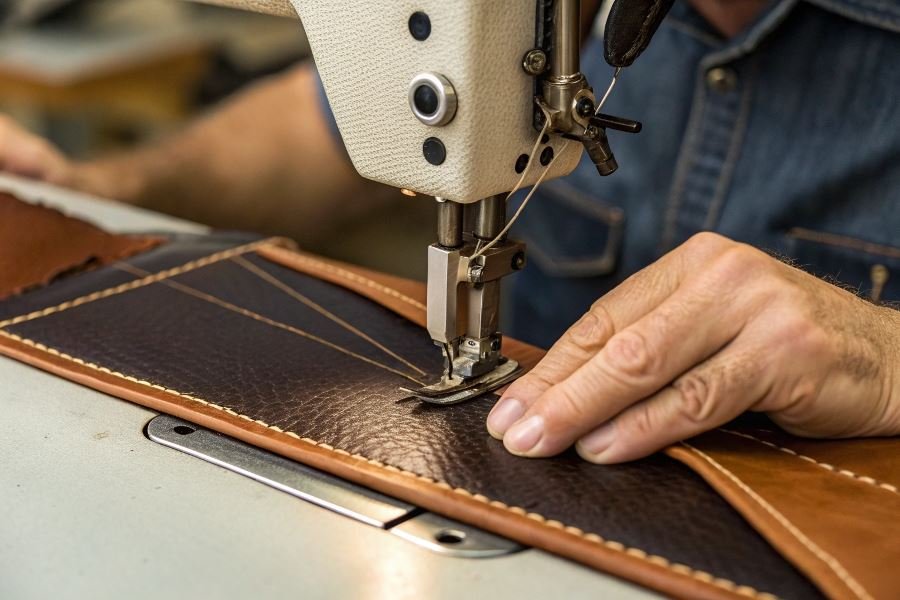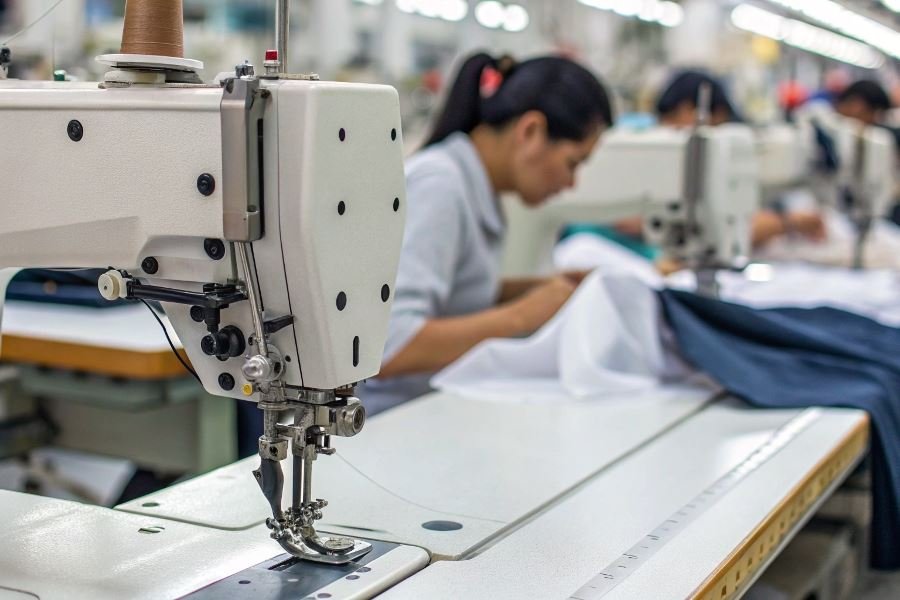
Ever watched a skilled operator guide fabric through an industrial sewing machine at breathtaking speed? That mesmerizing dance between human and machine represents the backbone of global apparel manufacturing. While your home sewing machine might handle occasional mending or hobby projects, industrial machines are the tireless workhorses that produce thousands of garments daily in factories worldwide.
Industrial sewing machines aren’t just bigger versions of domestic models—they’re purpose-built performance machines designed for specialized tasks and continuous operation. When manufacturers evaluate criteria for choosing an industrial sewing machine for mass production, they’re essentially selecting the engine that will power their entire operation.
“The right industrial machine doesn’t just stitch fabric—it transforms production capacity, quality control, and ultimately, profitability.”
The industrial advantage
What truly separates industrial from domestic machines? Speed tops the list—industrial machines typically operate at 1,500-5,000 stitches per minute compared to a domestic machine’s modest 850-1,000. They’re constructed with all-metal components rather than plastic, featuring powerful motors designed for 16+ hour operation without overheating.
Meeting mass production demands
Mass production environments create unique challenges that industrial machines must overcome:
- Volume requirements: Producing thousands of identical items daily
- Consistency demands: Maintaining perfect stitch quality across entire production runs
- Specialized operations: Performing specific functions (buttonholes, serging, bar tacking) with precision
- Durability needs: Withstanding continuous operation in demanding conditions
The machine that thrives in this environment becomes more than equipment—it becomes a competitive advantage.
The Technical Backbone of Mass Production Sewing
When production lines are humming and deadlines loom, the difference between profit and loss often comes down to your equipment choices. Industrial sewing machines form the backbone of any serious manufacturing operation, but not all are created equal. The technical specifications that might seem like minor details on a spec sheet translate directly to productivity, quality, and ultimately, your bottom line.
Selecting the right industrial sewing machine involves careful consideration of multiple criteria for choosing an industrial sewing machine for mass production environments. The technical specifications must align perfectly with your production demands, material types, and output expectations. Let’s dive into the essential technical factors that separate workhorses from showpieces.
Motor Power: The Heart of Continuous Production
The motor is quite literally the beating heart of any industrial sewing machine. For mass production, you need:
- Servo motors delivering 550-750 watts minimum for heavy materials
- Clutchless direct drive systems that reduce energy consumption by 70%
- Variable speed control with precision adjustments between 100-5,500 SPM (stitches per minute)
The Juki DDL-8700 and Brother S-7300A represent industry standards with their powerful servo motors that maintain consistent torque even after 12+ hours of continuous operation.
Motors that can maintain peak performance during extended production runs ultimately determine your maximum daily output capacity.
Stitch Quality: Where Technical Precision Meets Craftsmanship
Mass production cannot sacrifice quality for speed. Modern industrial machines must deliver:
| Stitch Feature | Production Requirement | Technical Specification |
|---|---|---|
| Consistency | Identical stitches across thousands of units | Digital tension control systems |
| Specialized Functions | Product-specific requirements | Programmable stitch patterns (up to 500 patterns) |
| Precision | Error rates below 0.5% | Computerized stitch length control (0.1mm increments) |
The Durkopp Adler 867 exemplifies this balance with its digital stitch control system that maintains perfect tension even when transitioning between different fabric thicknesses.
Stitch quality isn’t just about aesthetics—it directly impacts product durability, return rates, and brand reputation. The technical specifications that enable consistent stitch formation become your quality assurance system.
Durability: Engineering That Outlasts Trends
In mass production, machine downtime is the enemy of profitability. The construction materials and engineering approach determine service life:
- Cast iron frames versus aluminum alloys (the former providing 3-5x longer service life)
- Hardened steel gears and shafts rated for 15+ years of daily operation
- Self-lubricating systems that maintain optimal performance with minimal maintenance
The Consew 206RB-5 demonstrates exceptional durability with its full rotary hook system constructed from hardened steel components that routinely deliver 20+ years of service in demanding production environments.
The initial investment difference between commercial and true industrial-grade machines typically pays for itself within the first 18 months through reduced maintenance costs and eliminated downtime.
When evaluating durability, examine the warranty terms closely. Manufacturers confident in their engineering typically offer 5-year warranties on mechanical components—a telling indicator of expected service life.
The technical specifications that determine an industrial sewing machine’s suitability for mass production aren’t just numbers on a page—they’re the foundation of operational excellence. Choose wisely, and your production line will thank you with years of reliable, consistent, and profitable performance.
Maximizing Efficiency: Operational Criteria for Industrial Sewing Machines
Smart automation transforms production floors
The difference between surviving and thriving in mass production often comes down to automation. Today’s industrial sewing machines offer programmability that would have seemed like science fiction just two decades ago. Pattern memory systems can store hundreds of stitch patterns, allowing operators to switch between complex operations with a single button press. The Juki DDL-9000C exemplifies this evolution with its digital control panel that enables precise adjustments to thread tension, stitch length, and pressure foot height—all programmable for different fabrics.
The most advanced systems now incorporate IoT connectivity, allowing production managers to monitor performance metrics across an entire factory floor from a single dashboard.
Automation tiers typically break down into three categories:
| Automation Level | Features | Production Increase | Price Range |
|---|---|---|---|
| Basic | Automatic thread cutting, needle positioning | 15-25% | $1,200-2,500 |
| Intermediate | Programmable stitch patterns, automatic presser foot lift | 30-45% | $3,000-7,000 |
| Advanced | Full computer control, network connectivity, auto-sensing technology | 50-70% | $8,000-15,000+ |
When evaluating automation features, focus on those that address your specific production bottlenecks rather than the most impressive spec sheet.
Maintenance economics that protect your investment
The most powerful machine becomes worthless when it’s offline. Industrial sewing machines designed for mass production should offer:
- Modular components that can be quickly swapped out
- Self-diagnostic systems that identify issues before they cause failures
- Extended lubrication intervals to minimize downtime
Parts availability represents a critical factor often overlooked during purchase decisions. The Brother S-7300A might cost 15% more than comparable models, but when replacement parts arrive in 24 hours instead of two weeks, that premium pays for itself during the first breakdown.
The true cost of an industrial sewing machine isn’t what you pay to acquire it, but what you pay to keep it running over its lifetime.
Establish relationships with local service technicians before purchase. Their familiarity with specific brands can dramatically reduce maintenance costs and downtime. Many manufacturers now offer service contracts with guaranteed response times—a worthwhile investment for production-critical equipment.
ROI calculations beyond the price tag
Calculating return on investment requires looking beyond the initial purchase price. A comprehensive cost-benefit analysis should include:
- Energy efficiency – Newer models from Durkopp Adler can reduce power consumption by up to 30% compared to machines manufactured just five years ago
- Operator training requirements – Intuitive interfaces reduce training time and error rates
- Production speed increases – Measure in completed units per hour, not just theoretical stitch rates
- Reduced rejection rates – Higher precision means fewer defects and less wasted material
The most successful manufacturers calculate ROI using a 3-5 year horizon. A $12,000 machine that increases production by 40% while reducing defects by 25% might pay for itself in under eight months of operation.
When comparing options, create a standardized testing protocol using your actual production materials. The performance differences between seemingly similar machines can be substantial when working with your specific fabrics and patterns.
Discover the essential criteria for selecting industrial sewing machines that maximize productivity and quality in mass production environments. Learn about motor power, automation features, and ROI considerations for your manufacturing operation.
Discover the essential criteria for selecting industrial sewing machines that maximize productivity and quality in mass production environments. Learn about motor power, automation features, and ROI considerations for your manufacturing operation.