Did you know that a single square foot of production space can generate up to $1,200 in annual revenue when optimized with the right equipment? For artisanal spice producers, small-batch manufacturers, and specialty food businesses, this efficiency isn’t just impressive—it’s essential for survival.
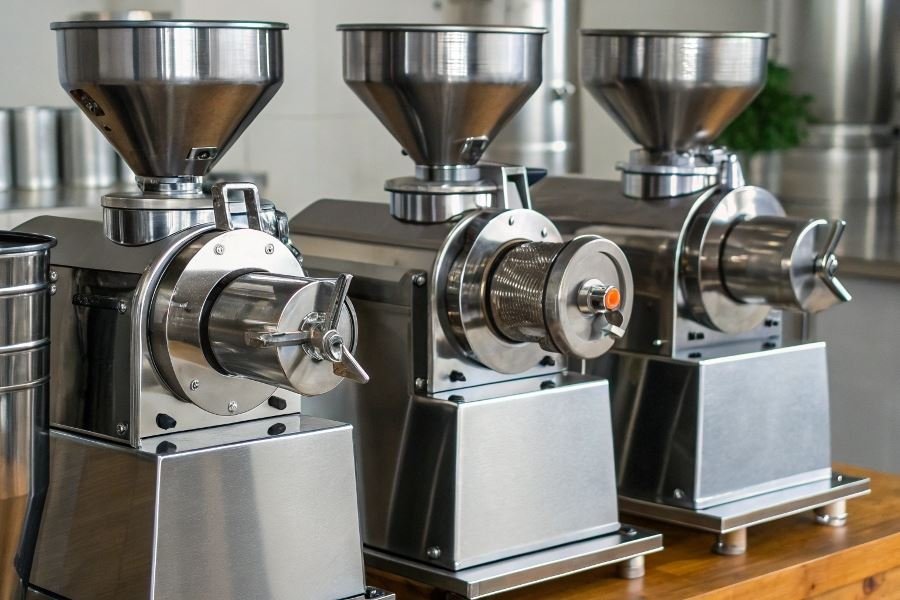
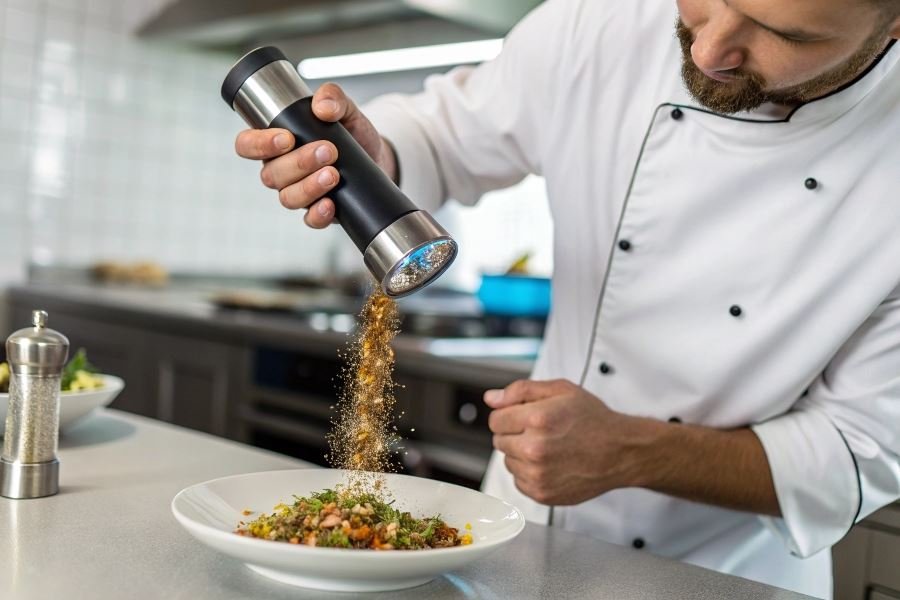
The landscape of commercial spice processing has undergone a remarkable transformation. Traditional industrial grinders once required dedicated facilities, but today’s compact spice grinding technology delivers professional-grade results in spaces as small as a food truck or boutique kitchen. These space-efficient powerhouses are responding to a market that increasingly values freshly-ground spices for their superior flavor profiles and aromatic intensity.
The space-efficiency imperative
The demand for compact grinding solutions stems from several converging factors:
- Rising commercial rents forcing businesses to maximize every square inch
- Craft food movement expansion creating more small-batch producers
- Consumer preference for freshly-processed spices over pre-ground alternatives
When selecting a compact grinder for commercial use, throughput capacity relative to footprint becomes the critical metric. The most efficient models now process up to 50 pounds per hour while occupying less than three square feet of counter space—a 40% improvement over models from just five years ago.
Productivity amplifiers in small operations
For small-scale spice operations, these compact grinders deliver outsized benefits:
“Our production doubled when we switched to a compact vertical grinder system, but our workspace requirements actually decreased by 30%.” — Artisanal spice producer
The productivity gains come from innovations like:
- Multi-stage grinding capabilities in single units
- Reduced cleaning time between batches
- Lower maintenance requirements and improved reliability
- Precision control systems that minimize waste
These compact workhorses aren’t just space-savers—they’re transforming what’s possible for small-scale spice entrepreneurs.
Top 3 Compact Spice Grinders That Revolutionize Small Production
When production floor space comes at a premium, finding equipment that delivers professional results without consuming valuable real estate becomes critical. Compact spice grinders for small production areas have evolved dramatically, offering solutions that don’t compromise on performance despite their smaller footprints. Let’s explore the standout options that are changing the game for small-batch producers, artisanal spice companies, and commercial kitchens with space constraints.
High-performance electric powerhouses
The Waring WSG60 Commercial Spice Grinder represents the gold standard in space-efficient electric models. At just 6.5″ × 6.5″ with a height of 12″, it processes up to 2.5 cups of spices in seconds while occupying minimal counter space. Its 19,000 RPM motor handles everything from cinnamon sticks to star anise without breaking a sweat.
The Mahlkönig EK43S deserves special mention for operations requiring consistent, precise grinds. Though marketed primarily for coffee, this 23″ tall workhorse with a reduced footprint compared to the original EK43 excels with dry spices, offering:
| Feature | Specification |
|---|---|
| Grinding capacity | 2.3-3.4 lbs/min |
| Dimensions | 9.5″ × 13″ × 23″ |
| Burr size | 98mm flat burrs |
| Grind settings | Stepless adjustment |
The Baratza Forte AP provides commercial-grade performance in an ultra-compact 5.5″ × 7.7″ footprint, making it ideal for operations where every inch matters.
Manual marvels with unmatched control
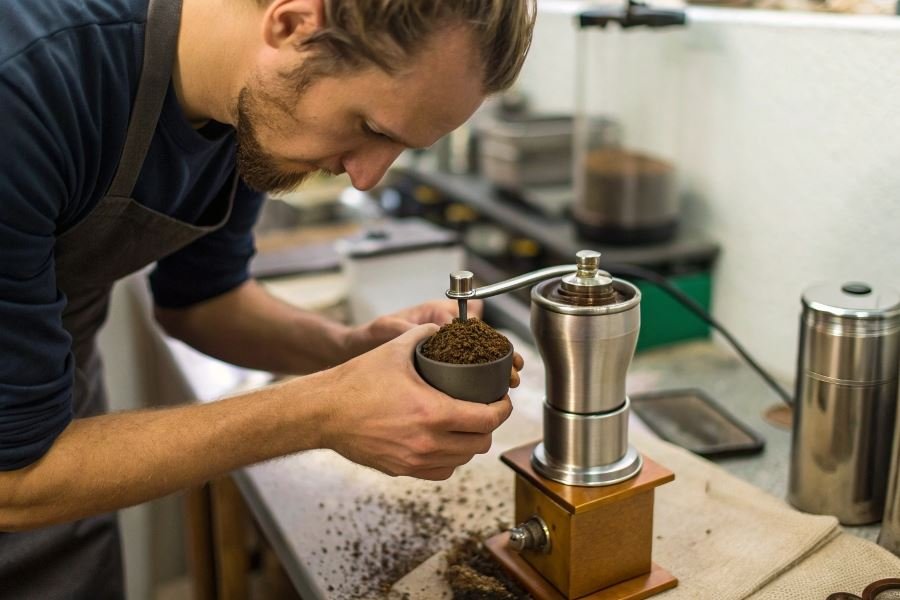
For operations prioritizing tactile control and durability without electrical requirements, manual options deliver surprising efficiency.
The Zassenhaus Santiago combines German engineering with a century-old design that’s remained virtually unchanged since 1867. Its carbon steel conical burrs maintain sharpness for decades, while the beechwood construction adds aesthetic appeal to production spaces. At just 5″ × 3.5″ × 8″, it’s remarkably space-efficient.
The Peugeot Bresil cast iron grinder offers industrial-strength durability in a compact package. Its two-stage grinding mechanism first cracks spices before grinding them to your desired consistency, preserving aromatic oils better than many electric alternatives.
What sets these manual options apart is their ability to operate during power outages and their superior heat management—crucial for preserving volatile oils in temperature-sensitive spices like nutmeg and cardamom.
Hybrid solutions for maximum versatility
The Ankarsrum Original represents the pinnacle of hybrid versatility. This Swedish-engineered marvel functions as both a powerful electric grinder and a manual option when paired with its hand-crank attachment. Its 8″ × 10.5″ × 15.7″ dimensions house multiple functions that would typically require several dedicated machines.
The KitchenAid Spice Grinder Attachment transforms existing stand mixers into dedicated spice processing stations without requiring additional counter space. For operations already utilizing KitchenAid mixers, this represents the ultimate space-saving solution.
The Komo FlicFloc offers a fascinating middle ground—electric operation with manual adjustment capabilities. Its innovative design allows for processing both oily and dry spices without clogging, a common limitation in many compact grinders.
When selecting the ideal compact grinder for your production needs, consider not just the footprint but also throughput requirements, maintenance accessibility, and noise levels—especially crucial in mixed-use production environments where customer-facing operations may occur simultaneously.
Maximizing Efficiency with Compact Spice Grinders
Small production spaces demand big thinking when it comes to equipment selection and workflow design. Compact spice grinders represent a powerful solution for artisanal spice companies, small-batch food manufacturers, and specialty culinary businesses operating in limited square footage. Let’s explore how to extract maximum value from these powerful little workhorses.
Strategic Placement Transforms Workflow
The positioning of your compact grinder can make or break your production efficiency. Unlike their industrial counterparts, compact models from manufacturers like Mahlkönig or Baratza can be integrated into existing countertop workflows without demanding dedicated floor space.
Corner utilization proves particularly effective—placing grinders at workflow intersections rather than endpoints reduces unnecessary movement. One specialty spice producer in Portland increased throughput by 22% simply by relocating their Waring Commercial WSG60 from a back counter to a central island position.
Consider vertical integration when horizontal space is limited:
| Placement Strategy | Efficiency Gain | Best For |
|---|---|---|
| Wall-mounted shelf systems | Reduces footprint by 100% | Pre-grinding staging |
| Mobile cart integration | Enables workflow flexibility | Multi-station production |
| Under-counter pull-out platforms | Preserves counter space | Intermittent grinding needs |
The most successful small-batch producers create dedicated grinding stations with all necessary tools within arm’s reach—measuring cups, storage containers, and cleaning supplies.
Maintenance Protocols for Confined Spaces
Maintaining equipment in tight quarters presents unique challenges. Dust management becomes critical when grinding aromatic spices like cinnamon or star anise in limited ventilation.
Implement these space-conscious maintenance practices:
- Scheduled deep cleaning during production downtimes rather than daily partial cleanings
- Portable vacuum systems with HEPA filtration to capture fine particulate without spreading it
- Modular component design that allows for cleaning individual parts without disassembling the entire unit
The Cuisinart SG-10 and similar models feature removable grinding chambers that can be cleaned separately from the motor housing—a crucial feature for small spaces where sink access might be limited.
Maintenance isn’t just about cleanliness—it’s about longevity. In confined production environments, equipment replacement creates disproportionate disruption.
Create a maintenance calendar that accounts for both preventive care and the realities of your space constraints. Many successful small producers dedicate 15 minutes at day’s end to quick-cleaning procedures, with comprehensive maintenance scheduled weekly.
ROI Analysis Beyond the Price Tag
The investment calculation for compact grinders extends beyond the initial purchase price. True ROI emerges from a combination of factors uniquely relevant to small-space operations:
Energy efficiency becomes magnified in small production environments. Compact models like the KitchenAid BCG111 typically consume 30-50% less power than industrial alternatives while maintaining sufficient throughput for small-batch production.
Multifunctionality delivers exceptional value—models offering adjustable grind settings can process everything from coarse sea salt to fine curry powders, eliminating the need for multiple specialized machines.
Consider these long-term value factors:
- Space-cost ratio: Calculate your per-square-foot production costs to understand the true value of compact equipment
- Maintenance savings: Smaller units typically require fewer replacement parts and less downtime
- Scalability potential: The best compact grinders grow with your business through accessory expansions rather than complete replacements
For operations processing less than 50 pounds of spices weekly, compact grinders typically reach ROI within 7-9 months, compared to 18+ months for industrial equipment—making them the financially prudent choice for space-conscious producers focused on quality over massive volume.
Discover the top 5 compact spice grinders perfect for small production spaces. Compare high-performance electric, manual, and hybrid models that maximize efficiency without sacrificing quality or taking up valuable workspace.
Discover the top 5 compact spice grinders perfect for small production spaces. Compare high-performance electric, manual, and hybrid models that maximize efficiency without sacrificing quality or taking up valuable workspace.