Ever walked into a restaurant kitchen and noticed the symphony of organization behind the scenes? That gleaming array of perfectly stored dishes isn’t just for show—it’s the backbone of operational excellence.
Behind every efficiently-run food establishment lies a critical decision that most customers never consider: the humble dish cabinet. These unsung heroes of commercial kitchens can make the difference between smooth service and costly chaos. When a busy restaurant goes through hundreds of dishes per shift, proper storage becomes not just convenient but essential to both food safety and operational flow.
The FDA reports that improper storage contributes to cross-contamination in nearly 20% of foodborne illness cases. Beyond safety, the right cabinet system can reduce breakage by up to 30% and cut staff retrieval time by almost half. These aren’t just incremental improvements—they’re game-changers for your bottom line.
“The dish cabinet is where efficiency meets compliance. Get it wrong, and you’re fighting an uphill battle every service.” – James Beard Award-winning chef Michael Voltaggio
Selecting appropriate storage solutions means navigating a complex web of considerations: material durability, space optimization, accessibility, and crucially—regulatory compliance. The NSF International and local health departments maintain strict guidelines on food-adjacent storage, with requirements for non-porous, easily sanitizable surfaces that resist moisture and bacterial growth.
Smart operators recognize that dish cabinet selection isn’t just a purchase—it’s an investment in operational excellence that pays dividends with every service.
The Ultimate Dish Cabinet Selection Guide for Food Businesses
When running a food establishment, the humble dish cabinet often gets overlooked in the equipment hierarchy. Yet these workhorses silently protect your investment in dinnerware while showcasing your commitment to cleanliness. The right cabinet doesn’t just store—it preserves, displays, and contributes to operational efficiency.
Selecting the perfect dish cabinet requires careful consideration of criteria for choosing a dish cabinet considering the specifics of a food enterprise. From bustling cafeterias serving hundreds daily to intimate bistros with artisanal plateware, your unique operational needs dictate the ideal specifications. Let’s dive into what truly matters when making this crucial investment.
Material matters: The foundation of durability
Stainless steel reigns supreme in commercial food environments, and for good reason. Grade 304 stainless offers exceptional corrosion resistance while withstanding the humidity and temperature fluctuations common in kitchens. For coastal establishments, consider upgrading to grade 316 stainless, which provides superior protection against salt air.
Tempered glass components add visibility while maintaining hygiene standards. Look for glass that’s at least 5mm thick with polished edges to prevent chipping and ensure longevity.
Food-grade plastics have their place too—particularly for components like drawer slides and interior organizers—but verify they meet NSF certification standards for food contact surfaces.
“The material of your dish cabinet isn’t just about durability—it’s your first line of defense in your food safety protocol.”
Sizing your solution: Capacity considerations
The relationship between your establishment’s volume and cabinet capacity is critical. Here’s a quick reference guide:
| Establishment Type | Recommended Capacity | Ideal Dimensions |
|---|---|---|
| Small café (≤30 seats) | 200-300 pieces | 36″W × 18″D × 72″H |
| Mid-sized restaurant (30-100 seats) | 500-800 pieces | 48″W × 24″D × 84″H |
| Large cafeteria/banquet hall | 1000+ pieces | Multiple units or custom solutions |
Beyond simple storage volume, consider your specific inventory. Deep shelves accommodate platters, while adjustable shelving allows for stemware and taller items. Measure your largest serving pieces and ensure at least 2″ clearance.
Factor in growth potential—purchasing a cabinet with 20% more capacity than your current needs provides flexibility as your business evolves.
Sanitation features: Where design meets compliance
Modern dish cabinets incorporate ingenious sanitation features that streamline maintenance while ensuring compliance with health regulations:
- Coved corners eliminate hard-to-clean crevices where bacteria thrive
- Removable shelf liners allow for thorough sanitizing
- Ventilation systems that prevent moisture accumulation without compromising dust protection
- UV sterilization options for high-end applications
Look for cabinets with sloped tops to prevent dust collection and debris storage. Doors should seal tightly but open smoothly—sliding doors conserve space in tight kitchens, while hinged doors provide better access in larger environments.
The best cabinets feature tool-free disassembly of key components, allowing for thorough cleaning without specialized maintenance calls. This seemingly small detail can save hours of labor monthly and thousands in maintenance costs annually.
Remember that your dish cabinet isn’t just storage—it’s an active participant in your food safety program and a reflection of your operational standards. Choose wisely, and this unsung hero will serve your establishment faithfully for years to come.
Strategic Cabinet Selection for Food Enterprise Excellence
Seamless Workflow Integration
The most sophisticated dish cabinets don’t just store—they transform operations. When evaluating cabinets for your food enterprise, workflow integration becomes the cornerstone of efficiency. Premium cabinets from manufacturers like Cambro and Metro feature modular designs that adapt to your existing kitchen layout rather than forcing your staff to adapt to them.
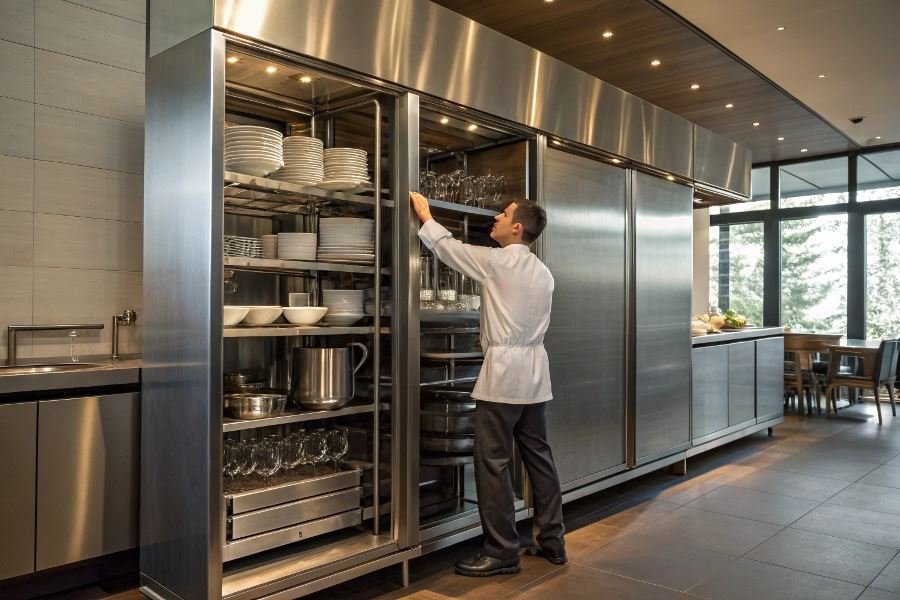
Placement proximity matters tremendously. Dish cabinets positioned within 5-8 steps of dishwashing stations can reduce staff movement by up to 30% during peak service hours. Consider cabinets with pass-through capabilities if your kitchen layout permits—these allow loading from the dishwashing area and unloading directly into service areas.
Space constraints in urban establishments demand vertical solutions. Look for cabinets with:
- Adjustable shelving configurations
- Stackable components
- Corner-optimized designs
- Pull-out or sliding mechanisms
The most valuable square footage in your kitchen isn’t what you see—it’s what you save.
Premium vs. Standard: The Real Cost Equation
The initial sticker shock of premium cabinets (2, 500 − 4, 000)versusstandardoptions(800-1,500) often drives purchasing decisions. However, this surface-level comparison misses critical factors in the true cost equation.
Material durability translates directly to longevity. Standard stainless steel cabinets typically use 18-gauge steel, while premium options feature 16-gauge or even 14-gauge construction. This seemingly minor difference can extend cabinet life by 5-7 years in high-volume operations.
| Cabinet Type | Initial Cost | Average Lifespan | Annual Cost (Amortized) | Replacement Frequency |
|---|---|---|---|---|
| Standard | $1,200 | 5-7 years | $171-240 | Higher |
| Premium | $3,200 | 12-15 years | $213-267 | Lower |
Premium cabinets from Hoshizaki or True Manufacturing often include features that generate ongoing savings:
- Self-closing doors reducing temperature fluctuations
- Antimicrobial surfaces decreasing sanitization labor
- Reinforced casters minimizing floor damage
- Condensation management systems protecting dishware
Beyond Purchase: The Maintenance Matrix
The hidden costs of cabinet ownership emerge in maintenance requirements. Premium cabinets typically require 60% less maintenance intervention over their lifespan compared to standard alternatives.
Warranty structures reveal manufacturer confidence. Standard cabinets typically offer 1-2 year limited warranties, while premium options from Vulcan or Hobart extend to 5-7 years with comprehensive coverage.
Evaluate these maintenance factors:
- Replacement part availability and standardization
- Gasket and seal durability (typically the first failure points)
- Cleaning accessibility for all surfaces
- Condensation management systems
- Corrosion resistance in high-humidity environments
The most forward-thinking operations maintain detailed maintenance logs. These records reveal that premium cabinets typically require first significant repairs at the 7-year mark, while standard units often need intervention within 2-3 years.
Modular design provides repair advantages. When components of premium cabinets eventually fail, they’re typically designed for section replacement rather than complete unit replacement—a substantial long-term savings that standard cabinets rarely offer.
Discover the 7 critical factors for selecting commercial dish cabinets that maximize efficiency, ensure food safety compliance, and integrate seamlessly into your kitchen workflow. Expert guidance for restaurant owners seeking durable, sanitary storage solutions.
Discover the 7 critical factors for selecting commercial dish cabinets that maximize efficiency, ensure food safety compliance, and integrate seamlessly into your kitchen workflow. Expert guidance for restaurant owners seeking durable, sanitary storage solutions.