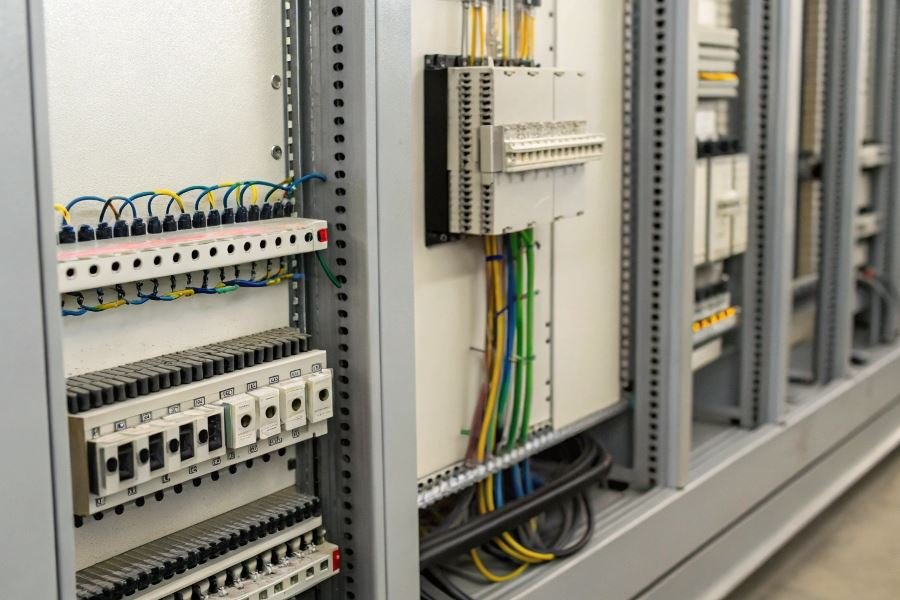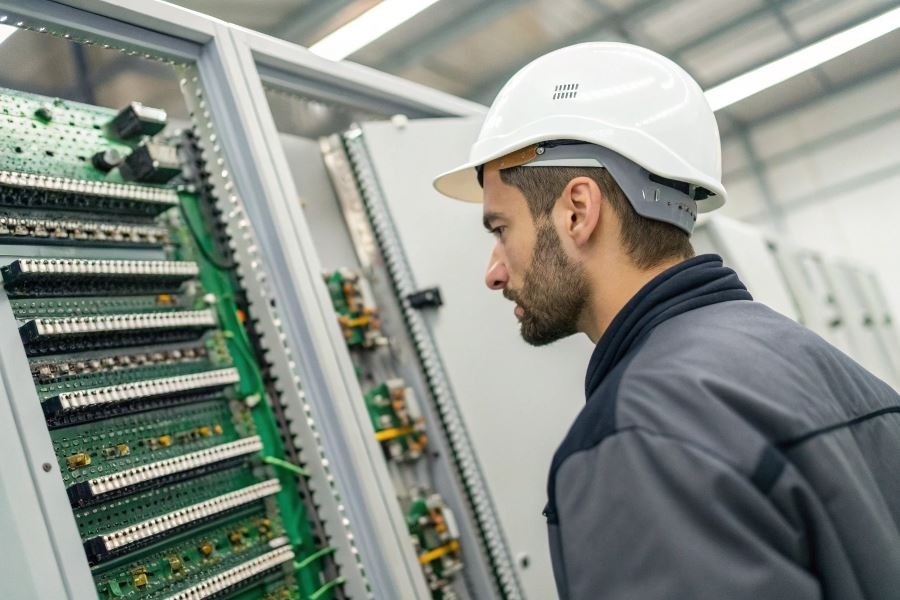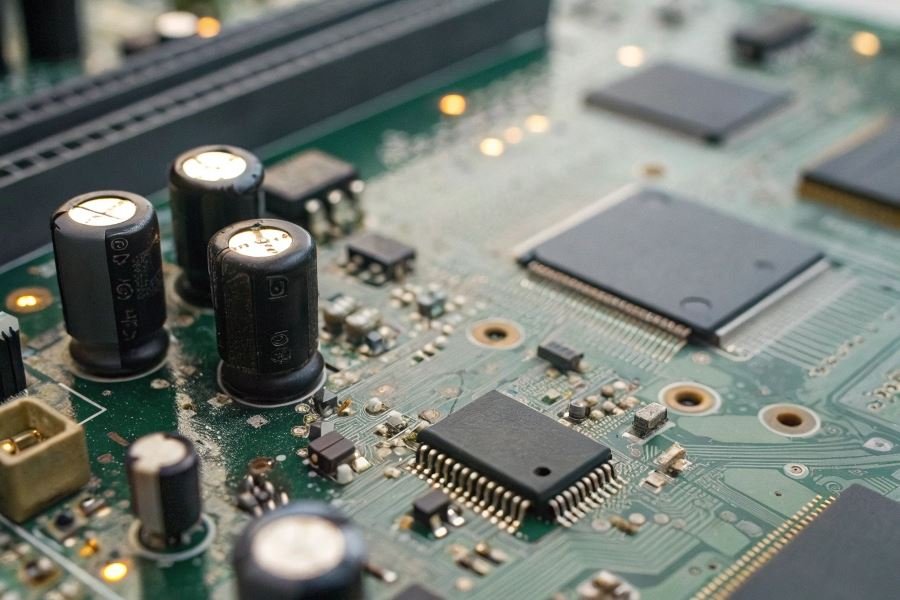
Ever watched a million-dollar manufacturing line screech to a halt because of a tiny electrical hiccup? In critical industrial environments, that “hiccup” costs an average of $22,000 per minute in downtime. The culprit often lurks unseen: electromagnetic interference wreaking havoc on input-output boards.
Interference protection in industrial input-output boards functions as your system’s immune system—a sophisticated defense mechanism that shields critical data pathways from the electromagnetic chaos of industrial environments. These specialized circuits and components filter out unwanted signals while preserving the integrity of legitimate commands and readings.
The electromagnetic battlefield
Modern factories are electromagnetic battlefields. Variable frequency drives, switching power supplies, and wireless communications create a constant storm of interference. Even seemingly innocent equipment like LED lighting can generate high-frequency noise that penetrates sensitive I/O channels.
The most common interference sources include:
- Motor drives and actuators (generating transient voltage spikes up to 2,000V)
- Radio-frequency transmitters (creating persistent background noise)
- Power line fluctuations (introducing harmonics and voltage variations)
- Electrostatic discharge (producing momentary but devastating pulses)
When protection fails: The domino effect
Inadequate interference protection doesn’t just create occasional glitches—it undermines your entire operation. Systems experiencing interference typically show 27% higher error rates and require maintenance visits 3x more frequently than properly protected installations.
The consequences cascade through operations:
- False triggers activating emergency shutdowns
- Corrupted sensor readings leading to quality control failures
- Communication dropouts between PLCs and SCADA systems
- Premature component failure from electrical stress
In the high-stakes world of industrial automation, interference protection isn’t just a technical specification—it’s the foundation of reliability, accuracy, and ultimately, profitability.
The Fortress: Essential Interference Protection Technologies
Industrial environments are electrical battlegrounds where signals fight to maintain their integrity. The backbone of reliable industrial automation lies in robust interference protection in industrial input-output boards. These critical components serve as the nervous system of industrial control systems, and their ability to function accurately amid electromagnetic chaos determines overall system reliability.
Galvanic Isolation: The Great Divide
Galvanic isolation creates an electrical moat around your sensitive circuits, preventing unwanted current flow while allowing signals to pass. This fundamental protection technique comes in several powerful forms:
Optocouplers remain the workhorses of isolation, using light to transmit signals across a physical gap. Modern versions from Texas Instruments achieve isolation voltages exceeding 5kV with response times under 100ns.
Digital isolators have revolutionized the field with higher speed and reliability than traditional optocouplers. These semiconductor-based solutions use capacitive or magnetic coupling to achieve:
| Isolation Type | Typical Voltage Rating | Speed | Power Efficiency |
|---|---|---|---|
| Capacitive | 2.5-5kV | 100+ Mbps | High |
| Magnetic | 2.5-7.5kV | 150+ Mbps | Medium |
| Optical | 3-7.5kV | 1-50 Mbps | Low |
Transformer-based isolation excels in power transfer applications, providing complete electrical separation while maintaining signal integrity across the barrier.
Filtering: The Signal Purifiers
Filtering solutions act as bouncers, allowing legitimate signals through while blocking electromagnetic riffraff.
Passive filtering employs combinations of resistors, capacitors, and inductors to create frequency-selective barriers. These cost-effective solutions require no power but offer limited adaptability:
- RC filters for simple low-pass applications
- LC filters for sharper cutoff characteristics
- Pi and T configurations for multi-stage filtering with steeper rolloff
Active filtering brings intelligence to the battle, using operational amplifiers and other powered components to create dynamic, responsive protection:
- Programmable gain amplifiers adjust sensitivity based on signal conditions
- Switched-capacitor filters provide precision cutoff frequencies
- Digital signal processing enables adaptive filtering that evolves with changing noise profiles
The most effective designs combine both approaches, with passive filters handling gross interference and active components fine-tuning the signal.
Shielding and Grounding: The Environmental Defense
Even the best isolation and filtering can be compromised without proper shielding and grounding strategies.
Electromagnetic shielding creates a conductive enclosure that redirects interference away from sensitive components. The effectiveness depends on material choice:
- Aluminum offers excellent shielding-to-weight ratio
- Steel provides superior low-frequency protection
- Mu-metal excels at magnetic field attenuation
- Copper delivers outstanding conductivity for high-frequency shielding
Grounding best practices form the foundation of any interference protection strategy:
- Single-point grounding prevents ground loops by ensuring all grounds connect at one physical location
- Star topology minimizes cross-interference between circuit sections
- Ground planes provide low-impedance paths for interference currents
- Isolation barriers between analog and digital grounds prevent digital noise from corrupting sensitive measurements
When implemented together, these core technologies create a comprehensive defense system that ensures industrial input-output boards perform flawlessly even in the harshest electromagnetic environments.
Mastering Interference Protection in Industrial I/O Boards
Design considerations that actually work
Industrial environments are electromagnetic battlefields. Motors, drives, and high-current switching create noise that can cripple sensitive I/O boards. Effective interference protection begins at the design phase with several critical considerations.
First, proper ground plane implementation serves as your foundation. A continuous, low-impedance ground plane acts as both shield and return path for noise currents. Many designers underestimate the impact of ground plane splits, which can create voltage differentials of several volts during transient events.
Physical separation matters more than you think. Analog and digital circuits should maintain maximum possible distance, with analog signals routed away from high-speed digital lines. When Texas Instruments tested their industrial-grade ADCs, they found that simply increasing separation by 2cm reduced noise coupling by up to 12dB in certain frequency bands.
Filtering components deserve careful selection:
| Component Type | Typical Values | Best Applications |
|---|---|---|
| Ferrite Beads | 100-600Ω @ 100MHz | High-frequency noise |
| Common-mode Chokes | 1-10mH | Differential noise rejection |
| X/Y Capacitors | 1-10nF | Line-to-line/line-to-ground filtering |
Differential signaling provides inherent noise immunity through common-mode rejection. Using twisted pair cables with RS-485 or LVDS transceivers can maintain signal integrity even with noise levels exceeding 1V peak-to-peak.
Testing methodologies that reveal the truth
Validating interference immunity requires rigorous testing beyond basic functional verification. The gold standard involves conducted and radiated immunity testing using specialized equipment.
Conducted immunity testing subjects boards to:
- Electrical fast transients (EFT) up to 4kV
- Surge immunity tests simulating lightning strikes
- Voltage dips and interruptions mimicking power grid instabilities
Keysight Technologies offers EMC test solutions that can inject precisely calibrated interference signals while monitoring system response. Their automated test systems can identify susceptibility windows that might be missed in manual testing.
Don’t underestimate the value of real-world testing. Laboratory conditions rarely match the chaotic electromagnetic environment of a factory floor. Field testing in actual industrial settings often reveals vulnerabilities that controlled tests miss.
Regulatory standards you can’t ignore
Compliance with international standards isn’t optional—it’s essential for market access and product reliability.
The cornerstone standard for industrial equipment is IEC 61000-4, which defines testing methods for various electromagnetic phenomena:
- IEC 61000-4-2: Electrostatic discharge immunity
- IEC 61000-4-3: Radiated RF immunity
- IEC 61000-4-4: Electrical fast transient immunity
- IEC 61000-4-5: Surge immunity
Regional variations exist, with UL requirements in North America and specific standards for specialized industries like railway (EN 50121) or medical (IEC 60601).
The CE mark for European markets requires documented compliance with the EMC Directive (2014/30/EU), which mandates both emissions and immunity requirements. Failure to meet these standards can result in product recalls and significant liability.
Documentation is your shield. Maintaining comprehensive test reports, design files, and compliance declarations protects against regulatory challenges and provides valuable troubleshooting resources when interference issues arise in the field.
By implementing robust design practices, thorough testing methodologies, and strict adherence to regulatory standards, manufacturers can create industrial I/O boards that perform reliably even in the harshest electromagnetic environments.
Discover cutting-edge techniques for safeguarding industrial I/O boards against electromagnetic interference. Learn about galvanic isolation, filtering solutions, and shielding strategies that ensure maximum system reliability in harsh industrial environments.
Discover cutting-edge techniques for safeguarding industrial I/O boards against electromagnetic interference. Learn about galvanic isolation, filtering solutions, and shielding strategies that ensure maximum system reliability in harsh industrial environments.