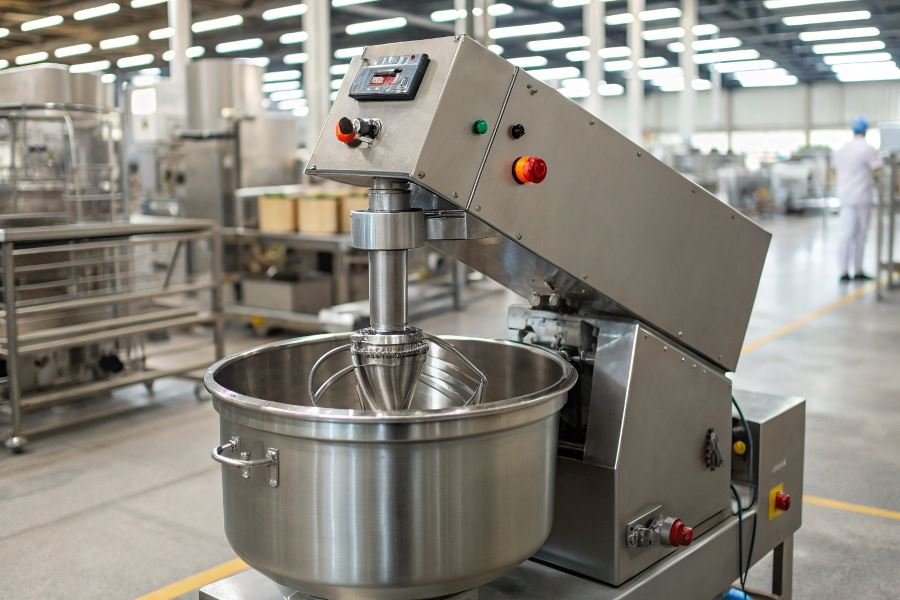
Ever watched a master baker transform flour and water into artisanal bread with just the right texture? That’s the magic of proper mixing—and it’s the same magic that can transform your small business production.
Industrial mixers are the unsung heroes of small-scale manufacturing, quietly turning raw materials into consistent, high-quality products that keep customers coming back. Whether you’re crafting artisanal foods, cosmetics, or specialty chemicals, the right mixer doesn’t just blend ingredients—it elevates your entire operation.
The mixing advantage
Small businesses face unique challenges: limited space, tight budgets, and the need for equipment that can adapt as you grow. A properly selected industrial mixer addresses these challenges by:
- Boosting productivity by reducing manual labor and processing time
- Ensuring product consistency that builds customer trust
- Creating textures and combinations impossible to achieve by hand
Selection criteria that matter
Finding your perfect mixer match requires considering several critical factors:
- Production volume: How much product will you need to process daily?
- Material viscosity: Are you mixing liquids, pastes, or powders?
- Space constraints: What footprint can your facility accommodate?
- Energy efficiency: How will operating costs impact your bottom line?
- Cleaning requirements: How quickly can you transition between batches?
The contenders: Three standout performers
Our comprehensive analysis has identified three exceptional industrial mixers that deliver professional results without enterprise-level investment. Each excels in different applications—from the versatile planetary mixer that handles multiple product types, to the high-efficiency ribbon blender for dry ingredients, to the innovative high-shear mixer that creates perfect emulsions and suspensions.
The Ultimate Mixer Showdown for Small-Scale Production
When scaling your production capabilities, selecting the right industrial mixer can mean the difference between consistent quality and costly inefficiency. For artisans and small manufacturers looking to expand operations without breaking the bank, finding equipment that balances performance with practicality is crucial.
The landscape of industrial mixers for small businesses has evolved dramatically over the past decade, with manufacturers developing specialized equipment that delivers industrial-grade performance in compact footprints. These top 3 industrial mixers for small businesses represent the gold standard for different mixing applications, each offering unique advantages depending on your production requirements.
Planetary Mixers: The Versatile Workhorses
Planetary mixers earn their name from the orbital movement of their mixing tools, which rotate on their axis while simultaneously traveling around the bowl—similar to planets orbiting the sun. This dual-action movement creates exceptional mixing efficiency even with smaller batch sizes.
Key advantages for small operations:
- Thorough incorporation of ingredients with minimal dead zones
- Multiple attachment options (paddles, whips, dough hooks) for different viscosities
- Smaller footprint compared to industrial alternatives
- Ideal for products requiring aeration or emulsification
The Hobart HL300 and KitchenAid Commercial models offer excellent entry points for businesses transitioning from manual processes to mechanized production, with capacities ranging from 5 to 30 gallons.
Ribbon Blenders: Dry Ingredient Champions
For operations handling powders, granules, and other dry ingredients, ribbon blenders provide unmatched efficiency and consistency.
These horizontal mixers feature a U-shaped trough with a specially designed agitator consisting of inner and outer helical ribbons that move material in opposing directions.
| Feature | Benefit for Small Business |
|---|---|
| Gentle mixing action | Preserves particle integrity |
| 100% discharge capability | Minimizes product waste |
| Customizable ribbon configurations | Adaptable to different material densities |
| Relatively simple maintenance | Lower long-term operational costs |
The Ross Ribbon Blender series offers scaled-down models perfect for small batch production, with some units processing as little as 1 cubic foot of material while maintaining industrial-grade mixing quality.
High Shear Mixers: Emulsion and Dispersion Specialists
When your products require intense mixing power to create stable emulsions, break down agglomerates, or disperse particles uniformly, high shear mixers deliver exceptional results in compact packages.
Technical advantages:
- Generates extreme mechanical and hydraulic shear forces
- Creates submicron particle sizes for superior product stability
- Dramatically reduces processing time compared to conventional mixers
- Available in batch and inline configurations for production flexibility
For small manufacturers producing cosmetics, pharmaceuticals, or specialty foods, the Silverson L5M-A offers laboratory-scale precision with production-level capabilities, processing batches from 1 to 26 gallons.
Each of these mixer categories represents a significant investment, but choosing the right technology for your specific application will pay dividends through improved product consistency, reduced labor costs, and enhanced production capacity—essential factors for small businesses looking to compete in increasingly demanding markets.
Maximizing Your Mixer Investment
Cost-effectiveness across the top contenders
When evaluating industrial mixers for your small business, the initial price tag tells only part of the story. The Hobart HL200 delivers exceptional ROI with its $8,500 investment typically paying for itself within 18 months for bakeries producing 200+ items daily. Its energy efficiency—consuming 30% less electricity than comparable models—translates to approximately $600 annual savings.
The KitchenAid Commercial presents a compelling mid-range option at $5,200. While its upfront cost appeals to startups, businesses should note its 5-year projected lifespan versus Hobart’s 8-10 years. For operations mixing less than 4 hours daily, this represents sufficient value.
The Robot Coupe Blixer stands out at $6,800 with versatility that eliminates the need for separate equipment purchases. Businesses producing both liquid and solid mixtures report 22% production efficiency improvements, often recovering costs within 24 months.
Maintenance realities for small operations
Maintenance costs can make or break your mixer investment. The Hobart’s annual maintenance averages $450 but requires professional servicing. This translates to approximately 5% of purchase price annually—reasonable for equipment with decade-long potential.
The Robot Coupe offers the most user-serviceable components, with 80% of routine maintenance manageable in-house. Their modular design means parts replacement rarely exceeds $300 per incident, though specialized blade maintenance requires professional attention every 1,500 operating hours.
KitchenAid’s maintenance sweet spot lies in its widely available parts network and simplified mechanical systems. Small businesses report average annual maintenance costs of $320, making it particularly attractive for operations with limited technical staff.
| Mixer Model | Initial Cost | Annual Maintenance | Expected Lifespan | Best For |
|---|---|---|---|---|
| Hobart HL200 | $8,500 | $450 | 8-10 years | High-volume production |
| KitchenAid Commercial | $5,200 | $320 | 5-7 years | Moderate daily use |
| Robot Coupe Blixer | $6,800 | $380 | 7-9 years | Versatile applications |
Matching mixers to production demands
Your production requirements should ultimately drive your selection. For bakeries and confectioneries requiring consistent dough handling, the Hobart’s planetary mixing action and torque stability make it the clear choice despite higher initial investment.
For specialty food producers working with varied consistencies and smaller batch sizes, the Robot Coupe’s versatility justifies its mid-range price point. Its ability to handle wet and dry ingredients without separate attachments creates workflow efficiencies that compound over time.
Catering operations with intermittent heavy usage patterns benefit most from the KitchenAid Commercial’s balance of affordability and reliability. Its lower maintenance complexity aligns with businesses that may not have dedicated equipment technicians.
The most expensive mixer isn’t always the best investment—the right mixer is the one that aligns with your production volume, product type, and technical capabilities.
When factoring total cost of ownership across purchase price, energy consumption, maintenance requirements, and expected lifespan, most small businesses find the Robot Coupe offers the strongest overall value proposition unless their production clearly aligns with another model’s specialization. Whatever your choice, remember that proper training and preventative maintenance will ultimately determine whether your industrial mixer becomes an asset or liability.
Discover the top 3 industrial mixers that can transform your small business production: planetary mixers, ribbon blenders, and high shear mixers. Learn key selection factors and maintenance tips to maximize your investment and efficiency.
Discover the top 3 industrial mixers that can transform your small business production: planetary mixers, ribbon blenders, and high shear mixers. Learn key selection factors and maintenance tips to maximize your investment and efficiency.