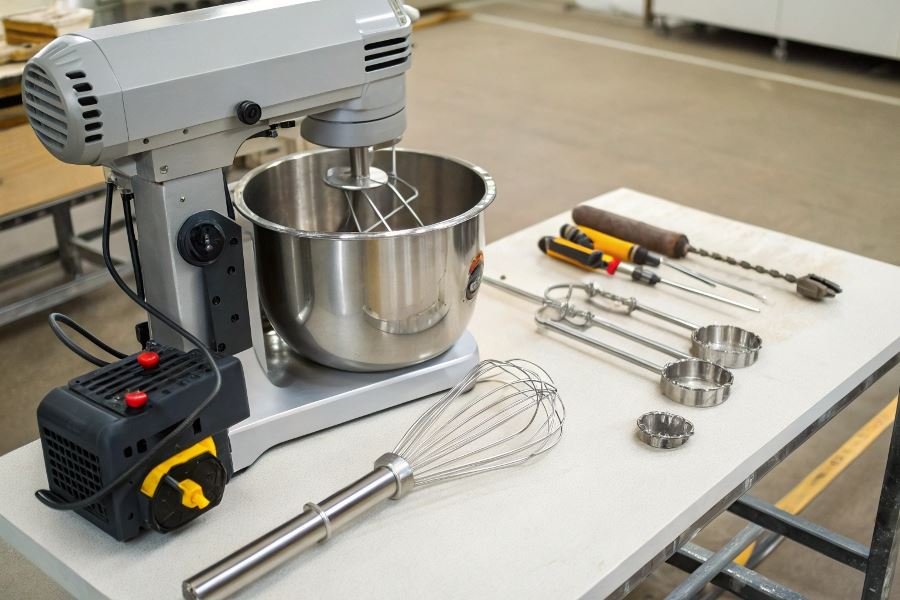
Ever watched a professional chef struggle with an underpowered hand mixer on a triple batch of dough? That same frustration—multiplied by thousands of dollars in lost productivity—plays out daily in production facilities nationwide when mixer power doesn’t match production needs.
The relationship between mixer power and production capacity isn’t just technical—it’s the heartbeat of your operation. Selecting appropriate mixer power based on your production volumes directly impacts your bottom line, product consistency, and equipment lifespan. When a food processing plant in Michigan upgraded from a 5HP to a 7.5HP industrial mixer for their expanding bakery line, they reported a 32% increase in throughput with zero compromise on product quality.
Power-to-volume ratio matters more than you think. Too little power creates inconsistent mixtures, extended processing times, and premature equipment failure. Conversely, excessive power wastes energy and capital. Finding that sweet spot requires understanding three critical factors:
- Material viscosity and density – Honey demands significantly more power than water
- Batch size and frequency – Continuous production needs differ from batch processing
- Mixing intensity requirements – Gentle blending versus high-shear homogenization
The difference between optimal and suboptimal mixer power selection often translates to thousands in operational costs annually. As one manufacturing consultant put it: “The right mixer power isn’t about the biggest motor—it’s about the smartest match between your production demands and your equipment capabilities.”
Power Precision: Matching Mixer Horsepower to Production Demands
Selecting the right mixer power isn’t just about buying the biggest machine your budget allows—it’s about engineering efficiency into your production process. When manufacturers understand how to choose the power of a mixer based on production volumes, they unlock significant cost savings while ensuring product quality remains consistent batch after batch.
Batch Size Mathematics: The Foundation of Power Calculation
The relationship between batch size and required power follows a predictable pattern, though not always linear. For small to medium operations processing up to 50 gallons per batch, a 1-3 HP motor typically suffices. Scale up to 100-500 gallon batches, and you’re looking at 5-10 HP requirements. Industrial operations handling 1,000+ gallon batches generally need 20+ HP motors.
Production frequency creates another dimension in this equation. A mixer running continuously 24/7 requires different specifications than one used for occasional batches. Continuous operation demands motors with service factors of 1.15 or higher and often justifies investing in premium efficiency models that deliver long-term energy savings.
| Batch Size (gallons) | Occasional Use (HP) | Continuous Production (HP) |
|---|---|---|
| 5-50 | 0.5-2 | 1-3 |
| 50-200 | 2-5 | 3-7.5 |
| 200-500 | 5-10 | 7.5-15 |
| 500-1,000 | 10-20 | 15-30 |
| 1,000+ | 20+ | 30+ |
The Viscosity Variable: Adjusting for Material Properties
Material properties dramatically influence power requirements—sometimes exponentially. Mixing water requires minimal power, while high-viscosity materials like adhesives or heavy creams demand substantially more.
The viscosity-power relationship follows a near-cubic function: doubling viscosity can require up to eight times more power! This explains why a 2 HP mixer perfect for water-based solutions might stall completely when faced with honey-like substances.
For materials with viscosities:
- Low (1-100 cP): Multiply base power by 1-1.5x
- Medium (100-10,000 cP): Multiply base power by 1.5-3x
- High (10,000-100,000 cP): Multiply base power by 3-8x
- Ultra-high (>100,000 cP): Multiply base power by 8-15x or consider specialized equipment
Density plays a similar role—materials with higher specific gravity require proportionally more power. For every 0.3 increase in specific gravity above 1.0, increase power requirements by approximately 30%.
Intensity and Time: The Final Power Determinants
Mixing intensity requirements vary dramatically by application. Gentle blending of compatible liquids might need only 0.1-0.2 HP per 100 gallons, while high-shear applications for emulsification can demand 1-3 HP per 100 gallons.
Processing time creates an inverse relationship with power: higher power allows shorter processing times. A 10 HP mixer might complete in 30 minutes what takes a 5 HP unit an hour to accomplish.
The efficiency sweet spot lies in balancing these factors. For batch processes, slightly higher power that reduces cycle time often delivers better ROI than minimum power solutions that extend processing time.
When calculating your requirements, remember that undersized mixers lead to incomplete mixing, extended processing times, and inconsistent product quality—while oversized units waste capital and energy. The perfect mixer power specification balances production volume, material properties, and process requirements into a single, optimized solution.
Powering Your Production: Matching Mixer Power to Your Volume Needs
When scaling your manufacturing operation, selecting the right mixer power isn’t just about avoiding immediate problems—it’s about optimizing efficiency, product quality, and your bottom line. Let’s dive into the specifics of how to match mixer horsepower to your production requirements with precision.
Power Ranges That Make Sense
Different production volumes demand distinctly different power specifications. Here’s what experienced manufacturers recommend:
Small-scale production (up to 50 gallons per batch)
- 1/4 HP to 2 HP mixers typically suffice
- Ideal for craft operations, R&D labs, and specialty product lines
- Energy consumption: approximately 0.2-1.5 kWh per hour of operation
Medium-scale production (50-500 gallons)
- 2 HP to 10 HP provides optimal performance
- Perfect for regional manufacturers and growing operations
- Look for mixers with variable speed drives to handle diverse product viscosities
Large-scale production (500+ gallons)
- 10 HP to 100+ HP depending on material viscosity and batch size
- Industrial-grade motors with cooling systems become essential
- Consider three-phase power requirements and facility electrical capacity
| Production Scale | Recommended Power | Typical Applications | Key Features to Seek |
|---|---|---|---|
| Small (≤50 gal) | 1/4 – 2 HP | Craft production, testing | Portable, single-phase compatible |
| Medium (50-500 gal) | 2 – 10 HP | Regional manufacturing | Variable speed, medium-duty gearing |
| Large (500+ gal) | 10 – 100+ HP | Industrial production | Heavy-duty construction, advanced cooling |
Avoiding Power Selection Pitfalls
The most expensive mixer isn’t always the right choice. Here are critical mistakes to avoid:
Underpowering your operation
- Insufficient power leads to incomplete mixing, extended processing times, and inconsistent product quality
- The hidden cost of underpowering often exceeds the savings from purchasing a smaller mixer
Overpowering without necessity
- Excessive power wastes energy and capital
- Can actually damage delicate ingredients or create unwanted heat in temperature-sensitive processes
Ignoring viscosity changes
- Products that thicken during processing (like adhesives or certain foods) require significantly more power at finishing stages
- Factor in a 25-50% power buffer for products that increase in viscosity
Neglecting mixer efficiency ratings
- Modern Baldor and SEW-EURODRIVE motors offer efficiency ratings that can reduce operational costs by 15-30%
- Premium efficiency motors typically pay for themselves within 12-24 months of continuous operation
Future-Proofing Your Power Selection
Smart manufacturers think beyond current needs:
Modular power systems
- Consider systems from manufacturers like Admix that allow motor upgrades without replacing the entire mixing system
- Modular designs can save up to 40% on future expansion costs
Variable frequency drives (VFDs)
- Installing a VFD from suppliers like ABB allows a single mixer to operate efficiently across multiple power ranges
- Provides flexibility to handle different product formulations without purchasing additional equipment
Scalable batch considerations
- If you anticipate scaling production within 3-5 years, consider purchasing a mixer with 20-30% more power capacity than currently needed
- The incremental cost of additional power capacity during initial purchase is typically 30-50% less than upgrading later
When selecting mixer power, remember that the goal isn’t just adequate mixing—it’s optimizing your entire production ecosystem. The right power selection creates a foundation for consistent quality, operational efficiency, and the agility to grow your production volumes without unnecessary capital expenditure.
Learn how to select the optimal mixer power based on your production volume, material viscosity, and batch size. This guide helps manufacturers match equipment capacity to actual needs for maximum efficiency and product quality.
Learn how to select the optimal mixer power based on your production volume, material viscosity, and batch size. This guide helps manufacturers match equipment capacity to actual needs for maximum efficiency and product quality.