Ever wondered why some tattoo artists swear by specific cartridge-machine combinations while others struggle with constant technical issues? The answer lies not in superstition, but in the nuanced world of needle cartridge compatibility.
When a tattoo machine and needle cartridge speak the same mechanical language, magic happens. Compatibility isn’t just a technical specification—it’s the foundation of artistic freedom. At its core, needle cartridge compatibility refers to how effectively a particular cartridge works with a specific tattoo machine design, affecting everything from line quality to color saturation and artist comfort.
The journey toward today’s cartridge systems began in the early 2000s when manufacturers first introduced disposable cartridges to address cross-contamination concerns. What started as simple safety innovations has evolved into sophisticated systems with specialized features. The watershed moment came in 2010 when several major manufacturers standardized connection types, revolutionizing how artists approach their craft.
“The right cartridge-machine pairing can be the difference between an eight-hour session that feels like four and a four-hour session that feels like twelve.” — Industry veteran
Three critical factors determine whether your cartridge and machine will work harmoniously:
- Voltage requirements – Different needle configurations require specific power levels
- Connection type – From bayonet mounts to click systems and proprietary designs
- Weight distribution – How the cartridge balances affects handling and precision
Understanding these elements isn’t just technical trivia—it’s essential knowledge for anyone serious about delivering exceptional tattoo work consistently. The compatibility conversation isn’t about limitations but about finding the perfect mechanical partner for your artistic vision.
Machine Matchmaking: Tattoo Cartridge Compatibility Guide
Rotary Machines: The Versatile Workhorses
Rotary tattoo machines have revolutionized the industry with their smooth, consistent operation. These machines use an electric motor to drive the needle in a continuous circular motion, creating less skin trauma and noise compared to their counterparts. When examining compatibility of needle cartridges with different tattoo machines, rotary systems offer the most versatile platform for cartridge adaptation.
Most modern rotary machines like the FK Irons Spektra Xion and Cheyenne SOL Nova feature universal grips designed to accept standard-sized cartridges with 8-9mm diameters. The key specification to watch for is the connection type—typically either a direct click system or threaded grip attachment.
Compatibility specifications for rotary machines:
- Voltage requirements: 5-12V DC (optimal range 7-9V for most cartridges)
- Stroke length compatibility: 3.5-4.5mm for liners, 2.5-3.5mm for shaders
- Connection types: Click, threaded, or hybrid systems
Many artists prefer rotary machines for their cartridge flexibility, allowing quick transitions between lining, shading, and coloring without changing the entire setup. The Bishop Rotary exemplifies this adaptability with its interchangeable stroke wheels that modify needle travel distance to match specific cartridge types.
Coil Machines: Traditional Power Meets Modern Cartridges
Coil machines, with their distinctive buzzing sound and powerful punch, represent tattoo tradition. These electromagnetic powerhouses drive needles with a hammering motion that many artists still prefer for bold lines and solid color packing. Adapting cartridge systems to coil machines requires specific hardware considerations.
The transition from traditional tube setups to cartridge systems on coil machines demands attention to weight distribution and power delivery.
| Adaptation Component | Purpose | Compatibility Factor |
|---|---|---|
| Cartridge grip adapter | Connects cartridge to machine | Must match machine thread size (typically 8mm or 5/16″) |
| Armature bar adjustment | Controls hit strength | May need recalibration for cartridge resistance |
| Power supply setting | Determines needle force | Usually requires 1-2V higher than rotary equivalents |
Manufacturers like Workhorse Irons have developed specialized conversion kits that transform traditional coil machines into cartridge-compatible systems without sacrificing the characteristic feel that artists value. These adaptations typically include modified front springs and specialized grips that accommodate the different weight and balance of cartridge systems.
Pen-Style Machines: Precision Engineering
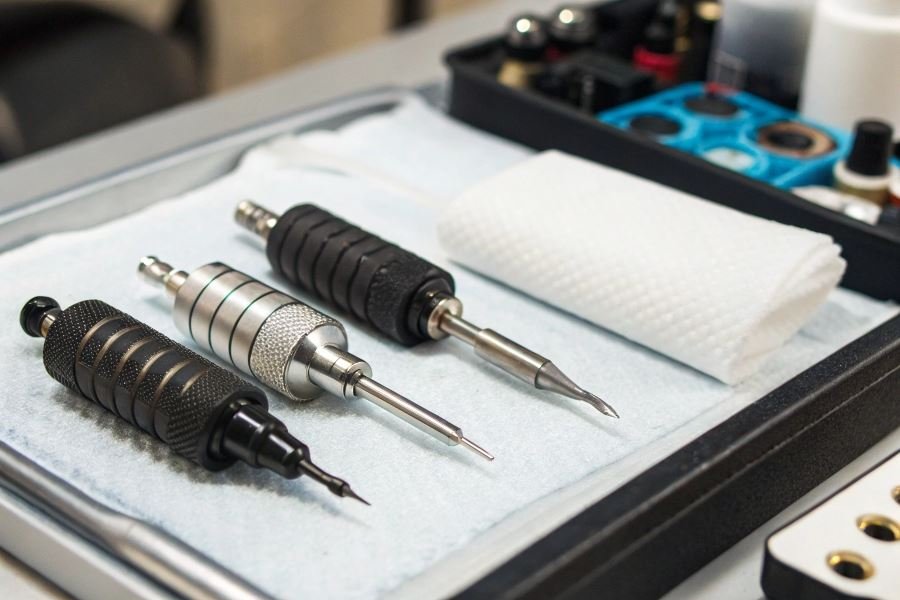
Pen-style machines represent the cutting edge of tattoo technology, offering ergonomic designs that mimic the familiar feel of an actual pen. These lightweight devices excel in precision work and typically feature proprietary cartridge systems designed specifically for their unique architecture.
Key features of pen-style cartridge systems:
- Streamlined profile (typically 12-18mm diameter)
- Integrated safety mechanisms preventing needle stick injuries
- Quick-change systems for rapid cartridge swapping
- Specialized membrane systems to prevent fluid backflow
The Hawk Pen and Cheyenne Pen exemplify this category with their dedicated cartridge designs that prioritize balance and maneuverability. These systems often feature proprietary connections that optimize performance but limit cross-compatibility with other machines.
What makes pen-style machines unique is their integrated approach to cartridge design—the entire system is engineered as a cohesive unit rather than adapted from previous technologies. This results in exceptional precision but typically at the cost of universal compatibility. Artists investing in these systems should factor in the potential need to maintain dedicated cartridge inventory specific to their machine.
Mastering Needle Cartridge Compatibility Across Tattoo Machines
Universal adapters unlock machine potential
The beauty of modern tattoo technology lies in its adaptability. Universal adapters have revolutionized how artists work across different machine platforms. These ingenious devices—typically costing between $15-45—transform incompatible cartridges into perfect matches for virtually any machine.
The EZ Connect Universal Adapter stands out with its ability to convert standard cartridge fittings to work with rotary, coil, and pneumatic machines. What makes these adapters remarkable is their precision engineering—machined from aircraft-grade aluminum with tolerances measured to 0.01mm.
Quick compatibility tip: When selecting an adapter, verify the thread pitch matches your machine’s specifications. The industry standard 8mm thread works with most machines, but some manufacturers like FK Irons use proprietary connections requiring specific adapters.
For artists working across multiple machine types, conversion kits offer comprehensive solutions:
| Adapter Type | Compatible With | Average Price | Key Benefit |
|---|---|---|---|
| Thread Converters | Most rotary machines | $20-30 | Converts between metric/imperial threads |
| Grip Adapters | Coil machines | $25-40 | Allows cartridge use on traditional machines |
| Quick-Connect | Various machines | $35-60 | Enables tool-free cartridge swapping |
Manufacturer compatibility considerations matter
Manufacturer-specific compatibility presents both challenges and opportunities for serious tattoo professionals. While standardization has improved, proprietary systems remain prevalent.
The compatibility landscape has evolved dramatically since cartridges first gained mainstream adoption around 2010, but manufacturer-specific nuances persist.
Cheyenne cartridges, for example, feature their Hawk connection system, which works natively with their machines but requires adapters for others. Similarly, Bishop Rotary machines often need specific fittings to accommodate standard cartridges.
When evaluating compatibility, consider these manufacturer-specific factors:
- Voltage requirements vary significantly—some cartridges perform optimally at 7-9V while others need 10-12V
- Stroke length compatibility affects how cartridges perform across different machines
- Weight distribution changes when adapters are added, potentially affecting handling
The most versatile artists maintain a collection of machine-specific cartridges for their primary work while keeping universal options with adapters for backup and specialty applications.
Troubleshooting compatibility headaches
Even with careful planning, compatibility issues arise. Recognizing and resolving these problems quickly separates professionals from amateurs.
The most common compatibility issue—needle cartridge slippage—typically results from thread wear or improper sizing. The solution often involves applying PTFE tape to the threads or investing in precision-machined adapters from Painful Pleasures.
Power delivery problems manifest as inconsistent needle performance. When cartridges run sluggishly on certain machines, the issue typically stems from:
- Voltage mismatch between machine output and cartridge requirements
- Excessive friction in adapter connections
- Incompatible stroke length for the needle configuration
For machines with digital power supplies, programming presets for different cartridge types eliminates guesswork. Most modern power units allow saving 3-5 configurations for instant recall.
Persistent leaking around cartridge connections indicates improper seating or incompatible components. The fix? Apply a thin silicone O-ring between connection points or upgrade to precision-machined adapters with integrated seals.
By understanding these compatibility fundamentals, you’ll maximize your investment in both machines and cartridges while ensuring consistent, professional results regardless of the equipment combination you choose.
Discover which needle cartridges work with your tattoo machine. Our comprehensive guide covers rotary, coil, and pen-style machines, compatibility factors, and solutions for cross-brand setups to optimize your tattooing performance.
Discover which needle cartridges work with your tattoo machine. Our comprehensive guide covers rotary, coil, and pen-style machines, compatibility factors, and solutions for cross-brand setups to optimize your tattooing performance.