Ever wondered how modern factories maintain pristine floors despite handling thousands of gallons of industrial oils? The answer lies in an ingenious system that operates largely unseen but delivers remarkable results.
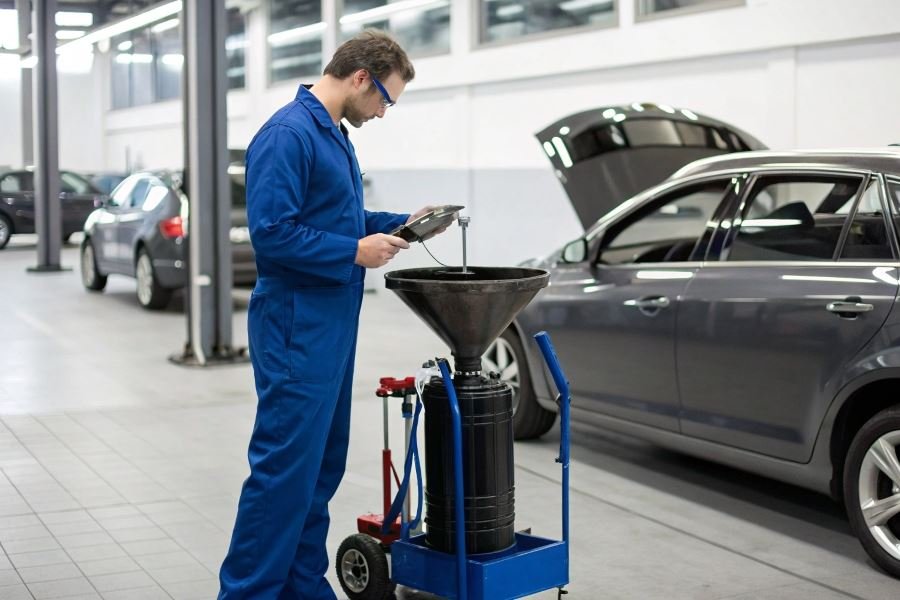
Pneumatic oil collection units represent the intersection of simple physics and brilliant engineering. At their core, these systems use compressed air to create vacuum pressure, drawing used oils, coolants, and other industrial fluids through specialized collection chambers before transferring them to storage containers. The basic components include vacuum generators, collection vessels, transfer pumps, filtration systems, and control mechanisms—all working in harmony to maintain cleaner, safer industrial environments.
The journey of pneumatic oil collection began in the late 1950s when early industrial vacuum systems were adapted specifically for oil recovery. What started as bulky, inefficient machines evolved dramatically through the 1970s and 1980s with the introduction of more powerful compressors and specialized collection heads. By the 1990s, these systems had become sophisticated enough to handle multiple fluid types simultaneously, revolutionizing maintenance procedures across manufacturing sectors.
Today’s market for pneumatic oil collection spans virtually every industrial sector—from automotive manufacturing to aerospace, maritime operations to food processing. The technology has become indispensable not just for maintenance but as a cornerstone of environmental compliance and resource conservation. Modern systems can recover up to 99% of spilled oils, often purifying them sufficiently for reuse, creating both ecological and economic benefits that were unimaginable when these humble systems first appeared.
The Science Behind Pneumatic Oil Collection
Vacuum Physics That Powers Performance
The fundamental physics driving pneumatic oil collection units is elegantly simple yet remarkably effective. These systems harness Bernoulli’s principle—the same concept that keeps airplanes aloft—to create powerful vacuum forces. When compressed air flows through a venturi tube, it accelerates, causing pressure to drop dramatically. This pressure differential generates suction power capable of drawing used oil from even the most challenging locations.
Understanding pneumatic oil collection units: principle of operation and advantages requires appreciating how these systems transform basic physics into practical industrial solutions. The vacuum generation occurs without moving parts, significantly reducing maintenance requirements while delivering consistent performance across varying conditions.
Key vacuum generation principles:
- Compressed air velocity increases through constricted passages
- Pressure decreases as velocity increases (Bernoulli’s principle)
- Vacuum levels typically range from -0.3 to -0.9 bar
- No electrical components required in hazardous environments
The Collection Process Demystified
The step-by-step process in pneumatic oil collection systems follows a logical sequence that maximizes efficiency while minimizing waste. The journey begins when compressed air enters the pneumatic pump, typically at 87-116 PSI (6-8 bar). This initiates the vacuum generation phase, creating powerful suction at the collection wand or probe.
As the operator positions the collection probe near waste oil, the vacuum draws fluid through reinforced hoses into a primary separation chamber. Here, the first stage of the process occurs:
- Oil enters the collection vessel
- Air and oil separate naturally through gravity
- Integrated baffles prevent turbulence and enhance separation
- Automatic shut-off mechanisms prevent overfilling
The beauty of this process lies in its simplicity—no electrical components, no complex mechanisms, just pure physics at work.
Performance Metrics That Matter
When evaluating pneumatic oil collection systems, several operational parameters determine real-world performance. Collection efficiency stands as the primary metric, typically measured in gallons per minute (GPM) or liters per minute (LPM).
| Parameter | Standard Range | Premium Range |
|---|---|---|
| Collection Rate | 1-3 GPM | 3-7 GPM |
| Max Viscosity | SAE 30 | SAE 50+ |
| Suction Distance | 15-25 ft | 25-40+ ft |
| Tank Capacity | 15-30 gallons | 30-60+ gallons |
| Air Consumption | 4-6 CFM | 3-5 CFM |
The relationship between air pressure and vacuum strength follows a non-linear curve, with most systems reaching optimal efficiency at 95-100 PSI input pressure. Modern units from manufacturers like Samoa and Graco incorporate precision regulators to maintain ideal operating conditions regardless of facility air supply fluctuations.
Performance optimization factors:
- Hose diameter affects flow rate (larger = faster collection)
- Ambient temperature impacts oil viscosity and collection speed
- Regular filter maintenance prevents performance degradation
- Proper probe selection for specific applications dramatically improves efficiency
These systems excel particularly when collecting hot oil (120-180°F), where their vacuum power can extract fluid up to 40% faster than when handling cold oil of the same grade. This temperature-dependent performance characteristic makes them ideal for maintenance operations immediately following equipment shutdown.
The Economic and Environmental Edge of Pneumatic Oil Collection
When precision meets efficiency in the workshop, pneumatic oil collection units stand as silent revolutionaries. These systems have transformed how businesses handle waste oil, delivering benefits that extend far beyond simple fluid management. Let’s explore why these systems have become indispensable for operations where quality and compliance matter.
Slashing costs while boosting productivity
Pneumatic oil collection systems deliver remarkable financial advantages compared to traditional manual methods. The numbers tell a compelling story:
| Comparison Factor | Traditional Methods | Pneumatic Systems |
|---|---|---|
| Labor hours/month | 40-60 hours | 8-12 hours |
| Oil recovery rate | 70-80% | 95-98% |
| Annual maintenance costs | $1,200-2,500 | $400-900 |
| Spill cleanup incidents | 6-12 annually | 0-2 annually |
The efficiency gains come from the fundamental design principles. By using compressed air to create vacuum pressure, these systems can extract oil from even the most challenging locations without the labor-intensive processes required by manual collection methods.
Time savings translate directly to bottom-line benefits. A medium-sized automotive service center typically recovers the initial investment within 14-18 months through reduced labor costs alone. When factoring in improved oil recovery rates—often approaching 98% compared to 75% with manual methods—the economic case becomes even stronger.
Environmental stewardship that satisfies regulators
The environmental advantages of pneumatic oil collection extend beyond simple compliance with regulations. These systems fundamentally change how waste oil interacts with the workplace environment.
Closed-loop collection virtually eliminates the risk of spills, addressing one of the most common sources of EPA violations in service facilities. The Clean Water Act requirements for preventing oil discharge into waterways become significantly easier to meet with pneumatic systems in place.
Beyond regulatory compliance, these systems deliver tangible environmental benefits:
- Reduced waste through higher collection efficiency
- Minimized contamination of recyclable oil
- Lower carbon footprint through reduced disposal requirements
- Elimination of absorbent materials needed for spill cleanup
Many facility managers report that their environmental compliance inspections have become remarkably straightforward after implementing pneumatic collection systems. The documentation of proper oil handling becomes a matter of system records rather than manual tracking.
Built for the long haul with minimal upkeep
The reliability equation for pneumatic oil collection units favors businesses focused on long-term operations. With properly maintained systems regularly lasting 15+ years, the total cost of ownership calculations become increasingly favorable over time.
Maintenance requirements remain refreshingly straightforward:
- Quarterly inspection of pneumatic lines and connections
- Annual replacement of basic filter elements
- Biennial inspection of vacuum pumps and seals
- Periodic calibration of monitoring systems
The simplicity of the pneumatic principle contributes directly to reliability. With fewer moving parts than mechanical pumps, these systems experience significantly reduced wear patterns. Many operators report maintenance intervals 3-4 times longer than comparable mechanical systems.
The reliability advantage extends to operational consistency as well. Unlike gravity-fed or manual systems that can be affected by temperature fluctuations or operator technique, pneumatic systems maintain consistent performance across varying conditions—ensuring predictable operations year-round.
When evaluating total value, the combination of efficiency gains, environmental benefits, and minimal maintenance requirements makes pneumatic oil collection units the clear choice for operations where precision and reliability matter.
Discover how pneumatic oil collection units work and their significant advantages for industrial efficiency. Learn about vacuum technology that makes oil recovery faster, cleaner, and more cost-effective than traditional methods.
Discover how pneumatic oil collection units work and their significant advantages for industrial efficiency. Learn about vacuum technology that makes oil recovery faster, cleaner, and more cost-effective than traditional methods.