Ever wondered why electricians pay thousands for tools that seemingly do the same job as your $30 multimeter? The difference isn’t just marketing—it’s the line between safety and disaster, accuracy and guesswork.
Professional electrical measuring instruments serve as the eyes and ears of anyone working with electrical systems. When a reading is off by even 0.5%, critical decisions based on that data can lead to equipment failure, energy waste, or worse—safety hazards that put lives at risk.
The unforgiving nature of electrical accuracy
Accuracy in electrical measurements isn’t a luxury—it’s essential. Consider this: a mere 2% voltage deviation in industrial equipment can reduce motor lifespan by up to 50%. Professional-grade instruments typically offer accuracy within ±0.1% compared to consumer models’ ±2-5% range. This precision becomes your insurance policy against costly mistakes.
Professional vs. consumer: Beyond the price tag
The gulf between professional and consumer instruments extends far beyond cost:
- Durability: Professional tools withstand drops, dust, and extreme temperatures
- Calibration stability: Maintain accuracy over thousands of measurements
- Measurement range: Can handle microvolts to kilovolts without switching devices
- Response time: Capture transient events lasting microseconds
When your life depends on your tools
Safety isn’t an afterthought with professional electrical instruments—it’s built into their DNA. True professional tools offer:
“The best electrical measuring instrument isn’t just accurate—it’s the one that keeps you alive to take another reading tomorrow.”
Professional instruments include CAT safety ratings (I through IV) that define the environments where they can be safely used. Never compromise by using a lower-rated instrument in high-energy circuits—the consequences can be fatal.
The Critical Elements That Define Professional Measuring Tools
When selecting professional electrical measuring instruments, the difference between adequate and exceptional often comes down to three fundamental characteristics. These aren’t just technical specifications—they’re the foundation of reliability in the field.
Precision and accuracy stand as the twin pillars of professional electrical measurement. While these terms are often used interchangeably, they represent distinct qualities that determine an instrument’s true value. When evaluating professional electrical measuring instruments, what to pay attention to becomes clear once you understand how these specifications translate to real-world performance. A digital multimeter with ±0.5% accuracy will provide significantly more reliable readings than one with ±2%, particularly when troubleshooting sensitive electronic components or calibrating industrial equipment.
The difference between consumer and professional-grade instruments becomes starkly apparent when examining their specifications:
Precision That Delivers Confidence
Precision refers to how consistently an instrument provides the same measurement when repeatedly testing identical conditions. This repeatability is crucial for:
- Fault isolation in complex circuits
- Calibration procedures requiring consistent baselines
- Comparative measurements across multiple test points
The best professional instruments offer resolution down to microvolts or nanoamps, with some specialized equipment reaching even greater sensitivity. Fluke multimeters, for instance, typically offer resolution of 0.001mV in their voltage measurements—a level of detail that makes the difference between identifying and missing an intermittent fault.
Measurement Range That Meets Every Challenge
The true value of professional instruments lies not just in their extreme precision, but in their ability to maintain that precision across dramatically different measurement scenarios.
Professional instruments distinguish themselves through:
| Feature | Consumer Grade | Professional Grade |
|---|---|---|
| DC Voltage Range | 0-600V | 0-1000V |
| AC Current | 0-10A | 0-20A with extended capabilities |
| Resistance | 0-2MΩ | 0-50MΩ or higher |
| Frequency | Basic | DC to 1GHz+ |
This expanded range eliminates the need for multiple specialized tools, allowing professionals to move seamlessly between testing microelectronics and industrial power systems with a single instrument.
Build Quality That Survives Real-World Conditions
The durability of measuring instruments directly impacts both safety and long-term value. Professional instruments are engineered with:
- Impact-resistant housings tested to survive drops from 6+ feet
- IP ratings (typically IP67) ensuring dust and water resistance
- Reinforced input protection against voltage spikes up to 10kV
Keysight oscilloscopes exemplify this approach with their military-grade construction standards, ensuring reliability even in harsh industrial environments.
The build quality extends beyond physical durability to include:
- Ergonomic considerations for extended use
- Battery life measured in days rather than hours
- Display visibility in varied lighting conditions, including direct sunlight
These quality indicators translate directly to reduced downtime, fewer calibration issues, and ultimately, more accurate troubleshooting and measurement results. When selecting instruments that will serve as the foundation of your diagnostic capabilities, these three factors—precision, range, and durability—form the essential triangle of professional performance.
The Precision Toolbox: Professional Electrical Measuring Instruments
When precision matters, professionals reach for instruments that deliver reliable, accurate measurements. The difference between consumer-grade and professional electrical measuring tools isn’t just price—it’s capability, durability, and trustworthiness when critical decisions hang in the balance.
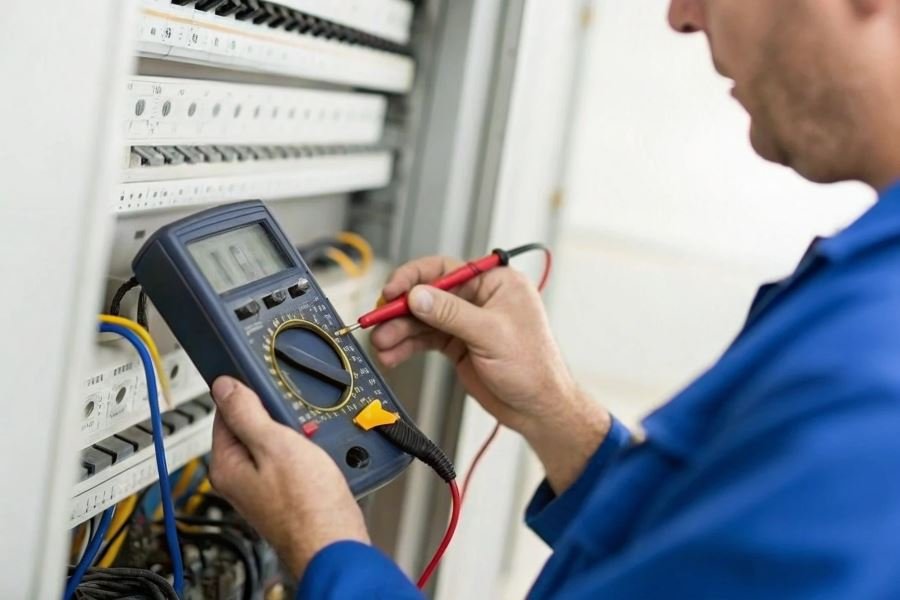
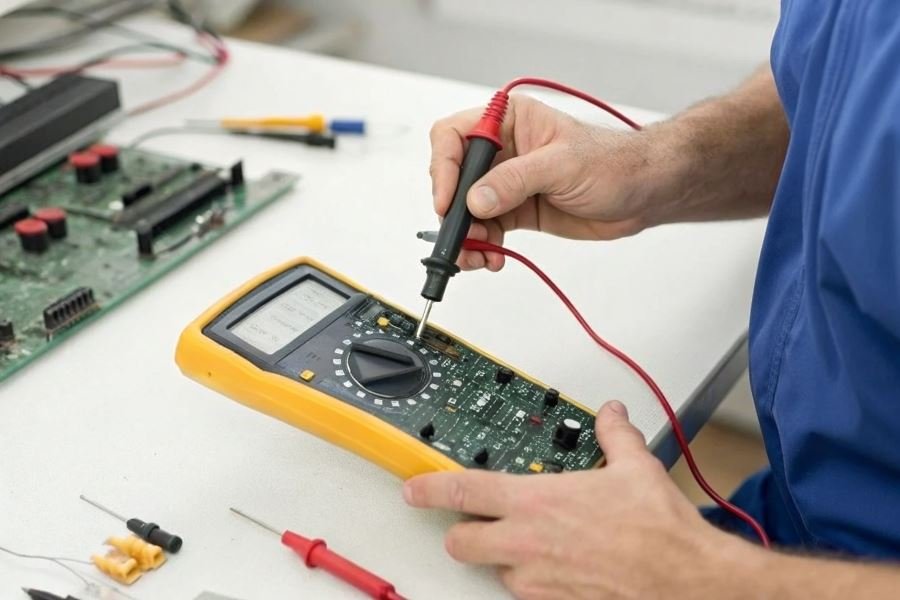
Digital multimeters that deliver certainty
The workhorse of electrical testing, a professional Fluke digital multimeter separates itself from bargain alternatives through several critical specifications:
Resolution matters deeply. Professional multimeters offer 4½ to 6½ digit resolution, allowing measurements down to microvolts and nanoamps. This precision becomes essential when troubleshooting sensitive electronics or calibrating industrial equipment.
Safety ratings aren’t negotiable. Look for multimeters with CAT III 1000V or CAT IV 600V ratings for industrial environments. These ratings ensure your instrument—and you—survive transient voltage spikes that would destroy lesser tools.
Advanced functions transform a good multimeter into an indispensable companion:
| Function | Professional Advantage |
|---|---|
| True RMS | Accurate readings on non-sinusoidal waveforms |
| Data logging | Captures intermittent issues over time |
| Low impedance mode | Eliminates ghost voltage readings |
| Temperature probes | Expands diagnostic capabilities |
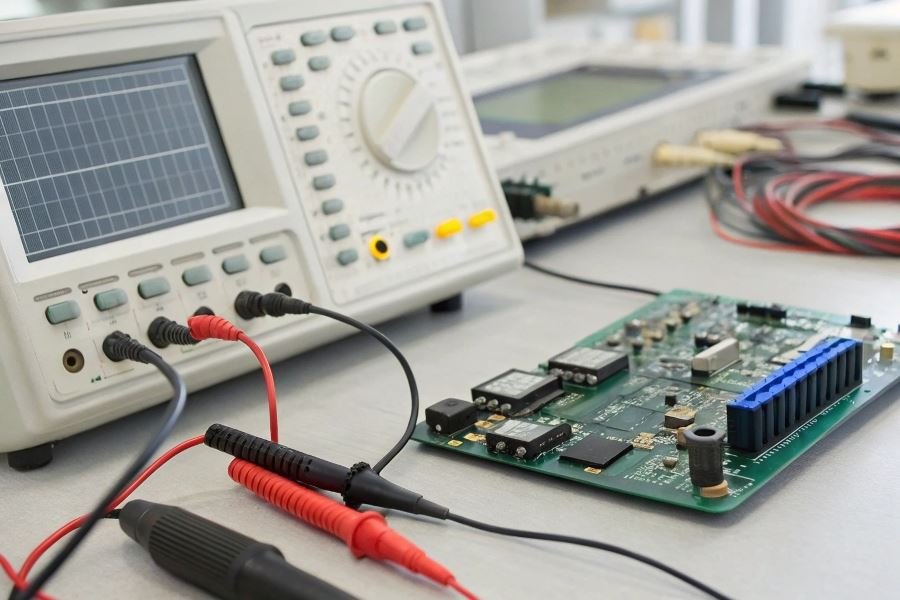
Oscilloscopes that reveal the invisible
When waveforms tell the story, professional oscilloscopes from manufacturers like Tektronix or Keysight provide the narrative clarity needed:
Bandwidth defines your vision. Entry-level professional scopes start at 100MHz, but complex digital signals often require 500MHz to 1GHz bandwidth. Purchasing beyond your current needs provides future-proofing as technologies advance.
Sampling rate determines detail capture. Professional oscilloscopes offer rates from 1 GSa/s to 20 GSa/s (gigasamples per second). Higher rates capture transient events that lower-rate instruments miss entirely.
Display quality transforms data into insight. Modern professional oscilloscopes feature:
- High-resolution color displays (1024×768 minimum)
- Responsive touchscreens for intuitive operation
- Multi-channel capabilities (4+ channels)
- Advanced triggering options for isolating specific events
The difference between a good oscilloscope and a great one becomes apparent the moment you’re hunting an elusive signal anomaly at 3 AM with a deadline approaching.
Thermal imaging tools that see heat
Professional thermal cameras from FLIR and Testo have revolutionized electrical troubleshooting by making temperature visible:
Resolution defines detection capability. Professional thermal imagers offer detector resolutions from 160×120 pixels in entry models to 640×480 in advanced units. Higher resolution means finding smaller hotspots at greater distances.
Temperature range and sensitivity separate professional tools from consumer options. Look for:
- Wide measurement ranges (-20°C to +1500°C)
- Thermal sensitivity under 0.05°C (50 mK)
- Accuracy of ±2% or better
Software capabilities extend the value of thermal data. Professional thermal imaging systems include:
- Detailed analysis software for report generation
- Multiple measurement points and area analysis
- Temperature trending and monitoring
- Integration with other measurement systems
The best thermal imagers include MSX (Multi-Spectral Dynamic Imaging) technology that overlays visual details onto thermal images, making problem identification intuitive even for those new to thermography.
Selecting professional electrical measuring instruments requires balancing immediate needs against long-term value. The premium paid for professional-grade tools typically returns dividends through accuracy, reliability, and capabilities that simply aren’t available in consumer alternatives.
Discover what truly matters when selecting professional electrical measuring instruments. Learn about precision specifications, safety ratings, and key features that separate quality tools from basic alternatives.
Discover what truly matters when selecting professional electrical measuring instruments. Learn about precision specifications, safety ratings, and key features that separate quality tools from basic alternatives.