What’s the one element touching every client who walks through your salon doors—even before your skilled hands do? It’s the air they breathe. In cosmetology settings, where treatments often involve close contact with clients’ skin and respiratory systems, air quality isn’t just a luxury—it’s a critical business asset.
When a client reclines in your treatment chair, they’re placing their health in your hands. Beyond your expertise with treatments and products, the very atmosphere of your space communicates volumes about your commitment to their wellbeing. Air sterilization has emerged as a non-negotiable component of premium cosmetology practices, particularly as awareness of airborne pathogens has heightened in recent years.
The invisible threats in salon environments
Cosmetology offices face unique air quality challenges. From aerosolized particles during nail services to chemical vapors from hair treatments, the ambient air can quickly become compromised. Studies by the American Journal of Respiratory Medicine have shown that beauty professionals experience respiratory issues at rates up to 70% higher than the general population—a statistic that should give every salon owner pause.
Navigating regulatory requirements
The Occupational Safety and Health Administration (OSHA) has established clear guidelines for air quality in beauty environments, with standards that have become increasingly stringent since their initial implementation in 1998. These regulations don’t just protect your staff—they safeguard your business from potential liability and ensure client confidence.
Selecting the right air sterilization solution
When evaluating air sterilizers for your cosmetology practice, consider these foundational factors:
- Filtration efficiency: Look for HEPA filtration that captures particles as small as 0.3 microns
- Coverage area: Match the device capacity to your space dimensions
- Noise level: Essential in maintaining the serene atmosphere clients expect
- Maintenance requirements: Factor in long-term operational costs beyond purchase price
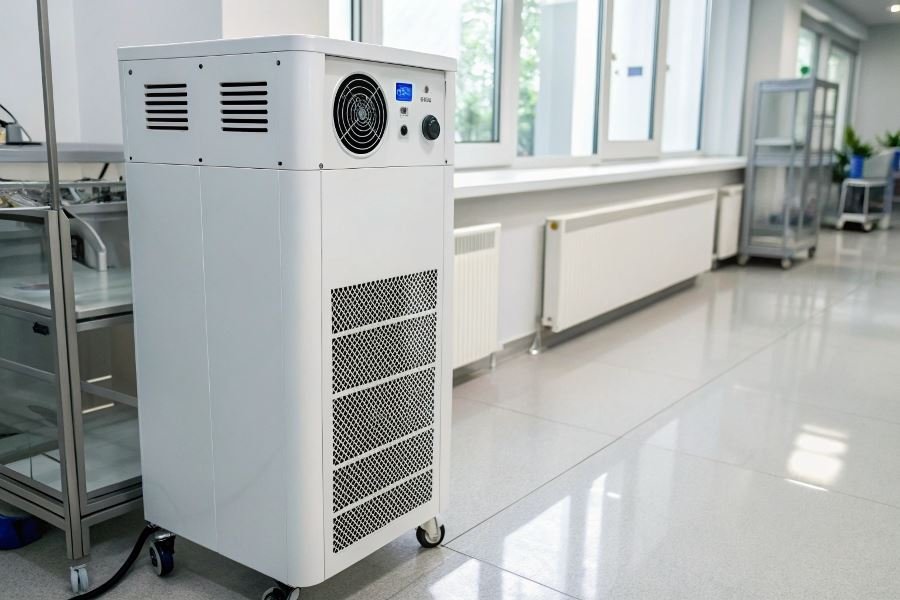
The perfect air sterilizer becomes an invisible guardian of your salon’s reputation—working silently but powerfully to create an environment where both beauty and health flourish.
Technical Essentials for Cosmetology Air Sterilization
When outfitting a cosmetology office with proper air purification systems, the technical specifications become the difference between adequate protection and exceptional safety. The market offers numerous options, but understanding the core technologies and performance metrics ensures you’re making an investment that truly protects clients and staff.
Selecting the right air sterilizer for a cosmetology office requires careful evaluation of several critical factors including sterilization method, room coverage capabilities, and operational characteristics that won’t disrupt your business. These criteria for choosing an air sterilizer for a cosmetology office must be weighed against the specific needs of your space, client volume, and treatment types offered.
Sterilization Technologies That Deliver Results
The foundation of any effective air sterilizer is its core purification technology:
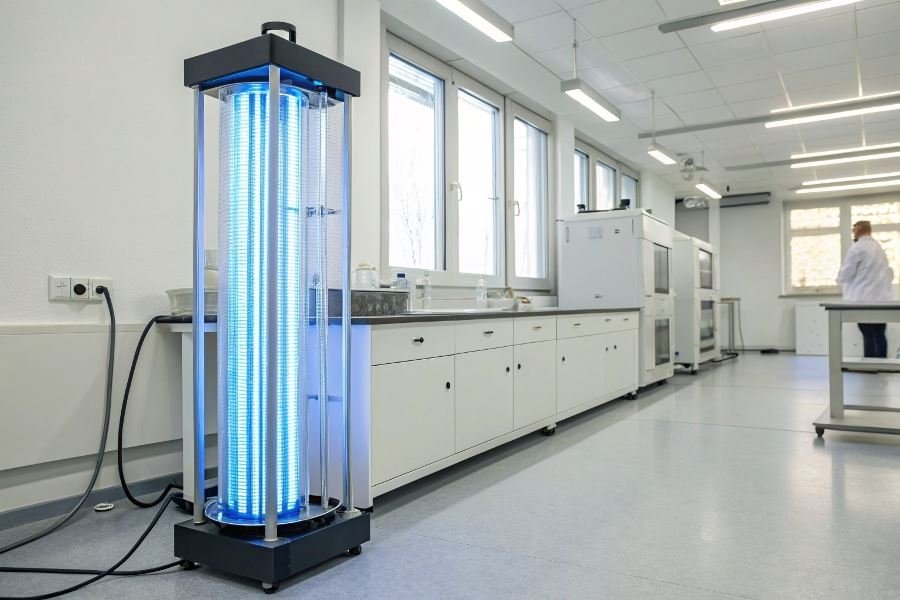
UV-C Sterilization: Operating at 254nm wavelength, UV-C systems destroy microorganisms’ DNA structure, rendering them unable to reproduce. Premium models like the Sterilray Far-UV Sterilizer achieve 99.9% pathogen elimination within seconds of exposure.
HEPA Filtration: True HEPA filters capture 99.97% of particles as small as 0.3 microns—including bacteria, mold spores, and many viruses. The IQAir HealthPro Plus utilizes HyperHEPA technology that traps ultrafine particles down to 0.003 microns.
Ionization Systems: These release negative ions that attach to airborne particles, causing them to become too heavy to remain airborne. Modern ionizers avoid harmful ozone production while effectively reducing airborne contaminants.
Many premium units combine technologies for multi-stage purification:
| Technology Combination | Benefits | Best For |
|---|---|---|
| HEPA + UV-C | Complete filtration with sterilization | High-traffic areas |
| HEPA + Ionization | Particle removal with extended air purification | Treatment rooms |
| Triple Technology | Maximum protection against all contaminants | Surgical procedures |
Coverage Capabilities and Air Exchange Rates
The effectiveness of any sterilizer depends on its ability to process your room’s entire air volume:
Room Size Matching: Calculate your space in square feet and select a unit rated for at least 20% more than your actual area to ensure complete coverage.
Air Changes Per Hour (ACH): Cosmetology settings require 6-15 complete air changes hourly. For invasive procedures, aim for the higher end of this spectrum.
CADR Rating: The Clean Air Delivery Rate measures how quickly a unit filters specific contaminants. For cosmetology applications, look for CADR ratings of at least 300 for dust, pollen, and smoke.
Operational Considerations for Daily Use
Noise Level Management: Sterilizers operate continuously, making noise levels crucial:
- Under 40dB: Whisper-quiet, ideal for treatment rooms
- 40-50dB: Comparable to light rainfall, acceptable for most settings
- Above 50dB: May interfere with client comfort
Energy Consumption: Modern efficient units like the Blueair Pro L consume less than 100 watts on standard settings while purifying spaces up to 780 sq ft.
Maintenance Requirements: Factor in filter replacement costs and frequency. HEPA filters typically require replacement every 6-12 months, while UV-C bulbs may last 9,000-20,000 hours depending on quality.
Smart Features: Premium models offer programmable operation, air quality monitoring, and smartphone integration that allows adjustment based on occupancy and treatment schedules.
When selecting your sterilization system, remember that client safety perceptions increasingly influence business success. The visible presence of professional-grade air sterilization equipment communicates your commitment to creating the safest possible environment for beauty and wellness treatments.
The Hidden Costs of Clean Air: Beyond the Purchase Price
The true cost of filter maintenance
When selecting an air sterilizer for your cosmetology office, the sticker price is just the beginning of your financial relationship with the device. Filter replacement costs can easily exceed the initial investment over a 3-5 year period. High-efficiency HEPA filters for professional-grade sterilizers typically require replacement every 6-12 months, with costs ranging from 80−350 per filter depending on quality and specifications.
The maintenance equation isn’t just about filter costs—it’s about accessibility and downtime. Some models from Medify Air and Airpura feature tool-free filter access panels that allow for 2-minute replacements, while others require partial disassembly and professional service visits.
The smartest investment often comes with indicator systems that monitor actual filter saturation rather than relying on arbitrary timeframes, preventing premature replacements while ensuring optimal performance.
Energy consumption that won’t shock your accountant
Air sterilizers operate continuously in cosmetology environments, making their energy footprint a significant consideration. Modern units have dramatically improved their efficiency profiles:
| Sterilizer Type | Average Wattage | Monthly Cost ($) | Annual Cost ($) |
|---|---|---|---|
| Basic HEPA | 40-90W | $5-12 | $60-144 |
| UV-C Enhanced | 70-120W | $9-16 | $108-192 |
| PCO/PECO Tech | 20-60W | $3-8 | $36-96 |
| Medical-Grade | 100-300W | $13-40 | $156-480 |
The latest generation of sterilizers from manufacturers like Molekule and Austin Air incorporate variable-speed DC motors that can reduce energy consumption by up to 70% compared to older AC motor technology. These smart systems adjust airflow based on detected contaminant levels rather than running at full capacity continuously.
Efficiency insight: A sterilizer that consumes 50% more energy but extends filter life by 30% may actually offer better long-term economics.
Seamless HVAC integration for whole-facility protection
Standalone air sterilizers provide targeted protection, but integration with existing HVAC infrastructure multiplies their effectiveness while potentially reducing operational costs.
The integration spectrum includes:
- Duct-mounted solutions that install directly into your existing ventilation system, treating air centrally before distribution
- Complementary systems that communicate with your HVAC controls to coordinate air treatment
- Hybrid approaches combining in-room units with whole-building filtration
Carrier and Trane offer professional-grade integration kits specifically designed for cosmetology environments, addressing the unique challenges of treatment rooms where chemical vapors, particulates, and biological contaminants require specialized filtration sequences.
Integration considerations extend beyond hardware compatibility—your sterilization solution should complement your HVAC system’s airflow patterns to prevent “dead zones” where contaminants might accumulate.
When evaluating integration options, assess whether your existing system can handle the additional static pressure from enhanced filtration without straining fans or reducing overall airflow. The most sophisticated solutions include pressure-differential monitoring to maintain optimal system performance regardless of filter loading conditions.
Discover essential criteria for selecting the perfect air sterilizer for your cosmetology office. Compare UV-C, HEPA, and ionization technologies while considering coverage area, noise levels, maintenance costs, and energy efficiency for optimal air quality.
Discover essential criteria for selecting the perfect air sterilizer for your cosmetology office. Compare UV-C, HEPA, and ionization technologies while considering coverage area, noise levels, maintenance costs, and energy efficiency for optimal air quality.