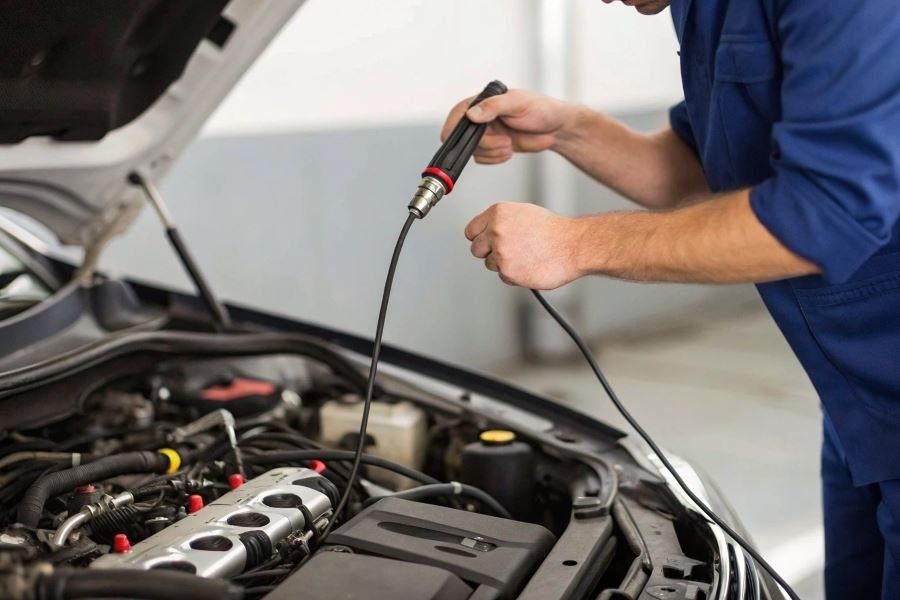
Ever wondered how mechanics can diagnose fuel injector problems without dismantling your entire engine? The answer might surprise you: sound waves. Not just any sound waves—ultrasonic ones that work their magic beyond human hearing.
Ultrasonic injector testers represent a revolutionary approach to diagnosing and maintaining fuel injection systems. These sophisticated devices use high-frequency sound waves to evaluate injector performance, detect internal wear, and identify potential failures before they leave you stranded on the highway.
The science behind the sound
At their core, ultrasonic injector testers operate on a brilliantly simple principle: they listen to your injectors. When an injector operates, it produces distinctive ultrasonic frequencies—typically between 20 kHz and 400 kHz—that reveal its internal condition. The tester captures these sound signatures through specialized transducers, then analyzes them against baseline patterns to identify anomalies.
Unlike traditional testing methods that require removing injectors from engines, ultrasonic testing is non-invasive and remarkably accurate. This technology can detect microscopic cracks, internal deposits, and valve seat wear that would be invisible to the naked eye.
From bench tests to sound waves: The evolution
Fuel injector testing has come a long way since the 1980s when bench testing was the gold standard. Early methods required complete removal of injectors, time-consuming setup, and often yielded incomplete diagnostics. The introduction of ultrasonic technology in the late 1990s marked a turning point, offering mechanics a way to evaluate injectors while they remained installed.
Today’s equipment features advanced digital signal processing, wireless connectivity, and AI-powered analysis that can distinguish between dozens of potential failure modes in seconds.
The Truth About Ultrasonic Injector Testers
When precision meets efficiency in the automotive diagnostic world, ultrasonic injector testing technology stands at the forefront of innovation. These sophisticated devices have revolutionized how technicians evaluate fuel injector performance, offering insights that were previously impossible to obtain without complete disassembly.
The fundamental principle behind ultrasonic injector testers leverages sound wave technology to evaluate internal components without invasive procedures. Ultrasonic injector testers: advantages and disadvantages become immediately apparent when comparing them to traditional testing methods. The technology’s ability to detect microscopic imperfections while the injector remains fully assembled represents a quantum leap in diagnostic capabilities.
Non-invasive precision that preserves integrity
The primary advantage of ultrasonic testing lies in its completely non-invasive approach. Unlike mechanical testing methods that often require disassembly, ultrasonic waves penetrate the injector housing without physical contact with internal components.
This preservation of component integrity translates to:
- Zero risk of contamination during testing
- No potential for technician-induced damage
- Ability to test injectors in near-original condition
The accuracy achieved through ultrasonic analysis often exceeds 95% when detecting internal wear patterns, microscopic cracks, and deposit formations that affect spray patterns.
Time efficiency that transforms workflows
Traditional injector testing protocols typically require 45-90 minutes per unit. Ultrasonic testing slashes this timeframe dramatically:
| Testing Method | Average Time Per Injector | Technician Involvement |
|---|---|---|
| Ultrasonic | 3-5 minutes | Minimal |
| Mechanical | 30-45 minutes | Continuous |
| Electrical | 15-20 minutes | Moderate |
| Visual | 10-15 minutes | Continuous |
This efficiency creates a compelling return on investment for high-volume shops processing multiple vehicles daily.
The financial equation
While the initial investment for quality ultrasonic testing equipment from manufacturers like Bosch or Launch Tech typically ranges from 3, 000−8,000, the cost-effectiveness becomes evident through:
- Reduced labor hours per diagnosis
- Decreased parts wastage from misdiagnosis
- Enhanced customer satisfaction through faster service delivery
- Ability to identify repairable injectors versus replacement-only scenarios
Limitations worth considering
Despite their impressive capabilities, ultrasonic testers aren’t without limitations:
Certain injector designs with complex internal geometries can create acoustic shadows that limit testing effectiveness. Particularly, some GDI (Gasoline Direct Injection) systems with multi-layer construction present challenges for ultrasonic wave penetration.
Technical expertise requirements represent another significant consideration. Interpreting ultrasonic readings demands specialized training and experience—the equipment is only as effective as the technician operating it.
Alternative testing methods comparison
Mechanical testing provides direct measurement of spray patterns and volumes but requires complete removal and often specialized cleaning facilities. Electrical testing offers quick resistance and impedance measurements but misses mechanical issues entirely. Visual inspection remains valuable for external damage assessment but provides no insight into internal conditions.
The comprehensive diagnostic picture emerges when understanding that ultrasonic testing complements rather than replaces these methods—creating a multi-faceted approach to injector diagnosis that maximizes accuracy while minimizing unnecessary parts replacement.
Making Smart Investments in Ultrasonic Injector Testing
Where ultrasonic testers truly excel
Ultrasonic injector testers have revolutionized fuel system diagnostics by providing unprecedented visibility into injector performance without disassembly. These systems shine brightest in high-volume repair facilities where technicians need quick, accurate assessments of multiple injectors daily. Independent shops handling diverse vehicle makes benefit tremendously, as ultrasonic technology works across gasoline, diesel, and alternative fuel systems.
Performance shops and racing teams particularly value these testers for their ability to detect microscopic wear patterns that affect precise fuel delivery. When tuning engines for maximum output, the difference between victory and defeat often comes down to injector spray patterns that only ultrasonic analysis can properly evaluate.
Fleet maintenance operations represent another perfect application. The preventative insights from ultrasonic testing help fleet managers identify failing injectors before they cause roadside breakdowns, dramatically reducing costly downtime and towing expenses.
Critical factors for your investment decision
When evaluating ultrasonic testing equipment, several factors deserve careful consideration:
Initial investment vs. long-term ROI – Quality ultrasonic testers typically range from $3,000 to $15,000 depending on capabilities. Calculate your return based on diagnostic time saved and increased repair accuracy.
Compatibility spectrum – The best systems accommodate multiple injector types and sizes without requiring expensive adapters for each variation.
Software intelligence – Modern systems from companies like Bosch and ASNU offer advanced analytics that interpret ultrasonic data and provide clear recommendations.
Training requirements – Consider whether the manufacturer provides comprehensive training and how quickly your team can become proficient.
| Factor | Budget Systems | Professional Systems | Premium Systems |
|---|---|---|---|
| Price Range | 3, 000−5,000 | 5, 000−10,000 | 10, 000−15,000 |
| Injector Types | Limited | Most Common | Universal |
| Software Updates | Paid | 1-2 Years Free | Lifetime |
| Warranty | 1 Year | 2-3 Years | 5+ Years |
| Training | Self-guided | Online courses | On-site training |
The horizon of injector testing technology
The ultrasonic testing landscape continues to evolve rapidly. Miniaturization is perhaps the most exciting trend, with manufacturers developing portable units that maintain professional-grade accuracy. These systems will make ultrasonic testing accessible to mobile mechanics and smaller shops.
AI-powered diagnostic algorithms represent another frontier. Next-generation testers from LAUNCH Tech are beginning to incorporate machine learning that compares injector performance against vast databases of known patterns, improving accuracy and reducing interpretation errors.
Wireless connectivity is becoming standard, allowing test results to be instantly shared with customers via smartphone apps or integrated with shop management software. This transparency builds customer trust while streamlining documentation.
Perhaps most promising is the integration with predictive maintenance systems. Rather than simply identifying current failures, advanced ultrasonic systems can now detect early warning signs and predict remaining injector life with remarkable accuracy.
For shops committed to staying ahead of the curve, ultrasonic injector testing represents not just a diagnostic tool but a competitive advantage that delivers measurable returns through faster, more accurate repairs and enhanced customer satisfaction.
Discover the complete guide to ultrasonic injector testers, exploring their technology, benefits, and limitations. Learn when these non-invasive diagnostic tools outperform traditional methods and what factors to consider before investing.
Discover the complete guide to ultrasonic injector testers, exploring their technology, benefits, and limitations. Learn when these non-invasive diagnostic tools outperform traditional methods and what factors to consider before investing.