Did you know that a single unsterilized salon tool can harbor over 100,000 bacteria? In the beauty industry, proper sterilization isn’t just good practice—it’s essential for client safety and your business reputation.
Salon professionals face a critical choice when investing in UV sterilization technology. The decision between portable and stationary systems impacts everything from workflow efficiency to client protection. UV sterilization has revolutionized salon sanitation by using ultraviolet light to destroy microorganisms’ DNA, effectively neutralizing bacteria, viruses, and fungi without harsh chemicals.
The sterilization imperative
For salon environments, proper sterilization serves as the foundation of professional service. Beyond meeting health regulations, thorough sterilization:
- Protects clients from potential infections and cross-contamination
- Safeguards staff from occupational exposure
- Preserves tools by preventing corrosion from chemical disinfectants
- Builds trust with increasingly health-conscious clientele
How UV sterilization works
UV-C light (wavelength 200-280nm) penetrates microbial cells, damaging their DNA and RNA structures. This technology has proven particularly effective against common salon contaminants:
“UV sterilization achieves up to 99.9% elimination of pathogens when properly implemented, making it one of the most reliable non-chemical approaches to salon tool sanitation.” — American Journal of Infection Control
Portable vs. stationary: The fundamental differences
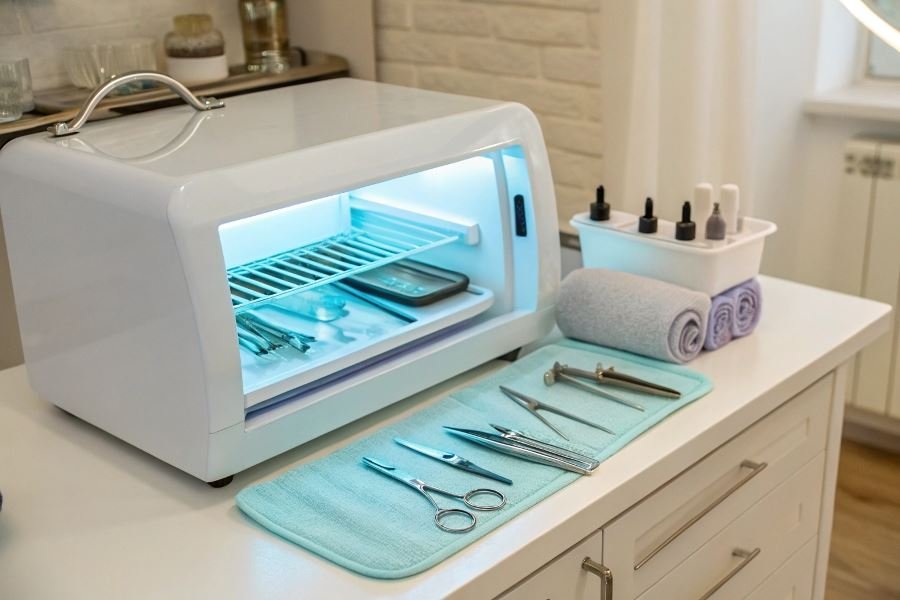
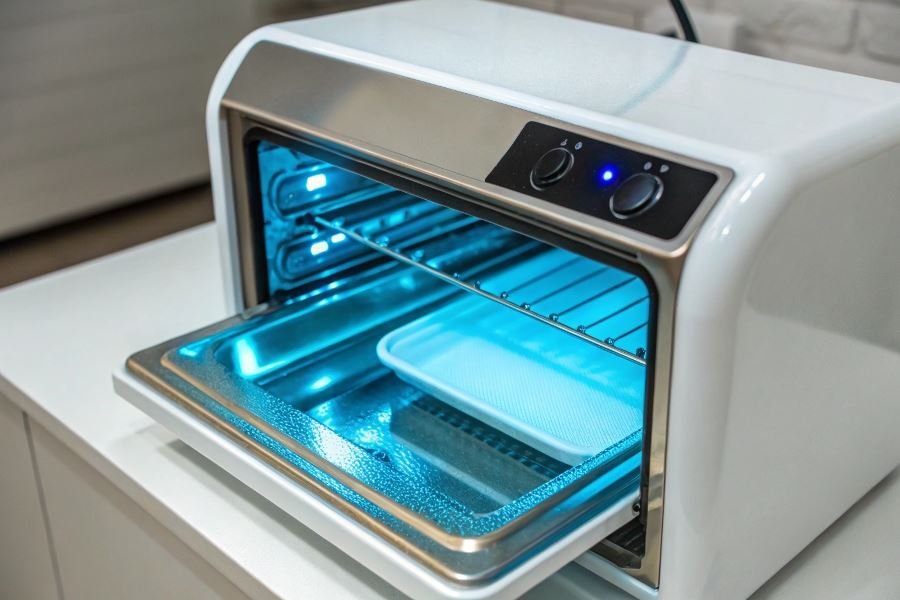
Portable systems offer flexibility and convenience—perfect for mobile professionals or salons with space constraints. These compact units can be moved between stations and typically accommodate smaller tool sets.
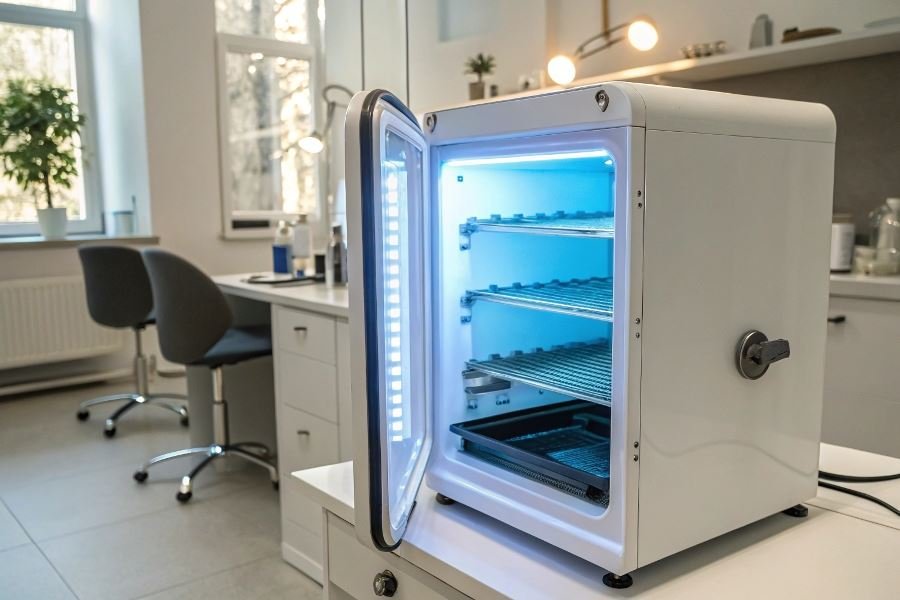
Stationary systems provide greater capacity and often more consistent results. These dedicated units frequently include advanced features like automatic timers and specialized compartments for different tool types.
The choice ultimately depends on your salon’s specific needs, space availability, and service volume.
Portable vs. Stationary UV Sterilizers: The Ultimate Salon Decision
When equipping your salon with proper sterilization tools, the choice between portable and stationary UV sterilizers represents a critical business decision that impacts everything from your workflow to your bottom line. Let’s dive into what truly separates these options and how to make the smartest investment for your specific salon needs.
Space considerations that shape your salon
Portable UV sterilizers have revolutionized the sterilization landscape with their compact footprints—typically occupying less than one square foot of counter space. This space efficiency makes them ideal for boutique salons where every inch counts. When deciding between portable UV sterilizers vs. stationary ones: what to choose for a salon often comes down to your available square footage and layout flexibility.
Stationary units, by comparison, require dedicated installation space—usually 2-4 square feet at minimum—and often need permanent electrical connections. The Keller Pro-Station 5000 exemplifies this category, offering industrial-grade sterilization but demanding approximately 3.5 square feet of dedicated floor space and professional installation.
Installation requirements differ dramatically between options:
| Feature | Portable Sterilizers | Stationary Sterilizers |
|---|---|---|
| Space Required | 0.5-1 sq ft | 2-4+ sq ft |
| Installation | Plug-and-play | Often requires professional setup |
| Mobility | Can be moved between stations | Fixed position |
| Power Requirements | Standard outlet (110V) | May require dedicated circuit (220V) |
Sterilization capacity that meets your demand
The throughput capabilities between these systems represent perhaps the most significant operational difference. Portable units typically accommodate 5-15 tools per cycle with cycle times averaging 10-20 minutes. This translates to approximately 20-60 tools per hour—sufficient for individual stylists or small teams.
Stationary systems dramatically outperform in volume processing, with high-end models like the SalonPro UV-3500 handling up to 100 implements simultaneously with 7-minute cycles, yielding theoretical throughput of 850+ tools hourly.
For multi-chair operations serving 20+ clients daily, this capacity difference becomes impossible to ignore.
Cost analysis beyond the price tag
Initial investment presents a stark contrast:
- Portable units: 150−600
- Stationary systems: 1, 200−5,000+
However, the long-term value equation isn’t quite so simple. When amortized over their operational lifespan, stationary systems often deliver superior economics for high-volume salons. The UltraSteril Commercial 2500 carries a $3,200 price tag but offers a 10-year warranty and capacity that would require 5-6 portable units to match—representing 750−3,600 in equivalent portable equipment.
Energy consumption adds another dimension: portable units typically consume 15-40 watts during operation, while commercial stationary systems draw 120-300 watts but process significantly more tools per kilowatt-hour.
Maintenance realities and operational lifespan
Maintenance requirements create perhaps the most overlooked distinction between these options:
- Portable sterilizers typically feature 1-4 UV bulbs requiring replacement every 6-12 months at 15−30 each
- Stationary systems contain 6-12 industrial-grade bulbs lasting 12-24 months at 25−45 each
While bulb replacement represents a higher absolute cost for stationary systems, the per-tool sterilization cost remains lower due to superior throughput.
Operational lifespan expectations diverge significantly:
Portable units typically offer 2-4 years of reliable service before electronic components or housing degradation necessitates replacement. Meanwhile, commercial stationary systems from manufacturers like Sterilux Professional routinely deliver 8-12 years of continuous operation with proper maintenance.
The decision ultimately hinges on your salon’s specific needs, growth trajectory, and operational style—but understanding these fundamental differences ensures you’ll make an investment that serves your business for years to come.
Making the Right Choice: Portable vs. Stationary UV Sterilizers
Selecting the perfect UV sterilization system for your salon isn’t just about following trends—it’s about making a strategic business decision that impacts your operations, client safety, and bottom line. Let’s dive into the framework that will help you determine whether portable or stationary UV sterilizers make more sense for your specific salon environment.
Assess your salon footprint and client flow
The physical dimensions of your space and your daily client volume create the foundation for your sterilization needs:
Small boutique salons (under 800 sq ft) with 5-15 clients daily typically benefit from 1-2 portable UV sterilizers. These compact units can be moved between stations as needed without consuming valuable real estate.
Mid-sized establishments (800-1500 sq ft) serving 15-30 clients daily often find a hybrid approach works best—a stationary unit for high-volume tools plus a portable option for specialized equipment.
Large salon operations (1500+ sq ft) handling 30+ clients daily almost universally benefit from multiple stationary units strategically positioned throughout the space.
The relationship between space and sterilization needs isn’t just about square footage—it’s about workflow efficiency and contamination control zones.
Inventory your tools and calculate sterilization cycles
Your tool inventory directly impacts your sterilization capacity requirements:
| Salon Type | Average Tool Count | Daily Sterilization Cycles | Recommended System |
|---|---|---|---|
| Nail-focused | 30-50 items | 3-5 cycles | Portable UV units |
| Hair-focused | 50-100 items | 5-8 cycles | Stationary system |
| Full-service | 100+ items | 8+ cycles | Multiple stationary units |
High-frequency sterilization needs (tools used multiple times daily) generally favor stationary systems with larger capacity and faster cycle times. The Salon Pro 3000 stationary system can process up to 40 tools in just 8 minutes.
Specialized equipment with irregular usage patterns may be better served by portable units like the UVClean Portable, which offers flexibility without the commitment of dedicated counter space.
Budget alignment and return on investment
The financial equation extends beyond initial purchase price:
Portable systems typically range from 150−600, with lower upfront costs but potentially higher long-term expenses due to shorter lifespans (2-3 years) and smaller capacity per cycle.
Stationary systems generally cost 800−2,500 initially but offer:
- Longer operational lifespans (5-7 years)
- Lower per-tool sterilization costs
- Reduced labor time for sterilization procedures
When calculating ROI, factor in not just equipment costs but also staff time savings, utility usage, and maintenance requirements over a 5-year horizon.
Match technology to specialization
Your salon’s service focus should heavily influence your sterilization approach:
Nail salons benefit from portable UV sterilizers with specialized compartments designed for small metal implements and files. The quick-access nature supports the rapid tool turnover in nail services.
Hair salons typically require larger capacity systems that can accommodate shears, combs, and clips simultaneously. Stationary units with adjustable shelving provide the versatility needed.
Medical spas and advanced skincare facilities should prioritize stationary systems with documented validation processes and cycle recording capabilities to meet higher sanitation standards.
The ideal sterilization solution isn’t about following industry trends—it’s about aligning technology with your specific operational needs, space constraints, and client expectations. By methodically evaluating these factors, you’ll invest in a system that enhances both safety and efficiency.
Discover the key differences between portable and stationary UV sterilizers for your salon. Compare space requirements, capacity, costs, and maintenance to make the right investment for your business size and sterilization needs.
Discover the key differences between portable and stationary UV sterilizers for your salon. Compare space requirements, capacity, costs, and maintenance to make the right investment for your business size and sterilization needs.