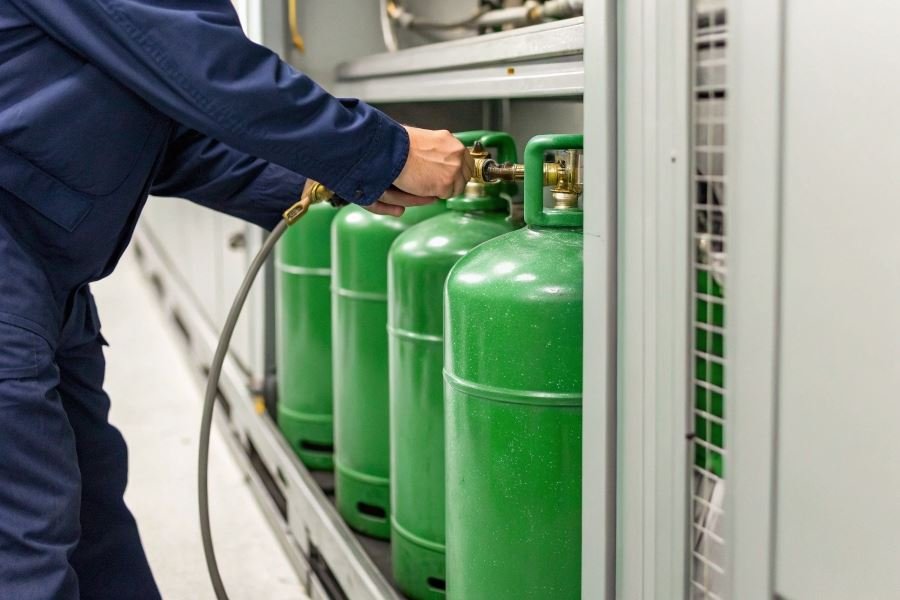
What keeps your food fresh, your home comfortable, and potentially impacts our planet’s future? The answer lies in a substance most people never think about: refrigerants.
Behind every cool breeze from your air conditioner and every perfectly chilled beverage in your refrigerator exists a fascinating world of chemical innovation. The comparison between traditional synthetic refrigerants and their natural counterparts represents one of today’s most critical technological crossroads—with implications for energy bills, global climate patterns, and even workplace safety.
From ice harvesting to molecular engineering
Refrigeration technology has undergone a remarkable evolution. In the 1800s, cooling meant harvesting natural ice from frozen lakes. The first mechanical refrigeration systems, developed in the 1830s, used whatever worked—ether, ammonia, even sulfur dioxide. By the 1930s, synthetic chlorofluorocarbons (CFCs) revolutionized cooling with their stability and efficiency.
The discovery that CFCs damaged the ozone layer led to the Montreal Protocol in 1987, triggering waves of innovation. Hydrochlorofluorocarbons (HCFCs) and hydrofluorocarbons (HFCs) followed, each generation addressing previous environmental concerns while creating new challenges.
The refrigerant spectrum: Synthetic vs. natural
Refrigerants broadly fall into two categories:
Synthetic refrigerants:
- HFCs (R-134a, R-410A): Currently dominant in most applications
- HFOs (R-1234yf): Newer generation with lower global warming potential
Natural refrigerants:
- Hydrocarbons (propane, isobutane): Excellent efficiency, highly flammable
- Carbon dioxide (R-744): Non-flammable, requires higher operating pressures
- Ammonia (R-717): Superior efficiency, toxic at high concentrations
Measuring what matters: The effectiveness equation
When evaluating refrigerant effectiveness, four critical metrics emerge:
- Energy efficiency – How much electricity is consumed per unit of cooling
- Environmental impact – Global warming potential and ozone depletion potential
- Safety profile – Toxicity, flammability, and pressure requirements
- Economic considerations – Initial cost, maintenance expenses, and regulatory compliance
The ideal refrigerant excels across all these dimensions—a balance that’s proving increasingly difficult to achieve with synthetic options alone.
The Technical Battleground of Cooling Systems
When examining the performance capabilities of different refrigeration systems, the comparison of refrigerants and natural refrigerants reveals fascinating technical differences that directly impact efficiency, cost, and environmental footprint. Traditional synthetic refrigerants have dominated the market for decades, but natural alternatives are rapidly gaining ground as technology evolves and environmental concerns mount.
The energy efficiency profile of cooling systems varies dramatically depending on the refrigerant choice. Natural refrigerants like ammonia (R717) deliver exceptional thermodynamic performance with a Coefficient of Performance (COP) typically 3-10% higher than synthetic HFCs. Propane (R290) systems demonstrate similar efficiency advantages, particularly in small to medium-sized applications. When comparing refrigerants and natural refrigerants to determine which is more effective, the data consistently shows that properly designed natural refrigerant systems require less energy input to achieve the same cooling output—a critical advantage in an era of rising energy costs.
Energy Efficiency Champions
| Refrigerant | Average COP | Energy Consumption | Cooling Capacity |
|---|---|---|---|
| Ammonia (R717) | 4.8-5.2 | Very Low | Excellent |
| CO₂ (R744) | 3.0-4.5* | Moderate | Very High |
| Propane (R290) | 3.8-4.3 | Low | Good |
| R134a (HFC) | 3.5-4.0 | Moderate | Good |
| R410A (HFC) | 3.3-3.8 | Moderate-High | Good |
*CO₂ systems achieve higher efficiency in transcritical operation in cooler climates
Pressure and Temperature Performance
The operating pressure and temperature ranges of refrigerants create distinct design requirements. CO₂ systems operate at significantly higher pressures (up to 120 bar) compared to conventional HFCs (typically 25-30 bar), necessitating specialized components and safety measures. This pressure differential creates both challenges and opportunities—CO₂ systems can be more compact but require more robust construction.
Ammonia offers exceptional performance across wide temperature ranges (-50°C to +10°C), making it ideal for industrial refrigeration. Meanwhile, hydrocarbons like propane and isobutane excel in medium-temperature applications, delivering impressive efficiency in commercial refrigeration and heat pump systems.
System Design Considerations
Compatibility factors drive significant differences in system architecture. Natural refrigerants often require:
- Enhanced safety measures (particularly for ammonia and hydrocarbons)
- Specialized compressor technology
- Different expansion valve configurations
- Modified heat exchanger designs
The volumetric cooling capacity of natural refrigerants often exceeds synthetic alternatives—ammonia provides approximately 6 times more cooling per unit volume than R134a. This translates to smaller compressors and reduced material costs, though specialized components may offset these savings.
Maintenance and Longevity Factors
The maintenance profile of natural refrigerant systems presents another dimension of performance comparison. Ammonia systems typically demonstrate exceptional longevity, with industrial installations frequently operating for 30+ years with proper maintenance. The chemical stability of natural refrigerants prevents the formation of acids that can degrade system components—a common issue with some synthetic refrigerants when exposed to moisture or high temperatures.
Leak detection requirements differ substantially between refrigerant types. While synthetic refrigerants often require sophisticated electronic detection systems, many natural refrigerants (particularly ammonia) have distinctive odors detectable at concentrations well below dangerous levels, providing an inherent safety advantage despite their higher toxicity or flammability ratings.
The technical performance analysis clearly demonstrates that natural refrigerants offer compelling advantages in efficiency, cooling capacity, and system longevity—though their implementation requires specialized knowledge and careful system design to maximize these benefits while addressing their unique characteristics.
The Green Bottom Line: Environmental and Economic Realities of Refrigerants
The refrigeration industry stands at a crossroads. As regulations tighten and environmental awareness grows, the choice between synthetic refrigerants and their natural counterparts has become more than just a technical decision—it’s a strategic business imperative with significant financial implications.
The environmental price tag
When evaluating refrigerants, two critical environmental metrics tell the story: Global Warming Potential (GWP) and Ozone Depletion Potential (ODP). Traditional HFCs like R-134a carry a GWP of 1,430—meaning they trap 1,430 times more heat than CO₂ over a 100-year period. Compare this to natural refrigerants like propane (R-290) with a GWP of just 3, or carbon dioxide (R-744) with a GWP of 1.
The atmospheric lifetime difference is staggering. While HFCs can persist for 15-29 years, natural refrigerants like ammonia break down in just days or weeks. This isn’t merely an environmental concern—it’s a business liability that grows with each passing year.
Regulatory realities reshaping the market
The regulatory landscape isn’t just changing—it’s accelerating. The Kigali Amendment to the Montreal Protocol mandates an 85% reduction in HFC consumption by 2036 for developed countries. Meanwhile, the American Innovation and Manufacturing (AIM) Act established an HFC phasedown schedule that will reduce production and consumption by 85% by 2036.
These aren’t distant concerns—they’re immediate business challenges.
| Refrigerant Type | GWP | ODP | Phase-out Timeline |
|---|---|---|---|
| R-404A (HFC) | 3,922 | 0 | 80% reduction by 2030 |
| R-134a (HFC) | 1,430 | 0 | 80% reduction by 2030 |
| R-717 (Ammonia) | 0 | 0 | No restrictions |
| R-290 (Propane) | 3 | 0 | No restrictions |
| R-744 (CO₂) | 1 | 0 | No restrictions |
Companies delaying transition face not only regulatory penalties but also escalating refrigerant costs as supply dwindles—a perfect storm for operational budgets.
The true cost equation
Total Cost of Ownership (TCO) analysis reveals surprising truths about natural refrigerants. While initial installation costs for systems using natural refrigerants like ammonia or CO₂ typically run 10-15% higher than traditional HFC systems, the long-term economics tell a different story.
Energy efficiency gains of 15-30% are common with properly designed natural refrigerant systems. A medium-sized commercial refrigeration installation can recoup the additional capital investment within 2-4 years through energy savings alone.
Factor in the steadily rising costs of synthetic refrigerants due to phasedown quotas, and the economic case becomes even stronger. Maintenance costs also favor natural options—systems using propane or CO₂ often require fewer service interventions due to simpler mechanical designs and lower operating pressures.
Tomorrow’s refrigeration landscape
The industry is voting with its investments. Major food retailers like Whole Foods and Aldi have committed to natural refrigerant transitions, while industrial refrigeration has largely embraced ammonia systems for their efficiency and reliability.
The trend line is clear: natural refrigerants are moving from alternative to mainstream.
Equipment manufacturers are responding with innovative designs that address historical challenges. Compact transcritical CO₂ systems now operate efficiently in warmer climates, while charge-limiting technologies have made hydrocarbon systems viable for smaller commercial applications.
The verdict? When environmental impact and long-term economics align, the market follows. Natural refrigerants aren’t just the environmentally responsible choice—increasingly, they’re the financially prudent one as well.
Discover which cooling agents deliver superior performance in our detailed analysis of natural vs synthetic refrigerants. Compare efficiency, environmental impact, and cost-effectiveness in modern cooling systems.
Discover which cooling agents deliver superior performance in our detailed analysis of natural vs synthetic refrigerants. Compare efficiency, environmental impact, and cost-effectiveness in modern cooling systems.