
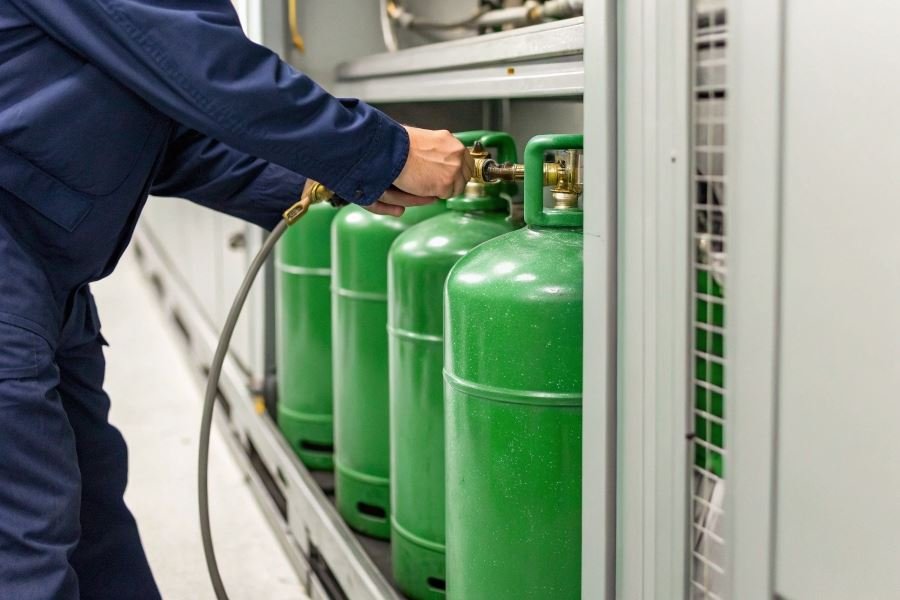
Did you know the average commercial refrigeration system from the 1990s released the equivalent of 40 cars’ worth of carbon emissions annually? The landscape of commercial refrigeration has undergone a remarkable transformation since those days, driven by environmental urgency and technological innovation.
The journey of refrigerants tells a fascinating story of human ingenuity and environmental awakening. When chlorofluorocarbons (CFCs) were first introduced in the 1930s, they were hailed as miracle compounds—stable, non-toxic, and efficient. By the 1970s, scientists discovered these same compounds were destroying the ozone layer, leading to the Montreal Protocol in 1987 that began phasing them out globally.
The environmental imperative
Today’s refrigerant development is shaped by dual pressures: stringent regulations and market demands for sustainability. The Kigali Amendment to the Montreal Protocol, which entered into force in 2019, mandates an 85% reduction in hydrofluorocarbon (HFC) consumption by 2036 for developed countries. This regulatory framework has catalyzed unprecedented innovation in the commercial refrigeration sector.
Performance metrics that matter
Modern refrigerants aren’t judged on cooling capacity alone. The industry now evaluates refrigerants through a comprehensive lens:
| Metric | Why It Matters |
|---|---|
| Global Warming Potential (GWP) | Measures climate impact over 100 years |
| Energy Efficiency | Affects operational costs and indirect emissions |
| Safety Classification | Determines installation requirements and costs |
| System Compatibility | Influences retrofit possibilities vs. new installations |
The push toward natural refrigerants like ammonia, CO₂, and hydrocarbons represents not just compliance with regulations, but a fundamental rethinking of how commercial cooling can become both more efficient and environmentally responsible.
Cooling Revolution: Sustainable Refrigerants Reshaping Commercial Equipment
The commercial refrigeration landscape is undergoing a profound transformation as environmental regulations tighten and businesses seek more sustainable cooling solutions. New trends in the development of refrigerants for commercial equipment are being driven by environmental concerns, regulatory pressures, and the pursuit of greater energy efficiency. This shift represents not just a technical evolution but a fundamental rethinking of how cooling systems can balance performance with planetary impact.
Natural refrigerants make a powerful comeback
Natural refrigerants—substances that occur naturally in the biosphere—are experiencing a renaissance in commercial applications. Unlike their synthetic counterparts, these solutions offer minimal environmental impact when released.
Carbon dioxide (CO₂/R744) has emerged as a frontrunner for medium to large commercial installations. With a Global Warming Potential (GWP) of just 1, CO₂ systems operate in transcritical cycles that excel in cooler climates. Major food retailers like Whole Foods Market have implemented CO₂ refrigeration systems in hundreds of stores, reporting energy savings between 5-18% compared to traditional HFC systems.
Ammonia (NH₃/R717) continues its dominance in industrial refrigeration while making inroads into smaller commercial applications through low-charge systems. With zero GWP and exceptional thermodynamic properties, ammonia delivers superior energy efficiency—typically 15-20% more efficient than HFC alternatives. The development of packaged systems with charges under 50 pounds has addressed previous safety concerns for smaller installations.
Hydrocarbon refrigerants like propane (R290) and isobutane (R600a) have found their niche in self-contained commercial units. These refrigerants offer GWP values below 4 and provide remarkable energy efficiency. The latest propane systems from manufacturers like True Manufacturing demonstrate energy consumption reductions of up to 30% compared to HFC-based equipment.
Low-GWP synthetics bridge the transition
While natural refrigerants lead the sustainability charge, not all applications can immediately adopt these solutions. Enter the new generation of synthetic alternatives designed specifically to minimize climate impact.
Hydrofluoroolefins (HFOs) and HFO blends represent the most promising synthetic alternatives, offering GWP values typically below 150—a dramatic improvement over traditional HFCs with GWPs often exceeding 1,400.
R-513A (GWP of 573) has become a popular replacement for R-134a in medium-temperature applications, requiring minimal system modifications. For lower-temperature applications, R-448A and R-449A (GWPs around 1,400) serve as transitional options, reducing climate impact by approximately 65% compared to R-404A.
The latest HFO pure refrigerants like R-1234yf and R-1234ze offer GWPs below 1, approaching the environmental performance of natural refrigerants while maintaining compatibility with existing system designs.
Energy efficiency takes center stage
The environmental impact of refrigeration extends beyond refrigerant leakage to the energy consumed during operation. Next-generation refrigerants are being developed with thermodynamic properties that maximize system efficiency.
Advanced refrigerant blends are being formulated to optimize performance across varying operating conditions. These “glide-matched” refrigerants can improve system efficiency by 5-12% by better aligning temperature profiles in heat exchangers.
Smart refrigerant management systems from companies like Emerson now continuously optimize refrigerant charge and flow based on ambient conditions and cooling demand, delivering additional efficiency gains of 3-8% in field tests.
The integration of heat recovery capabilities has become standard in modern refrigerant system designs, capturing waste heat for space heating or water heating applications—effectively doubling the useful energy extracted from each kilowatt of electricity consumed.
This evolution in refrigerant technology represents not just compliance with regulations, but a genuine opportunity for commercial operations to reduce both environmental impact and operating costs simultaneously.
The Future of Commercial Refrigeration is Changing Now
Breakthrough technologies reshaping refrigerants
The refrigerant landscape is undergoing a remarkable transformation. Research labs across the country are pioneering next-generation solutions that promise to revolutionize commercial refrigeration. Honeywell and Chemours are leading development of hydrofluoroolefins (HFOs) with global warming potentials (GWPs) below 10—a staggering 99% reduction compared to legacy HFCs.
Perhaps most exciting is the resurgence of natural refrigerants. Embraco has developed propane-based compressors that reduce energy consumption by up to 25% while maintaining zero ozone depletion potential. Meanwhile, carbon dioxide transcritical systems are gaining traction in supermarket applications, with Carrier reporting installation growth of 37% annually since 2020.
Magnetocaloric refrigeration represents the true bleeding edge—a technology that uses changing magnetic fields instead of compression cycles. Early prototypes from General Electric demonstrate potential efficiency improvements of 30% over conventional systems while eliminating refrigerants entirely.
Regulatory forces driving innovation
The regulatory environment continues to be the primary catalyst for refrigerant evolution. The American Innovation and Manufacturing (AIM) Act mandates a 85% phasedown of HFCs by 2036, creating urgency for alternatives. California has accelerated this timeline, requiring GWP values below 150 for new commercial refrigeration equipment by 2027.
The global harmonization of standards is creating unprecedented market clarity. The Kigali Amendment to the Montreal Protocol now has 145 countries committed to HFC reduction, establishing a predictable roadmap for manufacturers and end-users alike.
| Regulation | Implementation Date | GWP Threshold | Affected Equipment |
|---|---|---|---|
| AIM Act Phase 2 | January 2028 | 700 | All new commercial units |
| California CARB | January 2027 | 150 | Retail food refrigeration |
| EU F-Gas Regulation | January 2026 | 150 | Commercial refrigeration |
These regulations aren’t merely restrictions—they’re innovation accelerators. The Environmental Protection Agency has established the SNAP program (Significant New Alternatives Policy) to fast-track approval of promising refrigerant alternatives, reducing certification timelines by approximately 40%.
Smart adoption strategies for businesses
Forward-thinking businesses are implementing strategic approaches to refrigerant transition. Rather than waiting for equipment end-of-life, companies like Whole Foods are adopting phased implementation plans that prioritize high-impact systems first.
Total cost of ownership (TCO) analysis has become essential. While initial investment in new refrigerant technologies typically runs 15-20% higher than conventional systems, operational savings often deliver ROI within 3-5 years. Target reports 22% energy savings after transitioning 300 stores to transcritical CO2 systems.
“The businesses thriving through this transition aren’t just complying with regulations—they’re leveraging refrigerant innovation as a competitive advantage.”
Training programs have emerged as a critical success factor. The RSES (Refrigeration Service Engineers Society) has developed specialized certification programs for natural refrigerant handling, addressing the technician knowledge gap that has historically slowed adoption.
Collaborative industry partnerships are accelerating implementation. The North American Sustainable Refrigeration Council has created a knowledge-sharing platform where early adopters document best practices, helping followers avoid costly missteps in their transition strategies.
The refrigerant revolution isn’t coming—it’s here. Businesses that embrace these changes proactively will find themselves not just compliant, but competitively positioned in an increasingly sustainability-focused marketplace.
Discover the latest eco-friendly refrigerants transforming commercial equipment in 2025. From natural solutions to low-GWP alternatives, learn how sustainable cooling technologies are improving energy efficiency while meeting strict environmental regulations.
Discover the latest eco-friendly refrigerants transforming commercial equipment in 2025. From natural solutions to low-GWP alternatives, learn how sustainable cooling technologies are improving energy efficiency while meeting strict environmental regulations.


