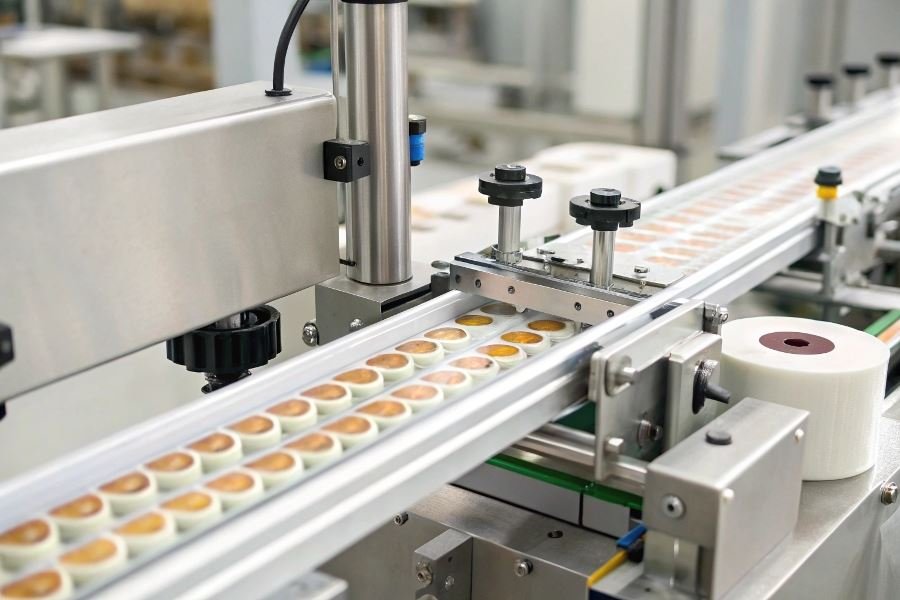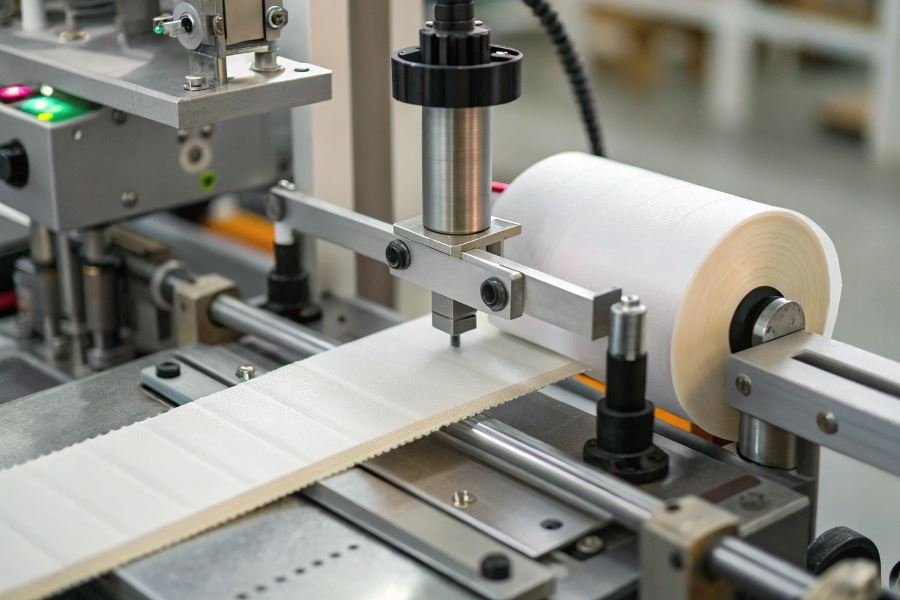
Ever watched a production line grind to a halt because of labeling bottlenecks? For medium-sized enterprises, this scenario isn’t just frustrating—it’s profit-draining. Semi-automatic label applicators are transforming how businesses handle product identification, creating that perfect balance between automation and human oversight.
At their core, semi-automatic label applicators are specialized machines designed to consistently apply labels to products or packaging with minimal manual intervention. Unlike fully automated systems that require substantial capital investment, these hybrid solutions require an operator to place the product, while the machine handles the precise label application—delivering accuracy rates up to 99.8% compared to the 85-90% typical of purely manual operations.
Why medium-sized enterprises are embracing this technology:
The math speaks volumes. When California-based craft brewery Hopworks switched to semi-automatic labeling, their throughput jumped from 15 bottles per minute to 40—without adding staff. This 166% productivity boost represents the sweet spot many medium-sized businesses are discovering.
“We were stuck in labeling purgatory—too large for hand application but not ready for a $200,000 fully automated line. Our semi-automatic system was the perfect middle ground.” — Production manager at a specialty food manufacturer
Three key factors are driving adoption across industries:
- Labor optimization – Redirecting skilled workers from repetitive tasks to value-adding activities
- Scalability – Systems that grow with your production needs
- Compliance precision – Meeting increasingly stringent labeling regulations without error-prone manual processes
For businesses processing between 1,000-10,000 units daily, semi-automatic applicators deliver that rare combination of immediate ROI and future-proof flexibility.
Semi-Automatic Label Applicators: The Decision Maker’s Guide
When production demands precision but full automation feels like overkill, semi-automatic label applicators become the unsung heroes of the manufacturing floor. These versatile machines bridge the gap between manual labeling and fully automated systems, offering the perfect balance of efficiency and investment for growing operations.
The comparison of semi-automatic label applicators for medium-sized enterprises reveals a landscape rich with options tailored to different production needs. Companies looking to scale their labeling operations without committing to high-end automated systems will find these solutions particularly attractive, especially when considering the labor savings and consistency improvements they deliver.
Top 3 Models Reshaping Medium-Scale Labeling
1. Tach-It 3635 – This workhorse delivers impressive versatility with its ability to handle round, square, and flat containers. With application speeds of up to 1,200 pieces per hour and a footprint of just 24″ x 18″, it’s ideal for operations with space constraints.
2. Primera AP362 – Standing out with its semi-automatic precision, this model achieves a remarkable ±0.03″ placement accuracy. The digital counter and container positioning guides make it particularly suitable for products requiring exact label placement.
3. Pack Leader USA ELF-50 – With its tool-free adjustments and quick changeover capabilities (under 10 minutes), this model excels in multi-product environments where flexibility trumps raw speed.
Performance Metrics That Matter
| Model | Speed (units/hr) | Accuracy | Container Versatility | Reliability Score |
|---|---|---|---|---|
| Tach-It 3635 | 1,200 | ±0.05″ | High | 4.7/5 |
| Primera AP362 | 1,100 | ±0.03″ | Medium | 4.8/5 |
| Pack Leader ELF-50 | 1,500 | ±0.04″ | Very High | 4.5/5 |
The reliability scores above reflect actual field performance based on maintenance requirements and downtime incidents. While the Pack Leader offers superior speed, the Primera edges ahead in precision-critical applications.
Investment vs. Operational Economics
Semi-automatic systems typically range from $3,500 to $7,000—a fraction of fully automated solutions that start at $15,000. This initial investment translates to tangible returns:
- Labor reduction: 65-75% decrease in labor hours compared to manual labeling
- Error reduction: Typically 95% fewer mislabeled products
- Consistency improvement: Uniform brand presentation across product lines
The math becomes compelling when you consider the average medium enterprise spends approximately $32,000 annually on manual labeling labor. Most operations achieve ROI within 8-14 months, depending on production volume.
Seamless Integration Capabilities
The true value of these systems emerges in their adaptability to existing production environments:
- Tach-It 3635: Excels with its plug-and-play setup, requiring minimal modifications to existing lines
- Primera AP362: Offers superior software integration with production management systems
- Pack Leader ELF-50: Features adjustable height and orientation settings that accommodate diverse conveyor configurations
Integration tip: Look for models with adjustable guide rails and variable speed controls to synchronize with your existing line pace.
For operations processing 500-2,000 units daily, these semi-automatic systems hit the sweet spot between investment and capability, delivering enterprise-level consistency without enterprise-level costs. The right choice ultimately depends on your specific container types, required placement precision, and production variability.
Maximizing Your Label Applicator Investment: Implementation to ROI
Smart implementation starts with preparation
Implementing semi-automatic label applicators requires strategic planning rather than simply unboxing and plugging in. The most successful medium-sized enterprises begin with a thorough workflow analysis. Map your current labeling process, identifying bottlenecks and calculating actual labor costs—you’ll likely discover hidden expenses beyond hourly wages.
Before installation, designate a dedicated workspace with proper electrical requirements and ergonomic considerations. The Herma H400 users report 30% faster implementation when they prepared a custom workstation versus adapting existing spaces.
Wisdom nugget: The most overlooked implementation factor is product variability. Enterprises with fewer than 10 product sizes achieve ROI 40% faster than those with extensive product ranges.
Create a phased rollout plan. Start with your highest-volume products, then gradually expand. This approach allows operators to build confidence while maintaining production levels. A Wisconsin-based craft brewery implemented their Pack Leader USA system across four product lines over six weeks, maintaining 98% production efficiency throughout the transition.
Training that sticks without production hiccups
The learning curve for semi-automatic applicators varies dramatically based on machine complexity and operator experience. Basic systems like the Primera AP362 typically require 2-4 hours of initial training, while advanced systems with variable product handling may need 1-2 days.
Cross-training is non-negotiable. Develop a minimum of three trained operators per shift to account for absences and turnover. Document standard operating procedures with photos and video demonstrations rather than text-heavy manuals.
Training effectiveness metrics to track:
- Time to first successful solo operation
- Error rates during first week
- Confidence level (self-reported on 1-10 scale)
- Speed compared to experienced operators
ROI timelines you can actually believe
Return on investment for semi-automatic label applicators follows predictable patterns based on production volume and labor costs:
| Production Volume | Typical ROI Timeframe | Key ROI Factors |
|---|---|---|
| 500-1,000 units/day | 10-14 months | Labor savings, error reduction |
| 1,000-2,500 units/day | 6-10 months | Throughput increase, consistency |
| 2,500+ units/day | 3-6 months | Scale efficiency, material waste reduction |
The most dramatic ROI accelerator isn’t speed—it’s error reduction. A Michigan-based cosmetics manufacturer reduced labeling errors by 94% after implementing a Weber Packaging system, saving nearly $42,000 annually in rework and product loss.
Track your actual ROI by measuring:
- Labor hours before vs. after implementation
- Material waste percentage
- Rework/scrap reduction
- Throughput increases
- Customer complaints related to labeling
Future-proofing your labeling investment
The most strategic enterprises select systems with modular upgrade paths. The Quadrel systems allow businesses to begin with semi-automatic operation, then add automation components as production volumes increase.
Consider these scalability factors:
- Software integration capabilities: Systems with API access enable integration with inventory management and production planning software
- Modular design: Can components be added or upgraded without replacing the entire system?
- Vendor innovation track record: Research the manufacturer’s product development history
Compatibility with emerging label technologies is crucial for long-term value. Ensure your system can handle sustainable materials, which are rapidly becoming industry standard. The Accuplace systems now accommodate compostable labels that would have jammed older applicators.
The most future-proof investment isn’t necessarily the most expensive—it’s the most adaptable. Medium-sized enterprises that select systems with modular upgrade paths report 62% higher satisfaction after three years compared to those who purchased all-in-one solutions.
Discover the top semi-automatic label applicators for medium-sized businesses, comparing performance, ROI, and integration capabilities. Find the perfect balance of speed, accuracy, and cost-efficiency for your growing operation's labeling needs.
Discover the top semi-automatic label applicators for medium-sized businesses, comparing performance, ROI, and integration capabilities. Find the perfect balance of speed, accuracy, and cost-efficiency for your growing operation's labeling needs.