Ever wondered why restaurant meats taste so impossibly tender and flavorful compared to home cooking? The secret might be hiding in plain sight: vacuum marination technology. This revolutionary approach doesn’t just enhance flavor—it fundamentally transforms how ingredients absorb marinades at the molecular level.
Vacuum marinators operate on a brilliantly simple principle: by removing air from a sealed container holding food and marinade, they create negative pressure that opens the cellular structure of ingredients. When the vacuum releases, marinade rushes deep into these microscopic openings, delivering flavor far beyond what traditional soaking methods achieve. What takes 24 hours conventionally happens in just 30 minutes with vacuum technology.
The journey of vacuum marination began in commercial kitchens during the 1970s when food scientists discovered that pressure differentials could dramatically accelerate flavor infusion. Initially bulky and expensive, these systems remained exclusively in professional settings until recent years when compact, affordable models entered the consumer market.
Today’s vacuum marinators represent the perfect intersection of science and culinary art. They’ve evolved from industrial equipment to sleek countertop appliances that fit seamlessly into modern kitchens. Beyond just enhancing flavor, they offer practical advantages: significantly reduced preparation time, more efficient use of expensive ingredients, and consistently superior results that elevate everyday cooking to restaurant quality.
For serious home chefs and professionals alike, vacuum marination has moved from luxury to necessity—transforming not just how we prepare food, but fundamentally how we experience it.
The Science Behind Flavor Infusion
Vacuum Physics Meets Culinary Chemistry
When exploring the realm of food preparation technology, vacuum marinators represent a fascinating intersection of physics and gastronomy. These devices leverage fundamental principles of pressure differential to transform ordinary ingredients into extraordinarily flavorful dishes. The operation of vacuum marinators relies on creating a low-pressure environment that fundamentally changes how marinades interact with food at the cellular level.
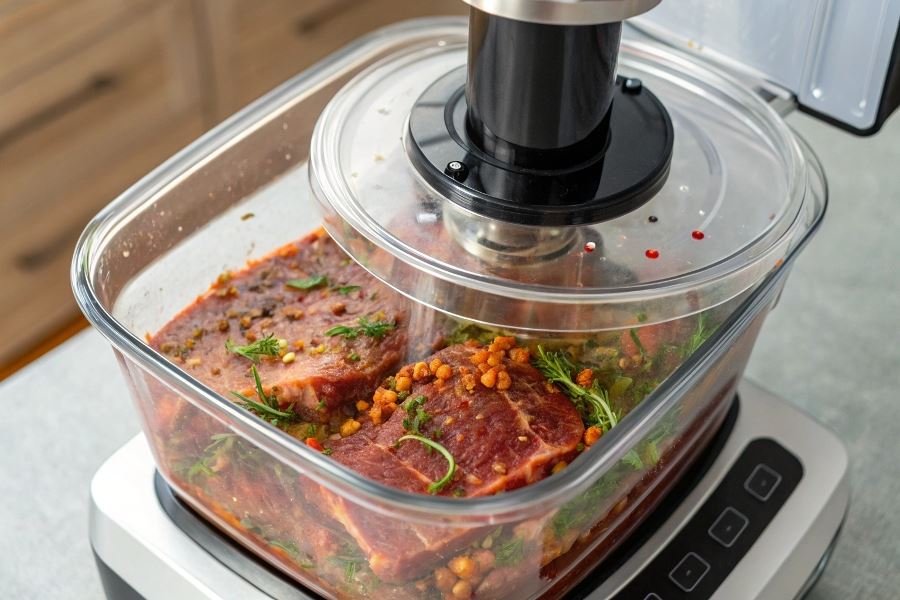
The vacuum marination process works by removing air from a sealed chamber containing food and marinade. This creates negative pressure that causes the cell structures in meats and vegetables to expand slightly. When the vacuum is released, these expanded cells rapidly contract, drawing the marinade deep into the food’s interior. This principle of operation and advantages of vacuum marinators creates a more thorough and efficient flavor infusion than could ever be achieved through traditional soaking methods.
The cellular expansion phenomenon is particularly fascinating from a scientific perspective. When atmospheric pressure is reduced in the chamber, gases trapped within food cells expand, creating microscopic channels. These pathways allow marinade components—including flavor compounds, tenderizing enzymes, and moisture—to penetrate far beyond the surface layer. The result is food that’s uniformly seasoned from edge to center.
The Vacuum Marination Process Decoded
The step-by-step process reveals the elegant simplicity behind this advanced technology:
- Food and marinade are placed together in the vacuum chamber
- The machine seals the chamber and activates the vacuum pump
- Air is extracted, creating negative pressure (typically 0.5-0.8 bar)
- Cell structures expand as internal gases increase in volume
- The vacuum is maintained for a programmed duration (usually 5-30 minutes)
- Upon release, atmospheric pressure returns, forcing marinade into the food
This cycle can be repeated multiple times for enhanced results, with each cycle driving flavors deeper into the food matrix. Modern vacuum marinators from brands like VacMaster and PolyScience offer programmable cycles that optimize this process for different food types.
Traditional vs. Vacuum Marination: The Numbers Speak
The efficiency difference between traditional and vacuum marination methods is striking when examined objectively:
| Marination Method | Time Required | Penetration Depth | Flavor Distribution | Marinade Usage |
|---|---|---|---|---|
| Traditional Soak | 12-24 hours | 2-4 mm | Surface-dominant | High (waste) |
| Vacuum Process | 20-40 minutes | 8-12 mm | Uniform throughout | Low (efficient) |
The vacuum method achieves in minutes what traditional marination requires hours or even days to accomplish.
Beyond time savings, vacuum marination delivers superior results in texture preservation. Traditional extended soaking can begin breaking down proteins excessively, resulting in mushy exteriors while interiors remain under-flavored. Vacuum technology ensures even tenderization without compromising structural integrity.
Flavor efficiency represents another significant advantage. Traditional marination typically requires submerging food completely, using substantial quantities of often expensive marinades. Vacuum systems can achieve superior results with 40-60% less marinade, as the pressure differential forces the liquid to work more effectively rather than relying on passive diffusion.
For professional kitchens and discerning home cooks alike, the technical advantages of vacuum marination translate directly to consistent quality, reduced preparation time, and enhanced flavor profiles that simply cannot be achieved through conventional methods.
Vacuum Marinators Unlock Culinary Potential
Time efficiency that transforms cooking
Vacuum marinators have revolutionized the marination process by reducing what once took hours or even overnight into mere minutes. The science is straightforward but powerful: by removing air from the chamber, these devices create negative pressure that forces marinade deep into food fibers at the cellular level.
Tests conducted by culinary institutes demonstrate that vacuum marination can reduce marinating time by up to 80% compared to traditional methods. A thick steak that would typically require 4-6 hours of marination can achieve the same flavor penetration in just 30-45 minutes with a quality vacuum marinator.
The flavor enhancement isn’t just faster—it’s more profound. The vacuum process opens the cellular structure of foods, allowing marinades to penetrate more thoroughly and distribute more evenly. This creates a consistency in flavor that’s nearly impossible to achieve with traditional methods.
“The difference between traditional and vacuum marination isn’t just time—it’s depth. Flavors don’t just coat the surface; they become integral to the food itself.”
Food safety advantages beyond flavor
Vacuum marination significantly improves food safety through multiple mechanisms. First, the sealed environment prevents cross-contamination during the marination process. Second, the reduced oxygen environment inhibits bacterial growth that typically accelerates food spoilage.
The shelf life extension is remarkable:
| Food Type | Traditional Shelf Life | Vacuum Marinated Shelf Life | Improvement |
|---|---|---|---|
| Poultry | 1-2 days | 3-4 days | 100% |
| Beef | 3-5 days | 7-9 days | 80% |
| Fish | 1-2 days | 3 days | 50% |
| Vegetables | 3-4 days | 7-8 days | 100% |
Commercial kitchens have embraced vacuum marinators not just for flavor but for inventory management. The extended shelf life allows for more efficient prep schedules and reduced waste—a critical advantage when operating on tight margins.
For home cooks, this means weekend meal prep can truly last the week, maintaining both safety and flavor integrity throughout.
Versatility that spans culinary boundaries
While most associate vacuum marinators with proteins, their applications extend far beyond meat preparation. These devices excel with:
- Vegetables: Infusing dressings into dense vegetables like beets or carrots
- Fruits: Creating rapid-infused cocktail components or dessert elements
- Tofu and plant proteins: Addressing the traditional challenge of flavor absorption
- Pickling: Accelerating the pickling process from weeks to days
Commercial kitchens using systems like the Vac-Star or PolyScience vacuum chambers report using their equipment for everything from traditional protein preparation to creating innovative compressed fruits with intensified flavors and unique textures.
The technology scales beautifully from compact countertop units perfect for home enthusiasts to industrial systems processing hundreds of pounds per hour. This accessibility has democratized what was once exclusively a commercial technique.
For artisanal food producers, vacuum marination offers consistency that translates to brand reliability—every batch achieves the same flavor profile and quality, something particularly valuable when building a reputation for excellence.
Discover how vacuum marinators transform food preparation by infusing flavors in minutes instead of hours. Learn the science behind vacuum marination technology and its benefits for enhanced taste, food safety, and efficiency in both home and professional kitchens.
Discover how vacuum marinators transform food preparation by infusing flavors in minutes instead of hours. Learn the science behind vacuum marination technology and its benefits for enhanced taste, food safety, and efficiency in both home and professional kitchens.